
enclosure frame height
Golf Simulator Ceiling Height Requirements for a Garage Build: The Real Numbers Before You Buy a Frame
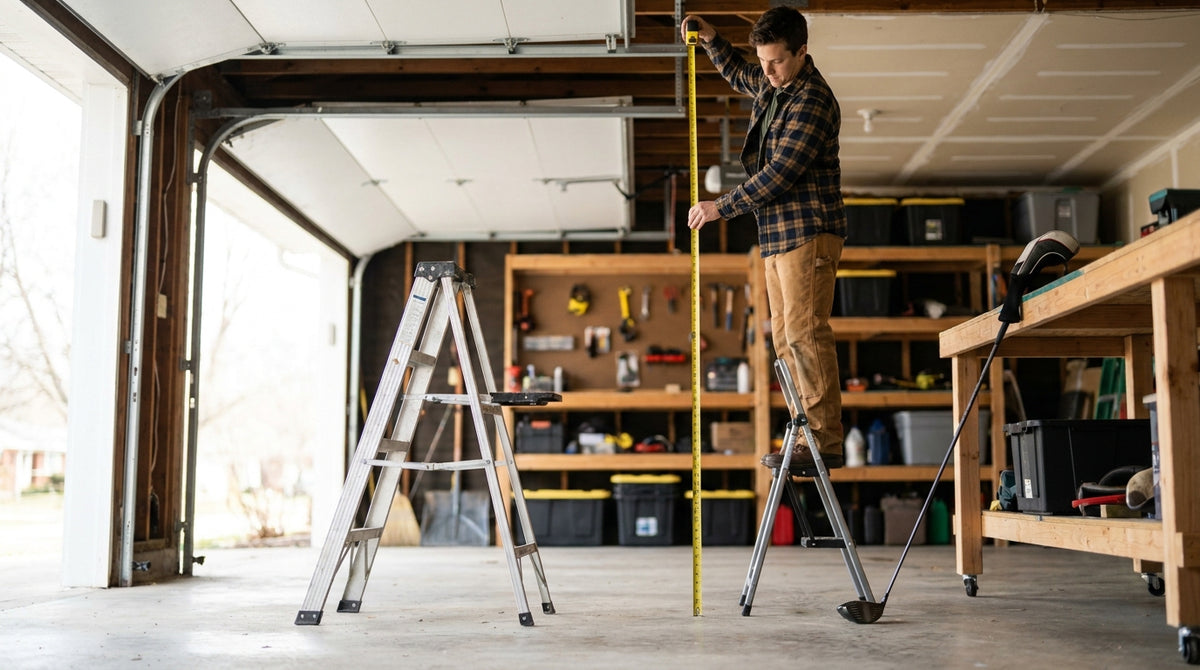
The average American garage has 8.6 feet of ceiling, and a 6-foot golfer swinging a driver needs about 9.5 feet of clear height to make a normal pass at the ball (Source: Garage Transformed / Sizes Visualizer garage ceiling data; My Golf Simulator swing-height chart). That gap - roughly a foot - is why so many garage builds end with a dented ceiling panel and a bag of clubs nobody swings past a 7-iron.
Ceiling height is the first hard constraint in any garage bay, and it decides everything downstream: which enclosure frame you can buy, how tall a screen you can hang, whether a hitting mat helps or hurts, and which clubs you can actually use. Get it wrong and you are returning a frame kit. Get it right and the rest of the build is just shopping.
Here are the real measured numbers, tier by tier.
Building one now? Carl’s Place DIY enclosure kit — from $1,000.
The Golf Simulator Ceiling Height Requirements Nobody Writes Down Correctly
Most published minimums are a single number - "you need 10 feet" - and that is useless, because clearance is a function of your body and your swing plane, not of the room.
A golfer between 5'6" and 6'0" with a neutral swing plane needs about 9.5 feet of ceiling. Go over 6'4" with an upright plane and you are into 11 to 12 feet (Source: My Golf Simulator ceiling height guide). That is a two-and-a-half-foot spread between two golfers who might share the same garage.
The arithmetic rule that actually helps: required clearance rises roughly 3 to 4 inches for every 4 inches of golfer height above 6 feet, and golfers under 5'8" can often work inside an 8.5-foot minimum (Source: Treasure Valley Solutions golf simulator ceiling height guide). Take any published number, find your own height on that scale, and adjust.
The mat penalty everybody forgets
Whatever you measure floor-to-ceiling, subtract 2 to 2.5 inches for a standard hitting mat (Source: My Golf Simulator ceiling height guide). You stand on the mat. The mat raises you. Your swing arc goes up with you.
That is not a rounding error when you are 3 inches from clearing. If you are planning a thicker mat base or a layer of interlocking floor tiles under it, subtract that too.
What the Data Says About Garage Ceilings
Swing-biomechanics measurements put the clubhead at roughly 8 to 9 feet off the ground at the top of a driver swing for an average-height golfer, and most players need 6 to 12 inches of clearance above the peak of that arc to avoid unconsciously shortening their motion (Source: Treasure Valley Solutions / Virtual Tee ceiling-height analyses).
Read that against the housing stock. Eight feet is the IRC code minimum and the prevailing residential standard, the average sits at 8.6 feet, and only about 5% of garages clear 10 feet (Source: Garage Transformed / Sizes Visualizer garage ceiling height data). So the typical builder is working in the exact band where the club is already at the drywall before any buffer gets added.
Enclosure kits enforce this with hard numbers. An 8-foot-tall frame needs roughly a 9-foot room once you add the recommended 2 to 3 inch buffer, and curved kits want 6 to 7 inches of headroom above the frame (Source: Shop Indoor Golf frame specs and Carl's Place enclosure sizing guide). The frame height, not the ceiling height, is what your order confirmation cares about.
Minimum Ceiling Height Needed by Golfer Height (Neutral Swing Plane)
Source: My Golf Simulator measured swing-height chart; subtract 2-2.5 in. of headroom for a standard hitting mat. Values in feet of clear ceiling height required.
How to Measure Your Garage Before You Buy Anything
Do this with a tape measure and ten minutes, not with a mental estimate.
1. Measure at the lowest point. Garage ceilings are rarely flat. Find the garage door track, the opener motor, any ductwork or light fixture, and measure to the bottom of whatever hangs lowest in your swing zone - not to the drywall.
2. Measure where you will actually stand. Hitting position, not the middle of the room. If the garage floor slopes toward the door (most do, for drainage), the number changes across the bay.
3. Subtract the mat. 2 to 2.5 inches for a standard mat, more if you are building up the floor.
4. Do the club test. Stand in the hitting position, hold a driver upside down at the clubhead, and reach the grip end straight up. If the butt of the grip touches, your real swing will too.
5. Write down width and depth while you are there. You need at least 10 feet from hitting position to the screen, and that is a safety spec rather than an image-quality preference - a ball struck at 150+ mph can rebound toward you (Source: Carl's Place / Golf Sim Depot enclosure guidance). Our guide to impact screen depth behind the hitting mat has the exact distances for 16, 18, and 20-foot rooms.
Ceiling Height Tiers: What Actually Fits in Your Garage
Once you have your number, the build decisions stop being opinions.
Ceiling Height Tier to What Actually Fits (Frame Kit, Screen, Mat, Club Range)
Swipe to compare →
| Ceiling Height | Frame Approach That Fits | Screen Size | Realistic Club Range |
|---|---|---|---|
| Under 8 ft | No standard enclosure - wall-mounted screen or a recessed pit (buys back 6-12 in.) | Wall-hung panel, no frame | Putting, chipping, wedges, choked-down short irons |
| 8 ft to 8'6" | Short freestanding or semi-retractable enclosure with a sub-8-ft frame height | About 10.5 ft wide by 8 ft tall (4:3) | Wedges through mid-irons; driver only for golfers under 5'8" with a flat plane |
| 9 ft | Standard DIY pipe frame around 8'4" tall; a 9.5-ft frame is too tight here | About 10'1" wide by 7'7" tall | Full bag for golfers up to about 6'0" with a neutral-to-flat swing |
| 10 ft and up | Full-size Pro or curved frame (9'4" to 10.25" tall) | About 11'5" wide by 8'7" tall, up to 146" by 110" | Full bag including driver for nearly all golfers, plus a ceiling-mounted launch monitor at 9-10 ft |
(Source: Shop Indoor Golf frame specs and Carl's Place enclosure sizing guide)
Know your ceiling number? Match it to a frame.
The Carl's Place DIY Enclosure Kit sizes down to fit tight garages (from $999.95), and the Pro Enclosure Kit covers 10-ft-plus rooms (from $3,409.95).
Shop DIY Enclosure KitsLow Ceiling Golf Simulator Workarounds That Actually Pay Off
If you measured under 8 feet, you are not out of the game - you just have to buy height or buy around it.
The recessed hitting pit. A shallow recess cut into the garage slab buys back 6 to 12 inches of clearance, which is often the entire difference between wedges-only and a full bag (Source: My Golf Simulator structural modification figures). It is the cheapest real fix on the list.
Raising the structure. Honest numbers: a structural ceiling raise runs $500 to $8,000 depending on what is above you, plus roughly $500 for an engineer, and basement underpinning runs around $30,000 (Source: Treasure Valley Solutions / My Golf Simulator cost figures). Worth pricing out if your garage is otherwise perfect, not worth it on a whim.
Go frameless. Hang the screen directly on the wall and skip the enclosure ceiling bar entirely. You lose ball containment on the sides, so add net wall extensions - our post on which enclosure panels actually need screen material covers what you can substitute.
Build the short game bay on purpose. Plenty of sub-8-foot garages become excellent wedge-and-putting rooms. A screen still reads chips and pitches fine for most launch monitors, and the practice transfers.
Budget Reality Before You Measure Twice
Garage builds that deliver a true full-swing experience generally land in the $8,000 to $12,000 range, while a budget enclosure, launch monitor, projector, and mat combination starts closer to $3,000 to $5,000 (Source: Home Performance Lab garage build roundup and Carl's Place cost guide).
That spread is exactly why the tape measure comes first. An enclosure frame that does not fit is a restocking fee and a month of waiting. If you are budgeting the frame specifically, our DIY enclosure frame cost breakdown lays out line-item budgets at $1.5k, $3k, and $5k.
For a 9-foot garage, a Carl's Place DIY Golf Simulator Enclosure Kit (from $999.95) paired with a Carl's Place Preferred Impact Screen (from $298.95) is the most common landing spot. Ten feet and up opens the Carl's Place Pro Golf Simulator Enclosure Kit (from $3,409.95) and a full-width screen.
Measure First, Then Shop
Your ceiling height is not a preference you can negotiate with - it is the spec sheet your whole build has to satisfy. Find the lowest obstruction, subtract the mat, add your height adjustment, and you will know within an inch which frame kit is actually on the table.
Once you have that number, sizing the screen is the easy part. Browse our golf impact screens and match the screen height to the clearance you measured, not to the screen you wish you had room for.


Not sure which simulator fits your room?
The two-minute Simulator Finder Quiz checks your space and budget against every system we carry.

Keep Reading
Related guides

golf simulatorGolf Simulator Basement Conversion Checklist: The 7 Steps to Run Before You Buy Anything

DIY golf simulatorGolf Simulator Garage Build Cost Breakdown: Every Line Item at Three Budget Tiers

diy golf simulator enclosure frame cost breakdownDIY Golf Simulator Enclosure Frame Cost Breakdown: Line-Item Budgets at $1.5k, $3k, and $5k