
diy golf simulator enclosure frame cost breakdown
DIY Golf Simulator Enclosure Frame Cost Breakdown: Line-Item Budgets at $1.5k, $3k, and $5k
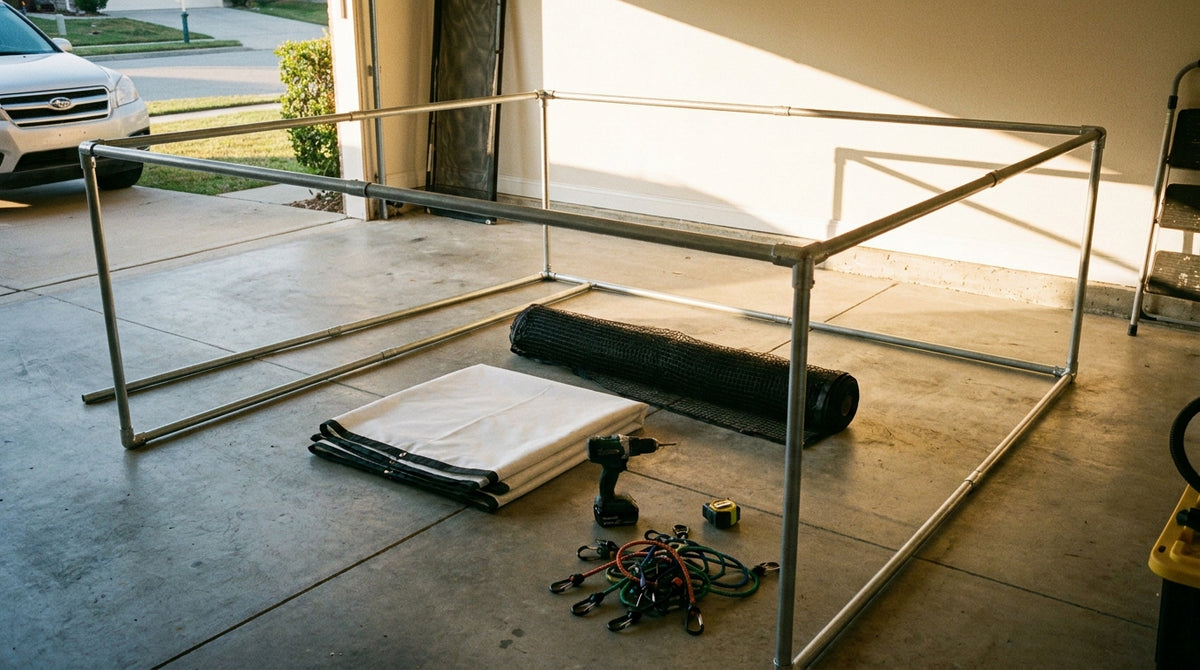
A complete 16x9 DIY EMT enclosure — frame, fittings, and impact screen — came in at roughly $670 in total materials. (Source: GolfingSim frame build guide) That same enclosure bought pre-assembled runs $1,000 to $3,000 more for equivalent size.
So why does almost every first-time build blow past $3,000?
Because the frame is never the expensive part. It's the mat, the turf, the netting, the padding, and the forty dollars of bungees you forgot — all the lines nobody puts in a blog post. On a typical DIY enclosure, frame materials are only 40–50% of total cost, with fabric at 30–40% and hardware eating another 10–20%. (Source: Canvas ETC — 'DIY Golf Impact Screen & Enclosure' build guide)
Building one now? Carl’s Place DIY enclosure kit — from $1,000.
This is the line-item version. Three real budget tiers, every line priced, and a clear answer on where to spend and where to save.
Start With the Frame Material, Because It Sets Your Ceiling
Your frame material decides two things: what you spend, and how wide you can go before the whole thing starts sagging.
Schedule 40 PVC is the cheapest at $80–$150, and it's the one that bites you. It sags noticeably on spans over 6–8 feet and can shatter outright on a full-speed strike. (Source: GolfingSim — 'Golf Impact Screen Frame Build DIY Guide: PVC vs Lumber vs EMT')
EMT conduit runs $200–$350 and handles 10–12 foot spans with minimal flex. 2x4 lumber is actually cheaper at $75–$175 and won't flex at all across 12 feet — it just can't be disassembled and moved. (Source: GolfingSim frame build guide)
The $125 you save going PVC gets spent back immediately in screen tension you'll never recover. We went deeper on that tradeoff in our breakdown of steel vs PVC frame material.
DIY Enclosure Frame Material Cost (Midpoint, USD)
Source: GolfingSim 'PVC vs Lumber vs EMT' frame build guide (ranges: PVC $80–150, lumber $75–175, EMT $200–350, aluminum $300–500)
What the Data Says About Each Line Item
Here's where the real money hides.
The receipt-level frame build
A documented $500 Home Depot EMT build lists 11 sticks of 1" EMT conduit at about $250, 12 foam pipe insulation tubes at about $30, and Gorilla duct tape at roughly $10 — with canopy fittings, screen, ball bungees, and tarp clips filling out the rest to $500. (Source: SimGolfLab — 'DIY Golf Simulator Enclosure: The $500 Home Depot Blueprint') That's the spine of the $1.5k tier.
Screens tier sharply, and you can see it
Budget single-layer screens start around $150 (GoSports ~$150, Amazgolf just under $200). Mid-tier dual-layer runs $300–$600, with Carl's Place Standard from $179.95, Preferred from $298.95 and Premium from $439.95, depending on size. Triple-layer premium sits between $450 and $1,100+. (Source: Golfer Logic / Golfstead / Spectrum Golf 2026 impact screen guides)
The jump from single to dual layer is the most visible upgrade in the entire build — image flatness and noise both change. Our single vs double layer comparison walks through exactly what changes.
Mats are where cheap becomes dangerous
Hitting mats under $200 use thin polypropylene turf over minimal foam, deliver zero shock absorption on concrete, and carry a 0% recommendation rate with consistent injury reports. Credible entry mats start at $349 (Big Moss High Impact 4x5) and $499.95 (Carl's HotShot 4x5 system), with premium at $999 (SIGPRO Softy) up to $1,149–$1,349 (TrueStrike Academy). (Source: GolfSimGenius / Golfers Authority / Breaking Eighty 2026 hitting mat guides)
Finishing materials scale per square foot
Simulator turf runs about $2.60/sq ft. Molded interlocking panel flooring is $11–$14/sq ft. Knotless side netting is $1–$3/sq ft, and knotted nylon is $1.50–$4/sq ft for repeated high-speed impacts. (Source: Pro Putt Systems, Golf Simulator Forum, GolfingSim side-netting guide) Measure your bay and multiply — don't guess a flat number.
Line-Item Enclosure & Bay Budget at Three Tiers
Swipe to compare →
| Line Item | $1.5k Tier | $3k Tier | $5k Tier |
|---|---|---|---|
| Frame | 2x4 lumber, wall-anchored — $125 | EMT conduit + canopy fittings — $275 | Carl's Place DIY pipe framing kit ($349.95–$414.95) or aluminum tube — up to $500 |
| Impact Screen | Single-layer (GoSports / Amazgolf) — $175 | Carl's Place Preferred screen — $300 | Triple-layer premium — $700 |
| Hitting Mat | Big Moss High Impact 4x5 — $349 | Carl's HotShot 4x5 system — $500 | SIGPRO Softy / TrueStrike Academy — $1,149 |
| Bay Turf | Basic turf ~100 sq ft @ $2.60/sq ft — $260 | Basic turf ~150 sq ft @ $2.60/sq ft — $390 | Interlocking panel system ~120 sq ft @ $11/sq ft — $1,320 |
| Side Netting / Curtains | Knotless netting ~80 sq ft @ $1.50 — $120 | Knotted nylon ~120 sq ft @ $2.50 — $300 | Knotted nylon + blackout side curtains — $600 |
| Padding & Foam | Pipe insulation + DIY foam — $40 | Foam tubes + partial wall pads — $200 | Memory-foam wall pad panels (12-pk) — $350 |
| Hardware (bungees, clips, tape, fasteners) | $75 | $150 | $300 |
| Running Total | $1,144 | $2,115 | $4,919 |
| What You Get | Rigid wall-mounted frame, playable screen, safe mat. No side containment depth, screen ripples visible on projection. | Freestanding EMT bay that disassembles, quiet dual-layer screen, real shock absorption, full netting. | Commercial-feel bay: flat triple-layer screen, premium mat, panel flooring, full padding and blackout curtains. |
The Buy-vs-Build Breakeven Is Tighter Than You Think
Pre-built kits start at $999.95 for Carl's Place DIY kit with impact screen and jump to $3,409.95 for the Pro kit. A realistically configured DIY kit build landed at $1,654.85, and SIGPRO's home enclosure lists from $1,599.99. (Source: Carl's Place and Shop Indoor Golf listed pricing)
Read that against the table. The kit floor sits at roughly the entire $1.5k tier budget — meaning at the low end, a kit buys you the frame and screen and nothing else. No mat, no turf, no netting.
Build the frame yourself and that same $1,000 covers your frame, screen, and most of a real mat.
Where to Spend and Where to Save
Never save on the mat. It's the one line where cheap is actively harmful, not just worse. A sub-$200 mat on a concrete garage floor is a wrist injury with a delivery date.
Spend on the screen, one tier up from budget. The single-to-dual-layer jump changes image quality and noise more than any other dollar in the build.
Save on the frame. Lumber or EMT both work. Nobody looks at your frame.
Save on flooring first. Panel systems at $11–$14/sq ft are the single biggest swing in the $5k tier — $1,320 versus $390 for basic turf. Start with turf and upgrade later.
Budget hardware honestly. Bungees, clips, tape, and fasteners are 10–20% of the build. Add $75–$300 before you start, not after.
One more thing worth planning around before you cut anything: depth. Your frame position dictates how much room sits behind the screen, and getting that wrong means rebuilding. Check our guide to air gap clearance behind the screen before you finalize dimensions.
Build the Frame, Buy the Screen
That's the honest summary of every tier above. The frame is $125–$500 of hardware-store parts and an afternoon. The screen is the part you can't fake — fabric layers, tension behavior, and how it looks under a projector are manufacturing, not effort.
Ready to price your screen line? Browse our impact screen collection — single, dual, and triple-layer options with the specs listed so you can drop a real number into your budget instead of a range.
Related reading: Golf Simulator Garage Build Cost Breakdown: Every Line Item at Three Budget Tiers


Not sure which simulator fits your room?
The two-minute Simulator Finder Quiz checks your space and budget against every system we carry.

Keep Reading
Related guides

golf simulatorGolf Simulator Basement Conversion Checklist: The 7 Steps to Run Before You Buy Anything

DIY golf simulatorGolf Simulator Garage Build Cost Breakdown: Every Line Item at Three Budget Tiers

enclosure frame heightGolf Simulator Ceiling Height Requirements for a Garage Build: The Real Numbers Before You Buy a Frame