
ball containment
Golf Impact Screen vs Curtain Enclosure Sides: Which Panels Actually Need Screen Material?
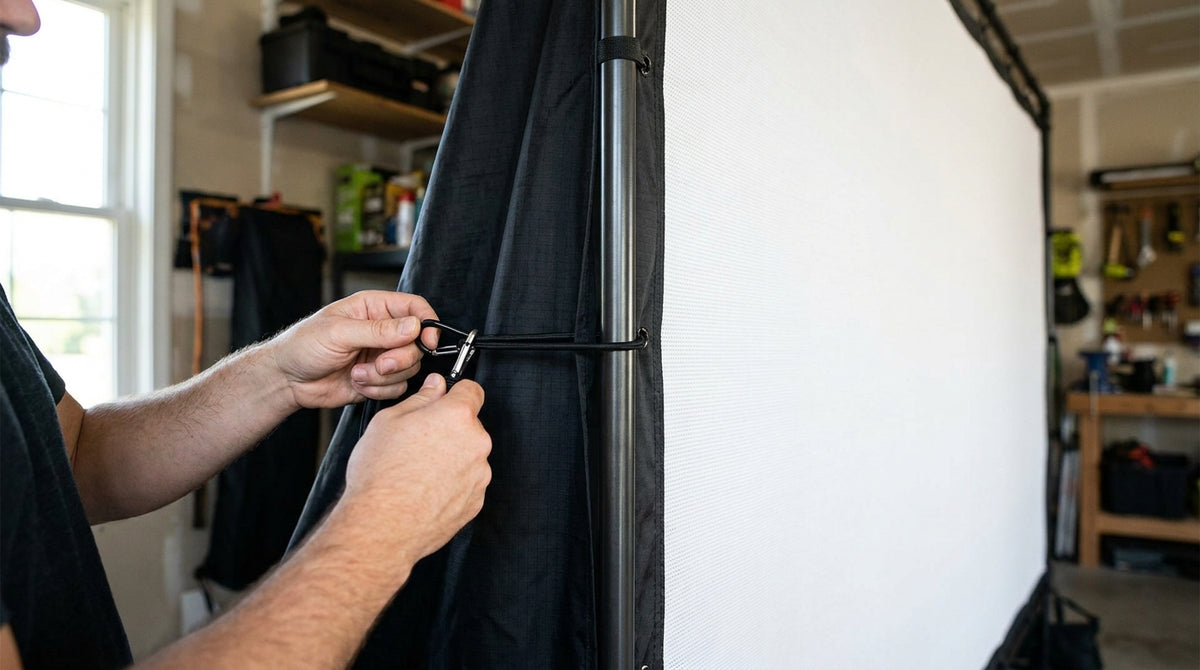
Your impact screen is rated to survive a golf ball moving at 250 mph. You are never going to hit a ball that fast. Neither is Rory. The fastest ball speeds on the PGA Tour sit around 167–174 mph, and most amateurs live in the 130–145 mph range off the driver.
So why does the front panel carry a rating with a 40% safety margin over the best players on earth — while the panels hanging on the sides of your enclosure carry no ball speed rating at all?
Because they are not the same product, and they are not doing the same job. The single most common spec mistake in a DIY build is treating the whole enclosure as one material problem. It isn't. Get the golf impact screen vs curtain enclosure sides distinction right and you save a few hundred dollars. Get it backwards and you either punch a ball through your wall or you buy screen-grade fabric for a panel that never takes a direct hit.
Building one now? Carl’s Place DIY enclosure kit — from $1,000.
The front panel and the sides do two completely different jobs
The front impact screen is a projection surface that also happens to absorb a perpendicular, full-speed strike thousands of times a year. It has to hold a bright, crisp image and it has to stop a ball dead without tearing, stretching, or spitting it back at your face.
The sides and ceiling do neither of those things. Nothing gets projected on them. They catch shanks, thin toe-strikes, and balls that have already ricocheted off the screen and lost most of their energy. Those impacts arrive at an oblique angle and at dramatically reduced speed.
That's the whole distinction. Direct and perpendicular at 110–175 mph on the front. Glancing and slowed on the sides. Two problems, two materials, two very different price tags.
Spec'ing your front panel right now?
The front is the one panel where the 250 mph rating is non-negotiable. Every screen we carry is built for direct, full-speed strikes — and the entry tier hits the same impact spec as the top tier.
Shop Impact Screens →What the data says about golf impact screen vs curtain enclosure sides
The numbers make the split obvious once you line them up.
Impact screens — including the entry-level Carl's Place Standard — are tested to withstand golf ball impacts of up to 250 mph (Source: Carl's Place, Standard Golf Impact Screens product page). That is engineered headroom, not marketing. It exists because the front panel eats a perpendicular strike every single swing.
Compare that to the common side spec: #18 knotless polyester netting with a 195 lb breaking strength, rated for swing speeds up to 110 mph (Source: GolfingSim, Golf Simulator Side Netting Setup Guide). That's a totally adequate number for a panel catching deflected balls — and a totally inadequate one for a hitting surface.
The material chemistry differs too. Enclosure sides and ceilings are typically ripstop nylon or 1000D polyester blackout fabric whose job is blocking ambient light and containing balls — not projection. Only the impact screen is built as ballistic-grade woven polyester engineered for both impact absorption and image quality (Source: Carl's Place enclosure guide / Canvas ETC DIY enclosure guide). Curtain fabric has no projection gain spec and no repeated direct-strike rating.
And the money: side netting runs $1–$3/sq ft for #18 knotless polyester and $1.50–$4/sq ft for #21 knotted nylon, adding up to roughly a $200 line item in a ~$1,060 DIY enclosure build (Source: GolfingSim / US Netting). About a fifth of the budget covers every panel that isn't the front.
Material Cost Per Square Foot: Front Hitting Surface vs Enclosure Sides
Source: Calculated from Carl's Place / Indoor Golf Outlet listed price ranges ($179.95–$489.95 Standard, $439.95–$1,119.95 Premium across 7.7'x7.7' to 10'x18'); netting rates from GolfingSim side-netting guide, midpoints used
Look at that chart for a second. The Standard screen and a knotted nylon side net cost almost the same per square foot. The gap isn't screen-vs-net — it's Premium screen vs everything else. Which is exactly why the material you pick for each panel matters more than the total square footage you're covering.
How to spec each panel
How to Spec Each Panel: Front Impact Screen vs Side/Ceiling Enclosure Curtains
Swipe to compare →
| Spec | Front panel (impact screen) | Sides & ceiling (curtain/netting) |
|---|---|---|
| Typical impact speed | 110–175+ mph, direct and perpendicular | Reduced-speed shanks and ricochets, oblique angle |
| Required rating | Tested to 250 mph ball speed (Carl's Place) | ~195 lb breaking strength, rated to 110 mph swing (#18 knotless) |
| Material | Ballistic-grade woven polyester, open or multilayer weave | Ripstop nylon / 1000D polyester blackout fabric or knotted net |
| Projection surface? | Yes — must hold a bright, crisp image | No — light blocking and ball containment only |
| Cost per sq ft | ~$2.70–$3.05 (Standard) / ~$6.20–$7.50 (Premium) | $1.00–$4.00 depending on twine and weave |
| Example price | Carl's Place Standard, $179.95–$489.95 by size | ~$200 for a full DIY side-netting set |
| Failure mode if mis-spec'd | Curtain fabric tears, balls punch through, image is muddy | Screen-grade fabric here is pure wasted spend |
Why curtain material fails as a hitting surface
Two separate failures, and they show up on different timelines.
The fast one is structural. Blackout curtain fabric has no repeated direct-strike rating because nobody engineered it for one. It's built to hang, block light, and absorb a glancing blow. Put a 140 mph driver into the same six-inch patch a few hundred times and the weave elongates, then a seam or a grommet line lets go. If you want the full picture of what a real screen survives, our breakdown of max ball speed ratings at 110+ mph covers what that headroom actually buys you.
The slow one is optical. Curtain fabric carries no gain spec at all. It scatters light unpredictably, so your projected image goes flat and muddy no matter how many lumens you throw at it. You end up blaming the projector for a fabric problem.
People sometimes try to split the difference by hanging a net in front of a cheap fabric panel. That mostly doesn't work either, and we broke down why in our post on layering an impact screen behind a hitting net.
Why screen material on the sides is wasted money
The other direction is less dangerous but more expensive. A full-wrap enclosure in screen-grade polyester means paying $2.70–$3.05/sq ft — or $6.20–$7.50 if you went Premium — for panels that will never see a direct strike or display a pixel.
Here's the part that actually saves people money: the Carl's Place Standard screen carries the same 250 mph impact rating as the Premium tier at roughly 40% of the cost, with Standard running $179.95–$489.95 versus $439.95–$1,119.95 for Premium across the same 7.7'x7.7' to 10'x18' size range (Source: Indoor Golf Outlet / Carl's Place product listings). Premium buys you image quality, not survivability. If you're weighing that call, our Standard vs Preferred vs Premium comparison lays out exactly where each tier earns its price.
Spend the money on the front. Spend a fifth of it on everything else.
How much side coverage you actually need
You don't have to wrap the entire room. Side panels only need to cover the 3–5 ft arc in front of the hitting position, because that's the window where lateral mis-hits leave the club face (Source: GolfingSim, Golf Simulator Side Netting Setup Guide). Balls that get past that arc are already heading into the screen.
Room width is the deciding variable. Standard indoor safety guidance calls for a minimum 7-foot clearance in all directions around the golfer, with 14 ft the real target room width and 10 ft the practical minimum (Source: Outta Bounds / GolfingSim safety guides). Under 7 ft of clearance on a side, containment stops being optional.
The short version of the spec
- Front: true impact screen, 250 mph rated, sized to your projector's aspect ratio. Standard tier if budget matters.
- Sides: #18 knotless polyester (195 lb) or 1000D blackout fabric, covering the 3–5 ft arc beside the hitting position.
- Ceiling: same curtain material as the sides — it catches skied drives and topped ricochets, nothing more.
Spec it that way and a full DIY enclosure — frame, screen, side netting, hardware — lands around $1,060, versus $2,499–$3,999 for a comparable pre-packaged system (Source: GolfingSim / Shop Indoor Golf 2026 cost guide). Almost all of that savings comes from not buying screen-grade material everywhere.
Buy the rating where the rating matters
One panel in your bay takes a perpendicular 140 mph hit and has to look good doing it. Everything else is a catcher's mitt. Once you separate those two jobs in your head, the shopping list writes itself — and you stop overpaying for fabric that never gets tested.
Get the front panel right first
Browse our full range of impact screens — every one built and rated for direct, full-speed strikes, in sizes from compact garage bays up to 10'x18' commercial walls. Check current pricing on the product page for your size.
Shop Impact Screens →Planning the whole bay? Use Build Your Bay: pick your room size, screen and mat, and we match every part (enclosure, framing, back cover, hitting mat) and add it all to your cart in one click.
From This Guide
Ball containment for your bay


Not sure which simulator fits your room?
The two-minute 3D Simulator Builder checks your space and budget against every system we carry.

Keep Reading


