
enclosure pipe frame kit
Golf Simulator Enclosure Pipe Frame Kit: What Size to Buy for Your Room
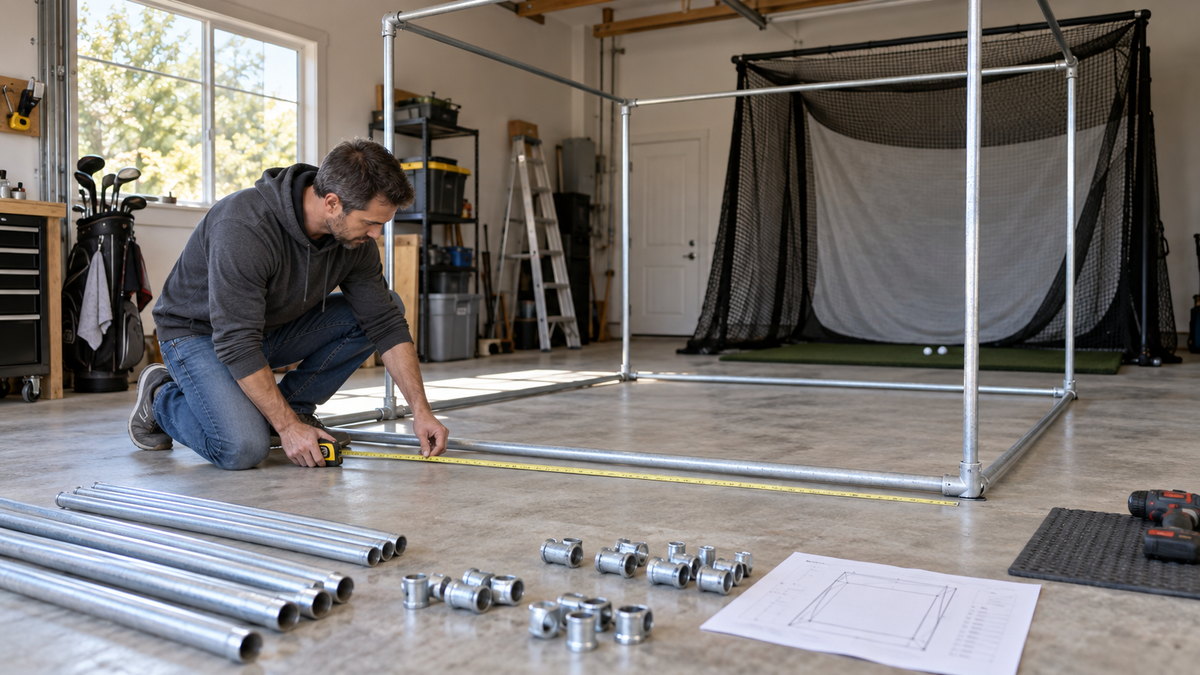
A 12 x 9 x 3 foot frame needs a room at least 14 feet wide, 10 feet tall and 15 feet deep. That gap between frame and room is where most first-time buyers go wrong. They measure the wall, order a frame that fits it exactly, and then discover there's no space left to swing.
If you're searching for a golf simulator enclosure pipe frame kit and wondering what size to buy, this guide maps your room to a frame size and finishes with a complete shopping list for the bay.
Start With the Room, Not the Frame
The frame is the last thing you size. Your ceiling, your width and your depth decide it, in that order of strictness.
Ceiling height sets the frame height
Nine feet is the usual recommended minimum for a golf simulator, and 10-11 feet is ideal for unrestricted swings. One source calls 8 feet the absolute minimum, and 8.5 feet is more forgiving (Source: Golfers Authority; Rapsodo ceiling-height guides). Because the frame has to fit under the ceiling and still clear your club at the top of the swing, most frames are built 8-9 feet tall.
Not sure your ceiling works? Our garage ceiling height guide walks through the real numbers before you buy.
Width sets the frame width
One manufacturer lists a 10 foot minimum width and recommends 12-16 feet. Another guide calls 12 feet the minimum and 15 feet ideal (Source: TruGolf; Shop Indoor Golf). Leave 1-2 feet of clearance on each side of your hitting area, which is why a 10-12 foot wide frame is the common pick.
Depth sets everything else
Depth is the one people forget. It covers the distance from the launch monitor to the ball, from the ball to the screen, and the air gap behind the screen.
For the screen-side math, see our guide to impact screen depth behind the hitting mat.
Ready to size a frame?
Our DIY pipe framing kit comes in several sizes, from $349.95 to $414.95 depending on size and options.
Shop the DIY Pipe Framing KitBy the Numbers: What the Data Says About Frame Size and Price
Here's what the research shows about room needs and what buyers pay.
- Depth by monitor type: photometric launch monitors need about 13.1 feet (4.5 m) of room depth, and radar units about 16.4 feet (5 m) (Source: GolfBays space guide).
- Depth by room: one manufacturer lists a 12 foot minimum and recommends 15-20 feet (Source: TruGolf).
- Premium pipe-frame kits with an impact screen have been listed around $3,929.95 for a 9x12x8 size, with the pipe often sold separately (Source: retail listing, 2026).
- Mid-range DIY kits run $1,499.99-$1,999.99 depending on size, again with pipe bought separately (Source: DIY enclosure announcement, 2026).
- Budget complete sets were tracked at $999.99 for 10x8 ft and $1,111.49 for 12x9 ft, so a bigger footprint cost only about $150 more (Source: price-tracking data; prices change often).
That last point matters. Going one size up usually costs less than regretting the smaller frame.
Tracked prices of complete golf simulator enclosure sets with impact screen by tier (USD)
Source: public retail listings and price-tracking data, 2026. Market prices vary by seller and change often; they are not GolfingSim prices.
Golf Simulator Frame Dimensions by Room Size
This table maps room to frame. The frame depth column (2-5 ft) is the front-to-back footprint of the frame itself, which is separate from the room depth you need for the swing.
Room dimensions and the frame size to buy
Swipe to compare →
| Frame size (W x H x D, ft) | Minimum room (W x H x D, ft) | Order alongside the frame |
|---|---|---|
| 10 x 8 x 2-5 | 12 x 9 x 13 (photometric launch monitor) | Impact screen, 10x8 hitting mat, foam pipe padding, optional side panels |
| 12 x 9 x 3-5 | 14 x 10 x 15 | Impact screen, 5x10 or larger mat, side panels, back or net cover |
| 14 x 9 x 3-5 | 16 x 10 x 16 (radar launch monitor) | Impact screen, large mat, side panels, ceiling and side net, projector mount |
| Custom (9x12x8 and similar) | Measure with your longest club (driver) | Check whether pipe is included, since many kits sell EMT pipe separately |
Two quick rules fall out of it. A 9-foot ceiling points to an 8-foot frame, and anything under a 12-foot-wide room points to the smaller 10-foot frame.
Which Pipe Frame Kit Fits Which Buyer
Once you know the size, you're choosing a build style. We carry three paths.
- Frame only, you supply the rest: the DIY Enclosure Pipe Framing Kit runs from $349.95 to $414.95. The Pro Enclosure Pipe Framing Kit runs from $910.00 to $1,260.00 and suits permanent bays.
- Frame plus screen in one order: the DIY Golf Simulator Enclosure Kit runs from $999.95 to $1,874.95, and the Pro Golf Simulator Enclosure Kit runs from $3,409.95 to $5,609.95. Both vary by size and options.
- Full bay with launch monitor: the Complete DIY Golf Bay Package (no launch monitor) runs from $3,252.70 to $3,717.70, depending on size and options.
Prices change, so check the product pages for current numbers and for exactly what's in the box. Our breakdown of what's included and what's missing in an enclosure kit covers the common gaps.
Your Complete Bay Shopping List
The frame is maybe a third of the order. Here's what to add so the bay works on day one.
- Impact screen: the Standard starts at $179.95, the Preferred at $298.95 and the Premium at $439.95, all priced by size.
- Hitting mat: the HotShot Golf Mat System starts at $499.95. Size it to your frame width using our hitting mat sizing guide.
- Safety baffle: the DIY Enclosure Safety Baffle is $40.00 and catches the shots that sneak past the screen edge.
- Back cover: the DIY Enclosure Back Cover Kit runs from $235.00 to $330.00.
- Foam padding: the DIY Enclosure Foam Insert Kit is $150.00.
Three Sizing Mistakes to Skip
Measuring the frame instead of the swing. Take your driver, stand where the ball will sit, and swing slowly. Mark the arc. Your frame has to clear it with room to spare.
Ignoring depth. A frame that fits the width but puts the screen too close to the monitor is a return waiting to happen.
Skipping the pipe check. Many kits on the market sell the EMT pipe separately, which can swing the total by hundreds of dollars. Confirm what's included before you compare prices.
If your space has no studs to work with, see how to build freestanding frames without drilling walls.
Pick the Frame, Then the Screen
Measure width, height and depth, size the frame one step up if the budget allows, and order the screen, mat and baffle in the same pass. Your screen is the part you'll look at every session, so choose it with the same care you gave the frame.
Browse our impact screens to match one to your frame size, and build the whole bay in one order.


Not sure which simulator fits your room?
The two-minute Simulator Finder Quiz checks your space and budget against every system we carry.

Keep Reading
Related guides

enclosure kit what's includedGolf Simulator Enclosure Kit: What's Included, What's Missing, and What to Add Before You Order

enclosure build orderGolf Simulator Garage Conversion Step by Step: The Build Order That Saves You Rework

10 foot ceilingGolf Simulator Room Size Requirements for a 10 Foot Ceiling: Width, Depth, and Swing Clearance