
golf simulator
Retractable Golf Impact Screen Roll Up Setup: How It Works and Who Actually Needs One
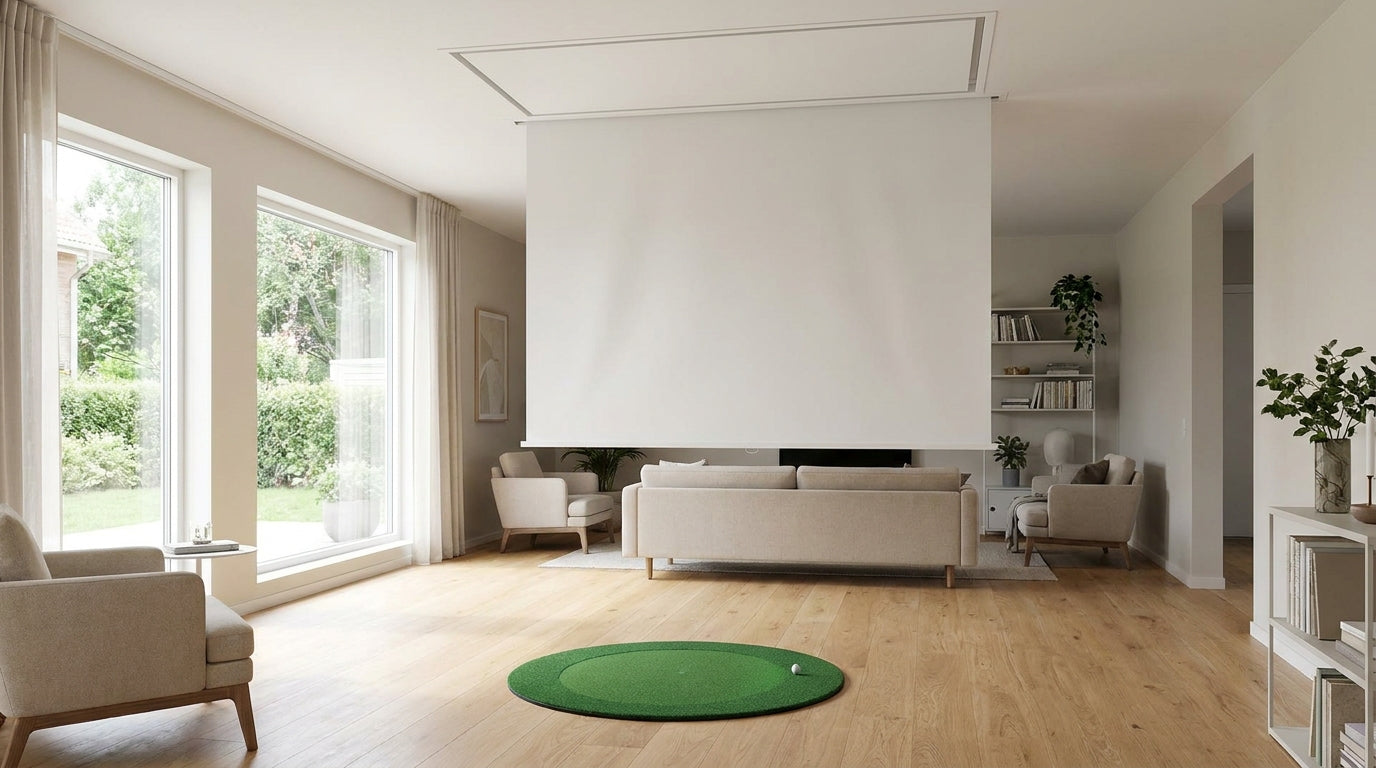
Here's the number that stops most people cold: a premium motorized retractable golf screen like the HomeCourse Pro runs about $1,999 — roughly 5 to 10 times what a comparable fixed screen costs (Source: Rain or Shine Golf / Scratch Golf / Indoor Golf Outlet listings). That's the price of making your simulator vanish into the ceiling when the room goes back to being a living room, a gym, or a garage bay.
So the real question behind any retractable golf impact screen roll up setup isn't "can I get one" — it's "is disappearing worth the premium, and will all that rolling wreck my image?" Let's break down how these screens work, what the data says about durability, and who genuinely needs one versus who's about to overpay for a fixed screen with extra steps.
How a Retractable Impact Screen Actually Works
A retractable screen is impact fabric wound around a roller mounted in a housing near your ceiling. When you want to play, it deploys down to full size. When you're done, it rolls back up and hides away.
There are two flavors, and the gap between them is bigger than the name suggests.
Motorized roll-up
A motor drives the roller, so the screen comes down and goes up at the touch of a button or remote. This is the premium experience — and the premium price. It's the version people picture when they imagine a screen that melts into the ceiling.
Manual pull-down
Same basic idea, but you pull the screen down and it retracts on a spring or clutch, like an oversized window shade. Cheaper, fewer parts to fail, but it fights you a little every session and there's no "set it and forget it."
Either way, the make-or-break spec is ceiling clearance. The housing needs vertical room, and so does the deployed screen. Retractables like the HomeCourse Pro want a minimum ceiling height of about 8'6", with 9–10 ft ideal, and deploy to roughly 8' tall by 10.6' wide (Source: HomeCourse / Rain or Shine Golf specifications). If you're tight on height, read our guide on sizing a screen for low-ceiling basements before you fall in love with a roller you can't physically fit.
Want the room back when you're done? Start with a screen built to take a beating.
Shop Impact Screens →Will Rolling It Up Wreck the Screen?
This is the concern that keeps buyers up at night, and it's a fair one. A fixed screen only fights ball impact. A retractable fights ball impact and the fatigue of being rolled and unrolled over and over.
The good news: loosely winding impact fabric around a core is actually gentler than folding it. Folding sets hard creases; rolling doesn't. The bad news: retractable owners do report screen sag and wrinkles at the fold-out edges, and that can soften your projected image right where you notice it (Source: Canvas ETC maintenance guide; HomeCourse Pro owner reviews).
A fixed screen stays consistently taut. A retractable trades some of that flatness for the convenience of vanishing. If a dead-flat, wrinkle-free image is non-negotiable for you, that's a real cost — and our post on removing impact screen wrinkles only gets you so far when the sag comes from the mechanism itself.
What the Data Says
Let's put real numbers on the trade-offs instead of vibes.
The price ladder is steep. A ready-made motorized electric retractable kit from METechs lists at $786.98, while premium branded units sit near $2,000 (Source: METechs product store). That's the spread between "entry motor and a roller" and "engineered, warrantied system."
The fabric itself is tough. Premium three-ply poly-spacer screens are rated to withstand roughly 34,000 hits with hardly any stretching (Source: Ace Indoor Golf / HiQ brand specifications). That durability matters double on a retractable, where rolling wear stacks on top of impact fatigue.
Upgrading the fabric is the cheap part. The price gap between a premium three-layer poly-spacer screen and a mid-tier one is only about $200–$300 (Source: Home Performance Lab / Carl's Place buying guides) — pocket change next to the roller mechanism itself. If you're going retractable, spend up on the fabric.
Motorized Retractable Golf Screen Price by Tier
Source: METechs, HomeCourse, and retailer listings (2025-2026); custom figure is an industry estimate
Retractable vs Fixed: The Honest Trade-off
Strip away the marketing and it comes down to one question: do you need the space back, or do you want the best possible image for the money? Here's how the two setups stack up.
Retractable vs. Fixed Golf Impact Screen — Key Trade-offs
Swipe to compare →
| Factor | Retractable (roll-up) | Fixed screen |
|---|---|---|
| Typical price | $800-$2,000+ | $150-$600 |
| Min ceiling height | 8'6"-10 ft (plus housing) | 8 ft |
| Flatness / tension | Some edge sag & wrinkles reported | Consistently taut |
| Best for | Multi-use rooms needing the space back | Dedicated golf rooms |
| Fabric wear factor | Ball impact + repeated rolling | Ball impact only |
Do You Actually Need One?
Be honest with yourself here, because the retractable premium only pays off in one scenario: the room does double duty.
You need a retractable if your simulator lives in a family room, a home gym, a formal garage bay, or anywhere the screen hanging permanently would start a fight with someone in your household. Getting the floor space and sightlines back is the whole point — and for that, the $2,000 buys real quality of life.
You do not need one if you have a dedicated golf room, a spare bedroom, or an unused corner of the basement. In that case a fixed screen gives you a flatter image, no motor to fail, and hundreds of dollars back in your pocket. If space is the only reason you're tempted, a freestanding no-drill setup can often solve "I need it out of the way" without the roller price tag.
One more reality check: retractables add a wear factor fixed screens don't have, so plan on watching the fabric more closely over the years. Our breakdown of how long an impact screen really lasts by tier is worth a read before you commit — especially since spending up on premium three-ply fabric is the cheapest insurance you can buy on a retractable build.
The Bottom Line
A retractable roll-up screen is a convenience product, not an image-quality upgrade. If your room has to transform, it's worth every dollar. If it doesn't, you're paying a fixed-screen premium for a motor you didn't need.
Whichever way you lean, the fabric is what actually takes your driver at full speed — so start there. Browse our impact screens and match the material to your room before you spend a cent on hardware.
Not sure which simulator fits your room?
The two-minute Simulator Finder Quiz checks your space and budget against every system we carry.


Keep Reading


