
golf simulator
How to Remove Golf Impact Screen Wrinkles: The Fix for Shipping Creases
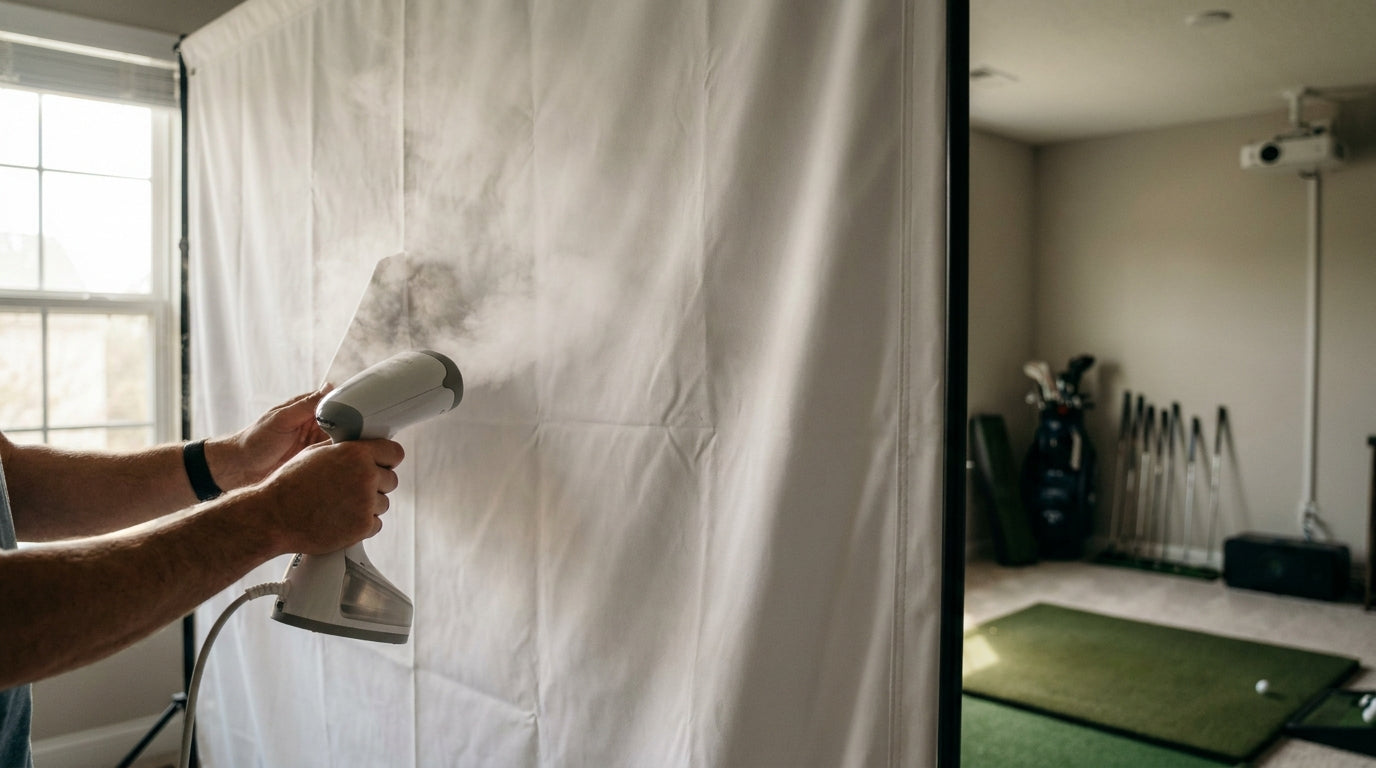
Here's the thing nobody tells you when your new impact screen shows up: it's going to look terrible for about a week. Fresh screens ship folded, and those sharp box creases can take anywhere from a few days to a few weeks to fully relax out (Source: Virtual-Golf-Simulator.com / Carl's Place). Panic sets in. You just spent good money and the thing looks like a road map.
Breathe. Learning how to remove golf impact screen wrinkles is mostly about patience, a little heat, and knowing what NOT to do. Do it right and your screen goes studio-smooth. Do it wrong and you melt a $600 sheet of polyester. Let's walk through the safe way.
First, Just Hang It and Wait
The cheapest wrinkle-removal method is free: gravity. Get the screen mounted with light tension and walk away.
Wrinkles noticeably soften by day 3, and most screens look studio-smooth by day 7 as the fabric relaxes under its own weight (Source: Virtual-Golf-Simulator.com / Carl's Place). The longer it sat boxed at the warehouse, the longer it takes — deep folds that were compressed for weeks need weeks to fully release.
So before you reach for any tools, hang it up. A warm room helps. If your creases are gone in three days, you just saved yourself a job. If they're stubborn, that's when the steamer comes out.
The Steamer Method (Fastest Active Fix)
A handheld garment steamer is the single best tool for this. It's fast, it's gentle, and it works: a handheld steamer removes golf screen wrinkles in under 10 minutes, applied roughly 10–15 seconds per wrinkled spot (Source: Swingyard.com / Carl's Place).
Two rules keep you out of trouble:
Lowest heat setting, always
Impact screens are woven polyester. Polyester melts. Use the lowest steam setting your unit has and never let the steamer head sit still on one spot.
Work the back side
Steam from behind the screen, not the projection face. That protects the surface your projector actually paints on, and it keeps any water spotting off the front. Keep the head a couple inches off the fabric, sweep across the crease, and let gravity pull it taut as the fibers warm up.
Starting fresh and want a screen that hangs flat from day one?
Shop Impact ScreensWhat the Data Says
A little context on the material you're working with, because it changes how careful you need to be.
Most golf impact screens run 1mm–3mm thick. A two-layer screen with a nylon cushion is around 3mm, while premium three-layer warp-knit screens measure roughly 4.5mm (Source: Canvas ETC / Alibaba 3-layer impact screen guide). Thicker multi-layer material holds fold creases longer, but it also shrugs off steam and tension better without damage.
Price is the other reason to slow down. Standard loosely-woven screens run about $250, mid-range 'preferred' screens around $400, and premium triple-layer screens roughly $600, with high-end branded systems from $1,500 to over $5,000 (Source: Carl's Place / Big Horn Golfer). The more you paid, the more an over-heated, over-stretched mistake stings.
Golf Impact Screen Price by Material Tier
Source: Carl's Place & Big Horn Golfer 2024 impact screen pricing
Let Proper Tension Do the Rest
Here's the part most people botch. After hanging and steaming, your remaining wrinkles get pulled flat by tensioning — not by cranking the screen drum-tight.
Screens should be tensioned smooth-and-slightly-loose, with a small amount of natural center sag considered totally normal (Source: Carl's Place). Even tension across every grommet is what flattens creases evenly. Yank one corner to kill a wrinkle and you'll just create a diagonal pucker somewhere else.
Over-tensioning to chase every last bit of sag is how grommets tear and fabric stretches out of shape. If you want the full method, our impact screen tensioning system guide breaks down bungee spacing and pull order step by step.
Wrinkle-Removal Methods at a Glance
Wrinkle-Removal Methods: Time, Heat, and Safety
Swipe to compare →
| Method | Time / Setting | Safety Note |
|---|---|---|
| Hang & gravity relax | 3 days to soften, ~7 days smooth | Safest — no heat, light tension only |
| Handheld steamer | Under 10 min; 10–15 sec per spot | Lowest heat, backside; don't soak |
| Proper tensioning | After hang/steam; smooth not tight | Small center sag is normal |
| Iron / heat gun | Not recommended | High risk of melting the polyester |
The One Move That Ruins Screens
Do not touch your screen with a clothes iron or a heat gun. Ever. Both put concentrated, direct heat on the fabric, and polyester goes from wrinkled to melted in about a second. A scorched spot is permanent, and it shows up as a bright blob every time your projector fires.
Steam works because it's diffuse, low, and moving. Direct contact heat is the opposite of all three. When in doubt, back off the heat and give it another day to hang — patience never burned a hole in anything.
Prevent the Wrinkles You'll Have Next Time
Shipping folds are the worst wrinkles precisely because they're the sharpest. If you ever take your screen down for a move or a room change, roll it — never fold it. Sharp fold creases can take weeks to relax back out, while a loosely rolled screen barely wrinkles at all (Source: Virtual-Golf-Simulator.com / Carl's Place).
Store it rolled around a wide tube in a dry spot. That habit alone means you never fight box creases again. And while you've got it down, it's a good time to skim our screen cleaning and maintenance guide — clean, well-tensioned screens simply last longer.
Not sure which screen tier you're even working with? Our breakdown of Standard vs Preferred vs Premium impact screens explains how the material differences affect exactly how these creases behave.
Bottom Line
New screen looking rough? Hang it, wait a week, and most of those creases vanish on their own. If a few stubborn ones hang around, hit the back with a low-heat handheld steamer for 10–15 seconds a spot, then finish with even, smooth-not-tight tension. Skip the iron, roll it for storage, and your screen will look flawless for years.
Ready to build around a screen that projects clean and hangs flat?
Browse Impact ScreensNot sure which simulator fits your room?
The two-minute Simulator Finder Quiz checks your space and budget against every system we carry.


Keep Reading


