
golf simulator
Golf Impact Screen Noise Reduction for Apartments: How to Quiet the Crack Without Rebuilding
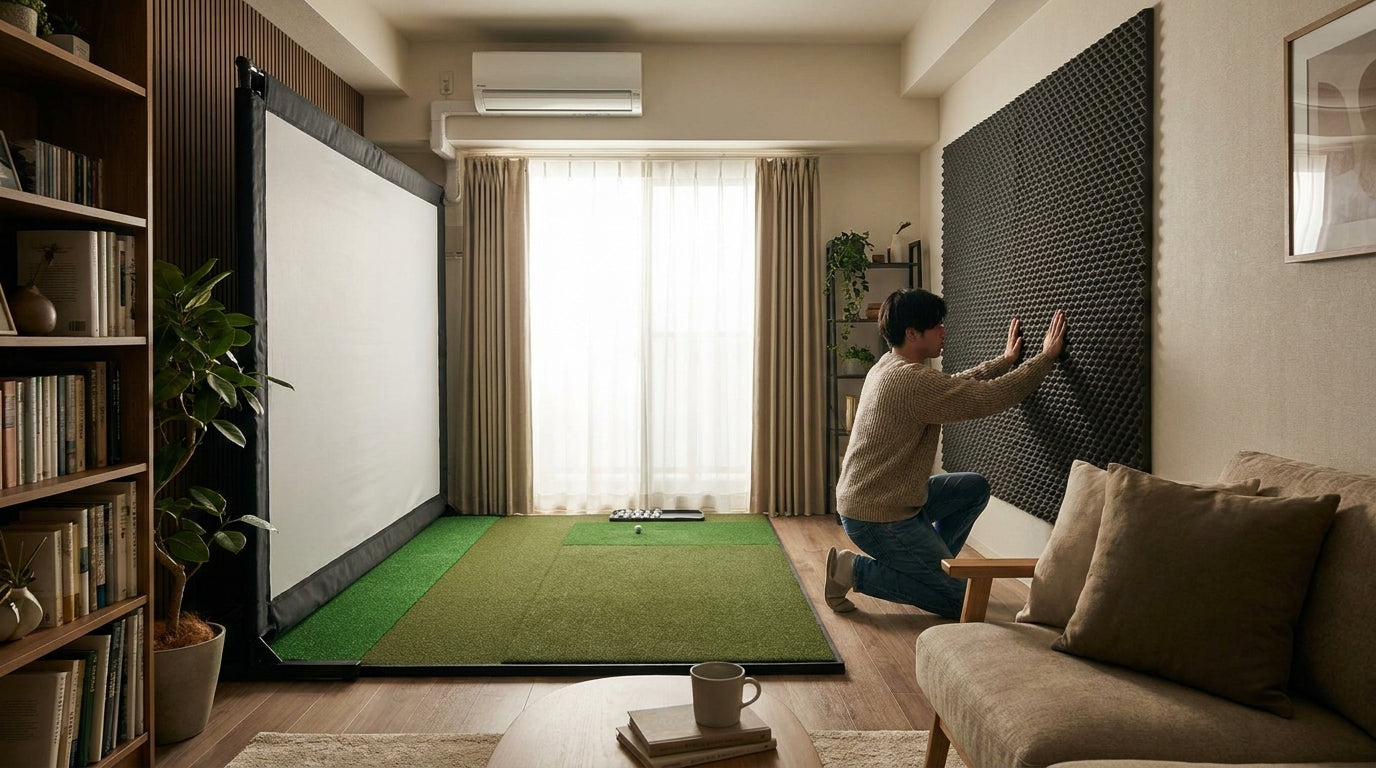
Take a full swing with a driver into a golf simulator screen and the room hits about 100 decibels — the same range as a jackhammer tearing up the street outside. (Source: Acoustic Geometry / BuildAGolfSim Quiet Golf Simulator Guide, 2025) That's the number that gets renters in trouble.
If you're chasing golf impact screen noise reduction for apartments, the problem isn't just that it's loud — it's the sharp, sudden crack that punches straight through shared walls and lands in your neighbor's living room at 9pm. Good news: you don't need to rebuild the place. You can knock perceived noise down by half with gear, not construction. Let's break down where the sound actually comes from, and how to kill it.
How Loud Is an Impact Screen, Really?
Every ball strike makes two sounds: the deep thud of the ball stretching the screen, and a high-frequency metallic crack at the moment club meets ball. The thud is what you feel. The crack is what your neighbors hear.
Building one now? Carl’s Place Preferred impact screen — from $299.
Iron shots into a screen land around 85–90 dB. A driver pushes that to roughly 100 dB at six feet. (Source: Acoustic Geometry / BuildAGolfSim, 2025) For reference, 100 dB is jackhammer territory — and it happens in a fraction of a second, over and over.
But the loudest part isn't the screen at all. The club-ball impact itself can spike past 120 dB at the instant of contact. (Source: USPTO patent filings on golf club/ball acoustics) That short, sharp transient is exactly the kind of sound walls do a poor job of stopping.
Starting with a quieter, multi-layer screen is the easiest win.
Shop Impact ScreensWhy the Crack Travels Through Walls
Low, booming sounds are annoying, but it's the high-frequency crack that carries. Sharp transients slip through gaps, hollow-core doors, and thin drywall far more easily than a steady hum.
There are two paths to worry about. Airborne noise — the crack — leaks through the weakest opening in the room, usually the door. Structure-borne noise — the thud and floor vibration — travels down into the unit below through the framing itself.
Renters in apartments and townhouses fight both. The fix is layered: soften the source, absorb what's bouncing around the room, then seal the leaks.
What the Data Says About Quieting It Down
Here's the encouraging part. You don't have to eliminate the noise — you just have to take the edge off the crack and stop it from escaping.
- Multi-layer impact screens deliver about 42% more noise reduction than a single-layer polyester screen. (Source: My Golf Simulator / Golf Simulator Forum)
- A combined approach — quality screen, foam underlayment, and a few acoustic panels — cuts perceived noise 30–60% without touching a single wall. (Source: My Golf Simulator, Quiet Golf Simulator, 2025)
- Acoustic panels 2–4 inches thick with NRC ratings of 0.7–0.9+ absorb most of the mid-range impact energy; NRC 0.90 means roughly 90% of an ideal absorber's ability. (Source: Acoustical Surfaces / Second Skin Audio)
- Upgrading to a solid-core door with seals and a sweep cuts noise leakage by 50–60%. (Source: My Golf Simulator, 2025)
Golf Simulator Noise by Source (dB)
Source: Acoustic Geometry, BuildAGolfSim, USPTO acoustic filings (2025)
Your Screen Is the First Line of Defense
The cheapest noise upgrade is the screen you were buying anyway. A dense, multi-layer screen with a cushioned core swallows the ball's energy over a longer moment instead of snapping it back instantly — and that softer catch is a quieter, duller sound.
That 42% reduction versus single-layer polyester is real, and it's why apartment builders should almost never run a thin single-ply screen. If you're weighing your options, our breakdown of a single layer vs double layer impact screen walks through exactly which one your room needs.
One more free trick: give the screen room to move. Mounting it flush against the wall turns the whole wall into a drum. Leaving a gap lets the screen absorb the hit and decouples it from the structure — see our guide on how much gap to leave behind your screen.
Renter-Friendly Dampening That Actually Works
You can get most of the way there with zero construction. Stack these tactics:
Acoustic panels behind and beside the screen soak up the crack before it reflects around the room. Aim for 2–4 inch panels at NRC 0.7 or higher. Heavy moving blankets or a thick curtain layered over the screen wall help too.
Seal the door. It's the weakest link in almost every room. A solid-core door with weatherstripping and a bottom sweep alone cuts leakage 50–60%. (Source: My Golf Simulator, 2025)
Float everything. Foam underlayment or a rubber mat under your hitting area kills the vibration heading downstairs. If you can't drill at all, a freestanding enclosure keeps the whole rig decoupled from the building — our renter's no-drilling setup guide covers that build.
Apartment Golf Soundproofing Tiers: Cost vs. Approach
Swipe to compare →
| Tier | Cost Range | What's Included / Result |
|---|---|---|
| Quick fixes (renter-friendly) | $500–$1,500 | Curtains, acoustic panels, door seals — up to 30–60% perceived noise cut |
| Partial upgrades | $2,000–$5,000 | 1–2 treated walls, multi-layer screen, foam underlayment |
| Full isolation | $5,000–$12,000+ | Multiple walls + ceiling; double 5/8" drywall + Green Glue = 12–15 dB gain |
| Multi-layer screen alone | Screen upgrade only | ~42% noise reduction vs. single-layer polyester |
When You Can Actually Build
Own the place? You have heavier options. Adding a second layer of 5/8-inch drywall with Green Glue damping compound buys a 12–15 dB improvement in isolation — a genuinely dramatic drop for the low-frequency thud your downstairs neighbor feels. (Source: My Golf Simulator soundproofing measurements)
That's a real project, but for a dedicated basement or garage room it's the difference between hearing someone golfing and hearing nothing at all.
The Bottom Line
You'll never make a driver strike whisper-quiet — but you can absolutely get it down to something your neighbors shrug off. Start with the screen, add panels and door seals, and float everything off the structure. That combination alone can cut perceived noise by more than half without a permit or a landlord conversation.
Ready to start with the quietest foundation? Browse our collection of multi-layer impact screens and build a setup you can actually use after dark.
From This Guide
Sound treatment for your bay


Not sure which simulator fits your room?
The two-minute Simulator Finder Quiz checks your space and budget against every system we carry.

Keep Reading
Related guides

golf simulatorGolf Simulator Hitting Mat Sizing Guide: Exact Dimensions for 10x12, 12x15, and 16x18 Rooms

golf simulatorGolf Simulator Enclosure Cost to Build: Every Line Item, DIY vs Pre-Made (2026 Numbers)

golf simulatorGolf Simulator Room Electrical Plan: Where Every Outlet Goes Before the Frame Closes Up