
bottom gap fix
Golf Impact Screen Bottom Gap Fix: How to Seal It So No Ball Ever Escapes
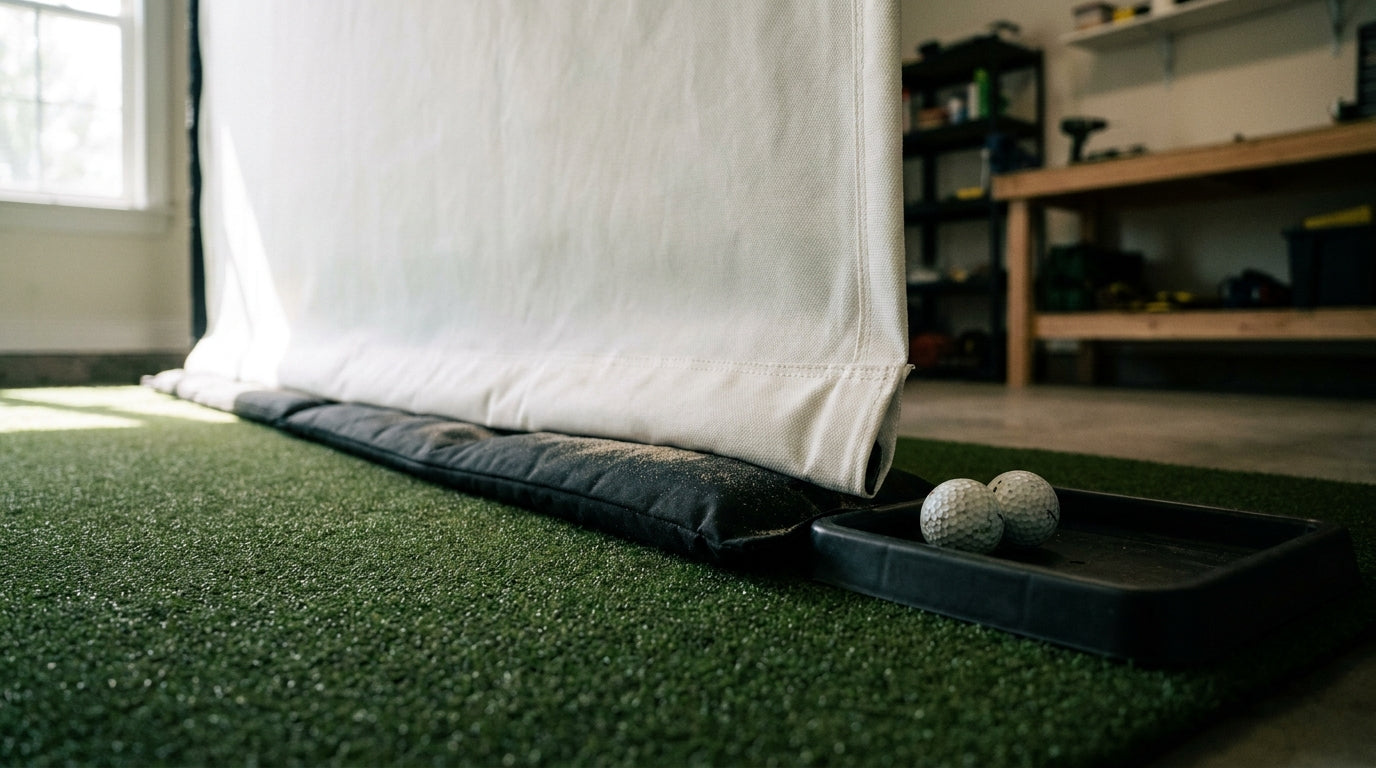
Here's the counterintuitive part: your impact screen is supposed to hang off the floor a little. Most builders leave the screen 12"–16" from the rear wall so it can deform inward and swallow ball energy instead of firing it back at your shins (Source: SimSpace Golf / Home Performance Lab). That rearward give is exactly why the bottom edge lifts and a gap opens up.
And a gap at the bottom of a golf simulator screen is not cosmetic. A low mishit finds that gap, ducks under the fabric, and rolls out across your floor — or worse, kicks off the wall behind it. If you've been chasing balls out of your bay after every session, this is your golf impact screen bottom gap fix. Let's seal it for good.
Why the Bottom Gap Opens Up in the First Place
The gap is a mechanical side effect of a screen doing its job. When you tension a screen and float it away from the wall, the fabric can billow backward on impact. On a hard shot, the bottom hem actually flaps upward for a split second — and that's the window a rolling ball needs to escape.
Two things make it worse. First, soft flooring: if your screen rests on high-pile carpet or thick turf, balls can squeeze underneath the edge (Source: Carl's Place). Second, an unweighted hem that has nothing holding it down. Both leave a path, and low shots find it every time.
If your screen is also bouncing balls back at you, the gap and the bounce are related problems. Our breakdown of ball bounce-back distance covers how much slack to leave, and how much is too much.
Why Containment Actually Matters (It's a Speed Problem)
People underestimate the forces involved. At a 100 mph clubhead speed, ball speed off the face reaches roughly 150 mph, and the USGA caps initial ball velocity at 255 feet per second — about 174 mph (Source: Shop Indoor Golf / USGA testing standard).
A thin, low screamer that finds a bottom gap isn't a gentle roll-out. It can shoot under or through the enclosure with real force, threatening the wall, the baseboard, and anything else in the room. Sealing the bottom is a safety and equipment issue, not a tidiness preference.
What the Data Says: 4 Ways to Seal the Gap
Good news — none of these fixes are expensive or complicated. Here's what the industry actually uses, with real costs.
The cheapest and most common fix is a weighted bottom sleeve. A hem roughly 3" deep can be threaded with a 3/4" weighted pipe or a 1/2" galvanized steel chain, keeping the screen from flying upward on impact — added for about $30 depending on screen size (Source: Ace Indoor Golf / virtual-golf-simulator.com). That weight holds the bottom flush so low shots can't kick under it.
Step it up with a floor-anchored hem pocket. Some screens include a 3.5" bottom pocket that rests on the floor and threads with an elastic shock cord to anchor the edge to the ground (Source: All Sport Systems / Golf Huts). That eliminates the flap entirely, which is the real culprit behind roll-outs.
If your floor is the problem, use turf overlap. Overlapping the hitting turf onto the screen base — or resting the screen directly on the floor — closes the path balls squeeze through on soft carpet (Source: Carl's Place). And for a two-in-one fix, builders commonly cut a shallow ball trench about 12 inches in front of the screen, or set an angled ~30° ramp of 2x4s and plywood at the base, to catch dropping balls and roll them back to the mat (Source: My Golf Simulator / Red Stakes Golf).
Cost to Add a Bottom-Gap Seal to a Golf Simulator Screen (by method)
Source: Industry estimates based on Ace Indoor Golf, All Sport Systems, and DIY builder guides
Which Seal Method Is Right for Your Room?
The right fix depends on your floor, your enclosure, and whether you also want ball return. Here's the quick comparison.
Bottom-Gap Sealing Methods Compared
Swipe to compare →
| Method | How it seals the gap | Best for |
|---|---|---|
| Weighted hem (pipe/chain, ~$30) | Weight holds the screen bottom flush to the floor so it can't flap up on impact | Most setups; cheapest fix |
| Floor skirt / hem pocket + shock cord (3.5") | Anchors the screen edge to the ground, removing any flap balls could roll under | Enclosures on hard floors |
| Turf overlap | Hitting turf laps onto the screen base, bridging the gap and stopping roll-outs | Rooms with high-pile carpet/thick turf |
| Ball tray / trench or angled ramp (~30°) | Catches dropping balls in a channel and returns them to the mat | Builders wanting containment + ball return |
Getting the Whole Bottom Edge Right
A seal only works if the rest of your hang is dialed in. If your screen is pulled too far off the wall, it'll billow more and the gap gets harder to close — our guide to screen distance from the wall walks through the sweet spot.
Don't forget the sides, either. Balls that duck under the bottom often have friends escaping around the edges. Side flaps handle the corners the same way a weighted hem handles the floor. Seal the bottom and the sides together and your enclosure finally behaves like a real, contained bay.
The Quick Checklist
Thread a weighted pipe or chain through the bottom hem. Rest the screen on a hard surface, or overlap your turf onto the base. Add a shallow trench or angled ramp if you want the balls to come back to you. That's the entire fix — under $75 in most rooms.
Seal It Once, Play in Peace
The bottom gap isn't a flaw in your screen — it's a predictable byproduct of a screen that flexes to absorb 150 mph shots. Weight the hem, anchor the edge, and let your turf do some of the work, and you'll never chase a runaway ball across the garage again.
Building your enclosure from scratch, or upgrading a screen that never sealed right? Browse our golf impact screens — many ship with weighted hems and floor pockets already built in, so containment is handled before your first swing.
Not sure which simulator fits your room?
The two-minute Simulator Finder Quiz checks your space and budget against every system we carry.


Keep Reading


