
frame material steel vs pvc
Golf Simulator Impact Screen Frame Material: Steel vs PVC (And When Cheap Actually Costs You)
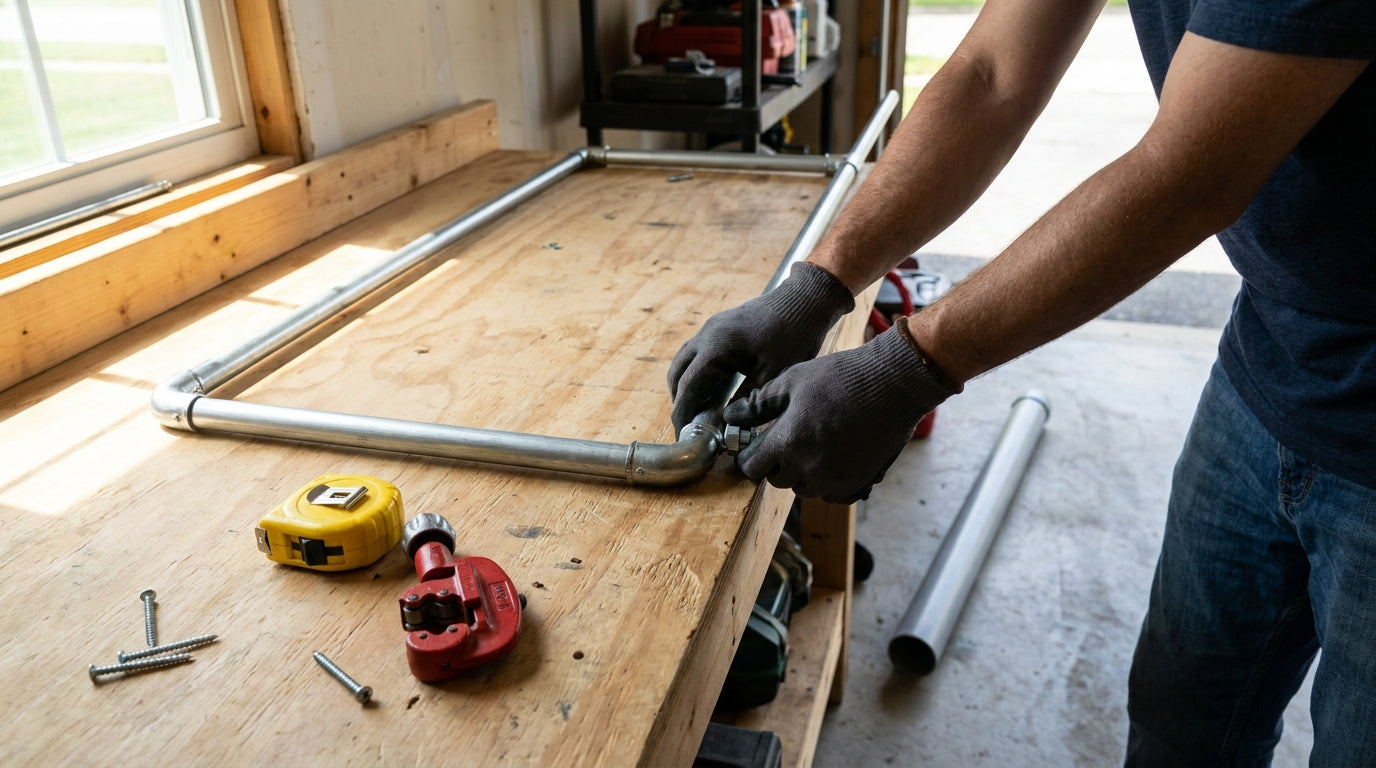
Here's the number that should stop every budget sim builder in their tracks: a 1-inch stick of EMT steel conduit and a heavy-duty Schedule 40 PVC stick cost almost exactly the same — roughly $10 to $15 each (Source: The Home Depot product listings — Allied Tube, Wheatland, Southland). So when people say "PVC is way cheaper," they're not really talking about the pipe. They're talking about fittings.
That single fact reframes the entire golf simulator impact screen frame material debate. Steel vs PVC isn't a story about the raw tube being expensive. It's a story about rigidity, sag over time, and what happens when a 150 mph ball strike meets your frame for the ten-thousandth time.
Let's actually settle it with data instead of forum opinions.
Building one now? Carl’s Place Standard impact screen — from $180.
Why Frame Material Even Matters for an Impact Screen
Your frame has exactly one job: hold the screen drum-tight and keep it there. A loose frame sags, the screen wrinkles, and your projected image bends like a funhouse mirror.
The problem is that an impact screen frame lives under constant tension AND absorbs repeated impact. Those two forces fight your material choice in different ways. Tension wants to bow your horizontal spans inward over time. Impact wants to crack, dent, or shatter whatever the ball can reach.
PVC and steel handle both very differently — and the gap is bigger than most first-time builders expect.
The Sag Problem: Where PVC Quietly Fails
This is the big one. PVC sags significantly on unsupported spans over 6 to 8 feet, which compromises screen tension on any enclosure wider than about 8 feet (Source: Canvas ETC DIY Golf Impact Screen & Enclosure Guide). Most real sim bays are 10 to 12 feet wide. See the conflict?
EMT steel conduit, by contrast, resists sag effectively over spans of 10 to 12 feet, making it suitable for full-width enclosures without a center support (Source: Canvas ETC DIY Golf Impact Screen & Enclosure Guide). That's the whole standard sim-width range covered by one material that stays straight.
This isn't just golf-forum folklore, either. Electrical code requires Schedule 40 PVC to be supported at least every 10 feet — and within 3 feet of every fitting — specifically because of its tendency to sag under its own load (Source: NEC / Schedule 40 PVC support spacing guidance — LedesTube, Central Conduit). Independent engineers already documented the exact weakness that wrecks a tensioned screen frame.
Maximum Unsupported Frame Span Before Sag: PVC vs Steel/EMT
Source: Compiled from Canvas ETC enclosure guide and NEC PVC support spacing; steel figures per EMT sim-build guidance
Notice that bumping PVC up to 1.5 inch only buys you about a foot of extra span. Even the fatter PVC tops out around 8 feet — still short of a standard bay. Steel pulls ahead and stays there. If you've ever fought a sagging frame, our screen wrinkle fix guide walks through the downstream symptoms in detail.
The Safety Gap Nobody Talks About
Sag ruins your image. This next one can ruin your day.
On repeated ball impact, PVC can shatter into sharp, jagged shards that fly back toward the golfer. Galvanized-steel EMT only dents or rings — it never shatters (Source: SimGolfLab DIY EMT enclosure build guide). That's the core safety case for steel, and it's not theoretical. Your frame perimeter sits right in the splash zone of mishits and ricochets.
PVC gets more brittle with age and cold, too. If your sim lives in a garage that swings through winter, that brittleness compounds — something we dig into in our cold garage durability breakdown. A dented steel rail is an annoyance. A cracked PVC rail spraying shards is a hazard.
What the Data Says: The Real Cost Comparison
Now the money. A full PVC pipe frame runs about $80 to $150 in materials, versus $200 to $350 for a comparable EMT galvanized-steel conduit frame (Source: SimGolfLab / Canvas ETC DIY enclosure guides). That's a real gap — but remember, the pipe itself is nearly identical in price. The steel premium comes almost entirely from connectors and fittings, not the tube (Source: The Home Depot product listings).
So you're not paying for stronger metal. You're paying for a more rigid joint system that actually holds a 12-foot span flat. For a permanent build, that's the best $100 to $200 you'll spend — and far cheaper than re-tensioning a sagging screen every few months.
PVC vs Steel/EMT Impact Screen Frame Comparison
Swipe to compare →
| Factor | PVC Pipe Frame | Steel / EMT Conduit Frame |
|---|---|---|
| Full frame material cost | $80–$150 | $200–$350 |
| Max span before sag | 6–8 ft | 10–12 ft |
| Rigidity over time | Bows under screen weight, wrinkles image | Holds tension, minimal long-term deflection |
| Repeated ball impact | Can shatter into sharp shards at connectors | Dents at most; never shatters |
| Best use case | Narrow (<8 ft) budget/temporary builds | Standard 10–12 ft permanent serious builds |
When PVC Is Actually Fine
I'm not anti-PVC. For the right build, it's a smart, cheap choice.
If your enclosure is under 8 feet wide, temporary, or you're renting and need something you can break down fast, PVC earns its keep. A narrow apartment or spare-bedroom bay where the span never exceeds PVC's sag limit will hold tension just fine. If that's your situation, pair it with a no-drill approach from our renter's setup guide.
The rule is simple: stay inside PVC's sag window and keep the ball away from the pipe, and it works. Push past 8 feet, and you're fighting physics.
When to Step Up to Steel
Go steel the moment your build is permanent or your span hits 10 to 12 feet. That's the standard sim width, and it's exactly where PVC gives up while EMT stays flat.
You should also choose steel if your frame rails sit anywhere the ball can reach, or if your room gets cold. The combination of rigidity, impact safety, and no center support makes EMT the default for serious builders — the same reason most of them choose a fixed frame over a roll-up, which we cover in our roll-up vs fixed frame breakdown.
The Bottom Line
The frame material debate comes down to span and permanence. Under 8 feet and temporary? PVC saves you a hundred bucks and works. Standard 10-to-12-foot permanent bay? Steel holds your tension flat, never shatters, and costs less than the headache of redoing a sagging build.
Whatever frame you settle on, it's only as good as the screen stretched across it. Browse our impact screen collection to pair your frame with a surface built to take the hit — straight, tight, and ready for your driver.
Planning the whole bay? Use Build Your Bay: pick your room size, screen and mat, and we match every part (enclosure, framing, back cover, hitting mat) and add it all to your cart in one click.
Related reading: Golf Impact Screen Nylon vs Polyester Material: Which Fabric Actually Gives You the Sharper Image?


Not sure which simulator fits your room?
The two-minute Simulator Finder Quiz checks your space and budget against every system we carry.

Keep Reading
Related guides

golf simulatorGolf Simulator Hitting Mat Sizing Guide: Exact Dimensions for 10x12, 12x15, and 16x18 Rooms

golf simulatorGolf Simulator Enclosure Cost to Build: Every Line Item, DIY vs Pre-Made (2026 Numbers)

golf simulatorGolf Simulator Room Electrical Plan: Where Every Outlet Goes Before the Frame Closes Up