
golf simulator
Golf Impact Screen Nylon vs Polyester Material: Which Fabric Actually Gives You the Sharper Image?
Here's a number that reframes the whole fabric debate: a quality polyester impact screen is tested to survive golf balls traveling up to 250 mph, while even professional golfers only average just over 180 mph of ball speed (Source: Carl's Place, 'How to Choose a Golf Impact Screen Material'). That's a massive safety margin — and it's exactly why the nylon-vs-polyester argument almost never comes down to "which one survives." Both survive. The real fight is over image sharpness, noise, sag, and price.
So if you've been agonizing over screen fabric fiber type — not color, not layers, not the frame — this one's for you. Let's break down what nylon and polyester actually do differently, and which fiber fits your swing and your room.
Why Fabric Fiber Type Even Matters
Most buyers obsess over screen size and forget the thread. But the fiber is what your projector image lands on, what absorbs a 90-mph 7-iron, and what either holds tension for years or starts to sag by month six.
Building one now? Carl’s Place Preferred impact screen — from $299.
Nylon and polyester are the two dominant fibers, with nylon/poly blends filling the gap. They feel similar in your hands. On a taut frame with a projector firing at them, they behave very differently.
Nylon: Tough, Quiet, and a Little Soft on Detail
Nylon's headline trait is toughness. It's an incredibly resilient fiber, and screens that lean on it tend to run a touch quieter on impact. If pure durability and low noise were the only scorecard, nylon would look great.
The catch is the surface. Nylon has a rougher surface texture, which scatters projected light and slightly softens image clarity (Source: Canvas ETC, 'Golf Impact Screen Materials Guide' & Apex Mills fabric guide). It also tends to cost more, and it can absorb moisture — which matters if your sim lives in a damp basement or garage.
Translation: nylon buys you toughness and quiet, but you pay for it in dollars and a slightly fuzzier picture.
Polyester: The Sharpest Picture, and the Best Value
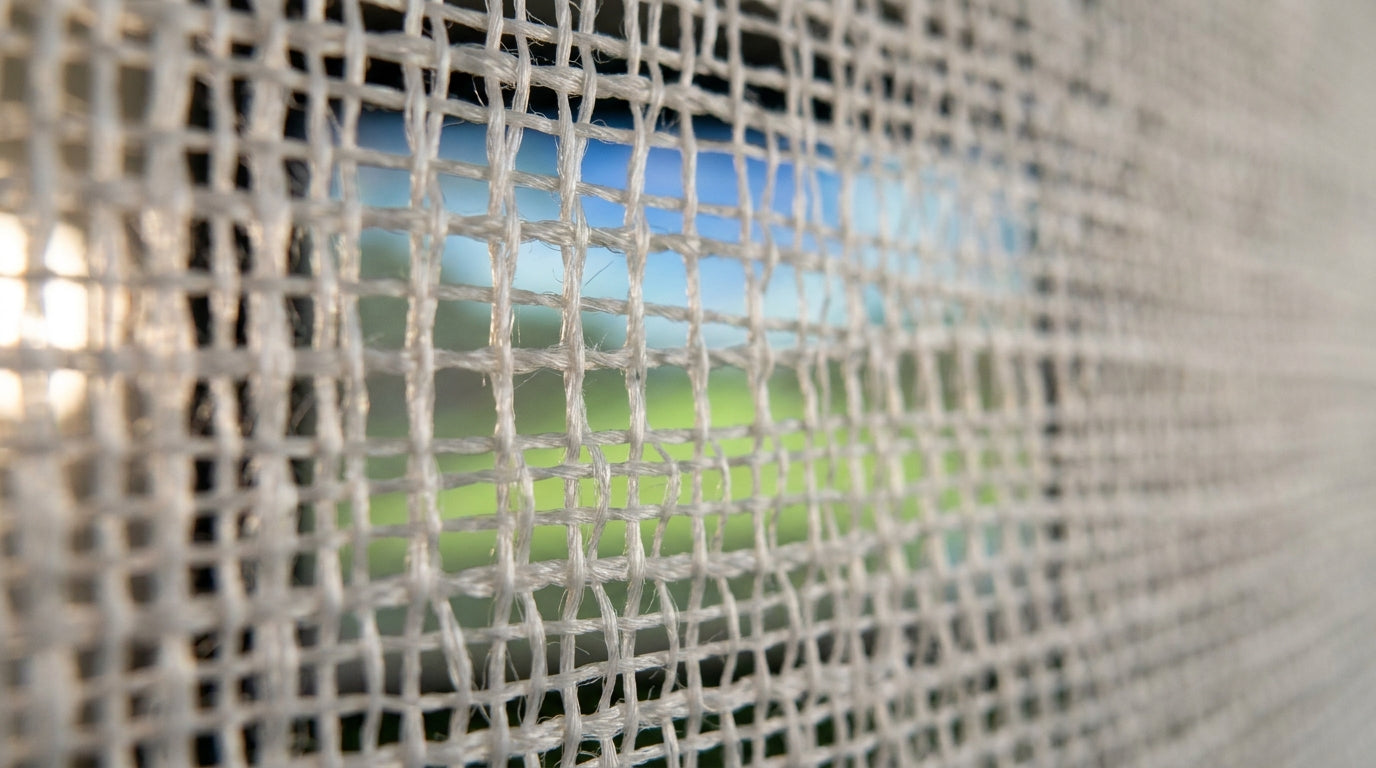
Polyester mesh is the most common impact-screen fiber for a reason. It's prized for durability, light weight, and value — and critically, its tighter, smoother weave delivers the crispest projected image (Source: Canvas ETC & Apex Mills fabric guide).
Carl's Place builds all three of its tiers — Standard, Preferred, and Premium — from 100% heavy-duty polyester, each rated to that 250 mph ball-speed ceiling (Source: Carl's Place product specs). That's the durability box checked, without giving up the image.
Polyester also wins on stability. It resists moisture and holds tension well, so it sags less over time than a fiber that drinks humidity. For a room you want to look great in year three, that's the whole game.
What About the Blend?
Nylon/poly blends try to grab the best of both — nylon's toughness, polyester's smoother face. In practice they land in the middle: a minor clarity gain over some poly, solid durability, moderate noise. The problem is cost. Blends often carry the highest price of the three, which makes them a hard sell when a good single-fiber polyester screen already nails image and longevity.
What the Data Says
Let's put the numbers on the table instead of trading opinions.
- Clarity winner: Nylon and polyethylene screens run quieter but can slightly compromise image clarity, whereas tightly woven polyester delivers the crispest projected picture (Source: My Golf Simulator, 'Best Impact Screen Materials for Picture Quality').
- Durability headroom: Polyester screens tested to 250 mph dwarf the ~180 mph ball speeds of even elite players, minimizing bounce-back and wear (Source: Carl's Place).
- Noise fix without switching fibers: Premium 'poly spacer' screens use a three-layer structure — two heavy-duty polyester faces joined by vertical spacer yarns — which cuts noise and bounce-back versus single-layer weaves (Source: Home Performance Lab, 'Best Golf Simulator Impact Screen (2026)').
That last point is the sleeper. If you liked nylon mainly for the quiet, layered polyester construction gives you the hush and the sharp image — no fiber compromise required.
Typical Golf Impact Screen Price by Tier (Polyester Construction)
Source: Home Performance Lab & Golfer Logic 2026 impact screen roundups
Pricing typically runs about $250 for Standard, $400 for Preferred, and $600 for the Premium three-layer poly build, with budget open-weave screens starting near $150–$180 (Source: Home Performance Lab & Golfer Logic 2026 impact screen roundups). Each tier up mostly buys you a sharper picture and quieter, longer-lasting fabric — not a different fiber.
Nylon vs. Polyester vs. Blend, Side by Side
Here's the whole decision in one grid.
Nylon vs. Polyester vs. Blended Impact-Screen Fabric
Swipe to compare →
| Attribute | Nylon | Polyester (Carl's Place) | Nylon/Poly Blend |
|---|---|---|---|
| Image clarity | Lower — rougher surface texture | Highest — smooth, tight weave | Moderate — minor gain over poly |
| Durability / toughness | Very high | High (250 mph rated, silicone-reinforced) | High |
| Noise / bounce-back | Quieter | Low with 3-layer poly spacer | Moderate |
| Relative cost | Premium (higher) | Best value for image + durability | Highest |
| Stretch / sag resistance | Good but can absorb moisture | Excellent — low moisture, holds tension | Good |
Which Fiber Fits Your Swing and Room?
If image quality is your top priority — you're running a bright, sharp projector and want a course that pops — go polyester. The smoother weave is the single biggest fabric factor in a crisp picture.
If your room is damp or the noise is what keeps you from swinging at night, you still don't need to jump to nylon. Step up to a layered polyester screen instead; the poly spacer construction handles sound and bounce-back while keeping the sharp image. If you're weighing that trade-off, our breakdown of single vs. double layer screens walks through exactly when the extra layer earns its keep.
Worried about the fastest swings? The physics are on your side. Our deep dive on max ball speed ratings at 110+ mph shows how much headroom a quality screen really has. And if you're stuck deciding between Carl's Place tiers, the Standard vs. Preferred vs. Premium guide maps each polyester build to the room it belongs in.
The Bottom Line
Nylon is tough and quiet but softer on detail and heavier on your wallet. Blends split the difference and charge the most for it. Tightly woven polyester gives you the sharpest projected image, elite-beating durability, and the best long-term tension — which is why it's the fiber serious sim builders default to.
Ready to see it for yourself? Browse our polyester impact screens and match the tier to your room, your projector, and your swing. Your golf course deserves a fabric that actually shows it off.


Not sure which simulator fits your room?
The two-minute Simulator Finder Quiz checks your space and budget against every system we carry.

Keep Reading
Related guides

golf simulatorGolf Simulator Enclosure Lighting Plan: Where to Mount Fixtures So They Never Wash Out Your Screen

golf simulatorGolf Simulator Basement Conversion Checklist: The 7 Steps to Run Before You Buy Anything

DIY golf simulatorGolf Simulator Garage Build Cost Breakdown: Every Line Item at Three Budget Tiers