
fixed frame golf screen
Golf Simulator Screen Roll Up vs Fixed Frame: Why Serious Sim Builders Default to Fixed
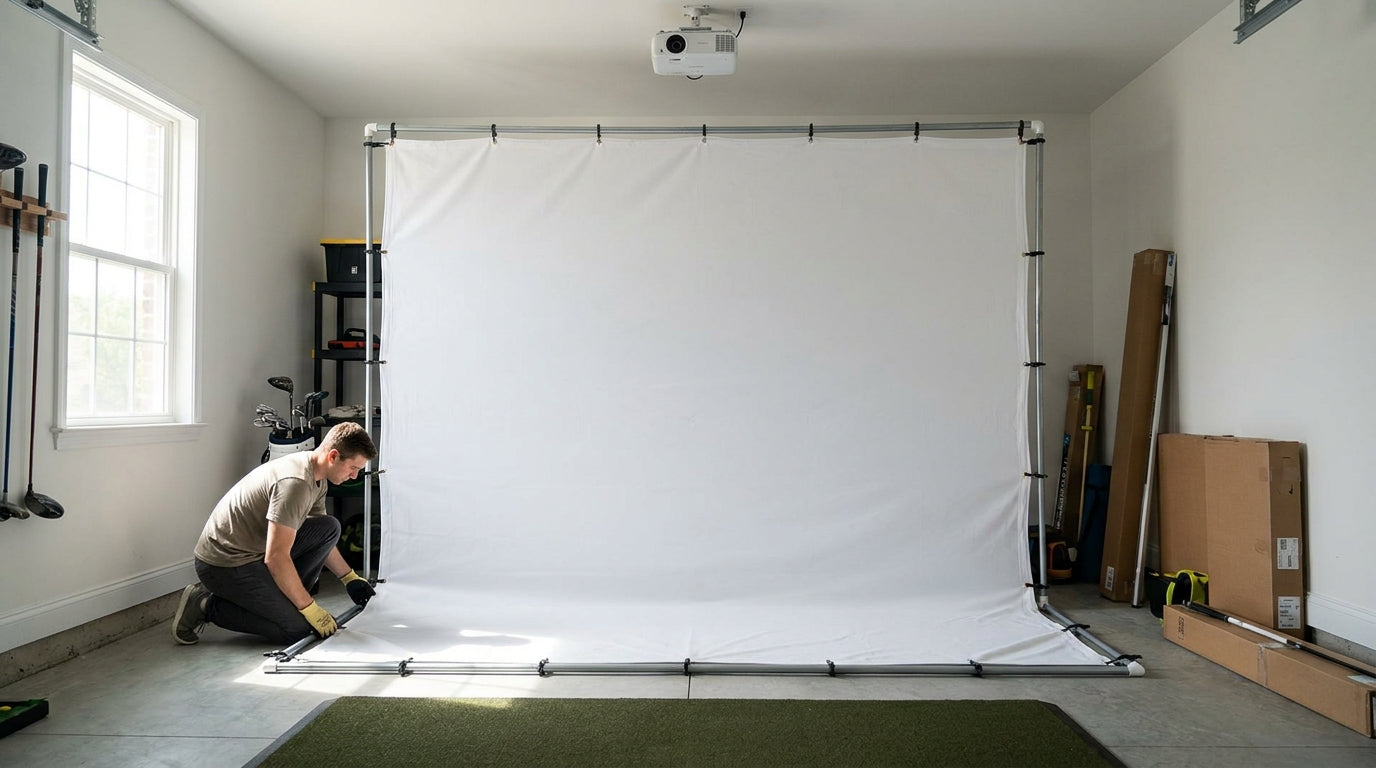
Here's a number that should stop you before you click 'add to cart' on a retractable impact screen: the entry-level retractable golf simulator screen system starts at $1,999. A Carl's Place fixed-frame screen starts at $195. That's a 10x price premium — and it buys you exactly one thing: the ability to roll your screen up and tuck it away.
If you're building a permanent home simulator bay, that might be the worst $1,800 you could spend.
Roll-up and retractable screens have a clear use case. But if you're committing to a dedicated sim room, the data is pretty unambiguous about which setup wins across every dimension that matters — image flatness, durability under ball impact, long-term sag resistance, and cost efficiency. Here's what the numbers actually say.
What Golf Simulator Screen Roll Up vs Fixed Frame Actually Means
Fixed-frame screens are exactly what they sound like: impact screen fabric stretched tight across a rigid frame — usually PVC pipe or steel. The screen is always deployed, always under tension, and never moves between sessions.
Ready to shop impact screens?
Browse the full Carl's Place lineup — every screen ships ready to mount with real size specs.
Shop Carl's Place Impact Screens →Roll-up or retractable screens use a motorized or manual rolling tube to store the screen when not in use. Some systems use a ceiling cassette housing; others hang from a bracket and retract by hand or motor.
The convenience of retractable screens is real — especially for shared spaces. The performance tradeoff is where it gets complicated.
The Image Quality Problem Nobody Warns You About
Walk into any dedicated golf simulator space that's been running for more than a year and ask about the retractable screen's image quality. The answer is usually some version of: fine, but there's a sag in the middle.
Here's why: gravity wins over time. Fixed-frame screens hold fabric under multi-directional tension — top, sides, and bottom — from the frame structure. Straight lines stay straight. Your projector sees a flat, consistent surface every single session.
Retractable screens don't have that structural advantage. The top is anchored to the housing, but the sides and bottom are free-hanging or held by minimal tension points. Over time — especially in warmer rooms where fabric relaxes — the center drops, and subtle bowing develops. Put a high-brightness projector on a bowed screen and every curved line in the sim course looks slightly wrong. This is the same root cause behind the impact screen sag and wrinkle issues that frustrate sim owners a year into their build.
Durability: The Number That Changes the Conversation
This is where fixed-frame systems win decisively — not by a little.
SIGPRO Premier screens mounted on a fixed frame are rated for over 200,000 ball strikes, equivalent to five to seven years of regular home simulator use. Users with 150,000 shots on record describe their screens as barely used. (Source: ShopIndoorGolf.com product review / SIGPRO product specs)
Budget retractable screens are typically rated for 5,000–15,000 ball strikes on the screen fabric — but that's not the only failure point. The rolling mechanism is its own liability. At least one documented user report describes a motorized retractable screen disconnecting from its rolling tube and ripping within two weeks of first use. (Source: METechs product review)
The mechanism problem is fundamental: every retraction cycle stresses the fabric against the roller tube. Fixed-frame screens have zero mechanical parts. If the screen material eventually wears, that's one predictable failure mode after hundreds of thousands of impacts. Retractable screens stack motor burnout, tube disconnection, crease fatigue from repeated rolling, and permanent fabric set — all on top of normal wear.
For a deeper look at how fabric construction affects long-term performance, our screen material durability comparison breaks down which material tiers actually survive regular swing speeds over time.
By the Numbers: What the Data Actually Says
The performance gap is wider than most buyer guides acknowledge.
In independent head-to-head testing, MyGolfSpy found that the top fixed-frame impact screen outperformed the leading competitor in all four tested categories: image quality, sound, bounce-back, and durability/sag resistance. Not three out of four. All four. (Source: MyGolfSpy independent testing)
On material science: screens woven at 200 TPI polyester (tighter weave) show a 25% longer lifespan compared to 150 TPI screens at the same material thickness, based on simulated impact studies. (Source: Canvas ETC material science analysis) Fixed-frame builds can use any weave density without constraint. Retractable screens need fabric that compresses cleanly around a roller tube, which limits how stiff or thick the material can practically be — meaning higher-performing fabrics are often off the table.
On acoustics: multi-layer impact screen construction with a sound-dampening core produces a 42% reduction in ball-impact noise compared to single-layer polyester screens. (Source: Canvas ETC acoustic testing data) Fixed-frame builds are fully compatible with multi-layer materials. Retractable systems usually aren't — and if noise is a concern in your build, our impact screen sound dampening guide covers the full range of material options available to fixed-frame builders.
Average Entry Price by Golf Simulator Screen Setup Type
Source: Carl's Place, SIGPRO, Rain or Shine Golf, G-TRAK retail pricing 2024–2025 (bighorngolfer.com, shopindoorgolf.com, golfsimdepot.com)
Fixed Frame vs. Roll-Up: Head-to-Head Across Every Dimension
Here's how these two screen types compare on every metric that actually affects your build:
Fixed-Frame vs. Roll-Up/Retractable Impact Screen: Head-to-Head Comparison
Swipe to compare →
| Dimension | Fixed-Frame Screen | Roll-Up / Retractable Screen |
|---|---|---|
| Image Consistency | Flat surface held by multi-directional tension (top, sides, bottom); straight lines stay straight for projector | Center sag develops over time as gravity wins; wrinkles and ripples worsen with high-brightness projectors |
| Durability Under Impact | Premium builds rated 200,000+ ball strikes; no mechanical parts to degrade | Screen fabric rated 5,000–15,000 strikes on budget models; rolling mechanism adds a second failure point |
| Setup Permanence | Zero pre-session setup; screen is always deployed and tensioned correctly | Must deploy before and retract after each session; motor or tube mechanism can fail mid-use |
| Sag Over Time | Minimal — frame holds tension in all directions indefinitely | Progressive; bottom edge drifts, center settles, fabric takes a permanent set without re-tensioning |
| Entry-Level Cost | ~$195 (screen fabric only, Carl's Place Standard) | ~$1,999 (G-TRAK retractable system) — mechanism cost dominates |
| Failure Modes | Screen material wear (predictable, long-timeline) | Screen material wear + motor burnout + tube disconnection + crease fatigue from rolling |
Who Should Actually Consider a Roll-Up Screen?
Roll-up and retractable screens aren't bad products. They're the right tool for a specific situation: a multi-use room where you genuinely can't leave a screen deployed between sessions.
If you're running a sim in a shared garage that also parks two cars, or converting a living room that needs to look normal when guests come over, the retractable option exists for you. The performance hit is real, but so is the convenience.
The honest test is simple: if you can leave the screen up permanently, you should. The performance gap is real, the cost gap is massive, and the mechanical complexity of retractable systems is a reliability risk that compounds over time. If you're building in a shared or flexible space, our multi-use room golf simulator setup guide covers how to maximize a fixed-frame build even in tighter, shared spaces.
The Bottom Line
For dedicated home golf simulator bays, fixed-frame impact screens win the golf simulator screen roll up vs fixed frame comparison on every performance axis that matters: image flatness, durability, material flexibility, acoustic compatibility, and cost per year of use. The only thing a roll-up screen does better is disappearing when you want your room back.
If you're serious about your sim, that tradeoff rarely makes sense. Build the fixed-frame setup, spend the savings on a better projector or launch monitor, and hit 200,000 shots before you have to think about screen replacement.
Ready to find the right fixed-frame screen for your build? Browse our full collection of impact screens at GolfingSim — sorted by size, material tier, and room type to help you match the right spec to your space.
Not sure which simulator fits your room?
The two-minute Simulator Finder Quiz checks your space and budget against every system we carry.


Keep Reading


