
cold garage durability
Golf Simulator Impact Screen Cold Garage Durability: Will Winter Actually Crack Your Screen?
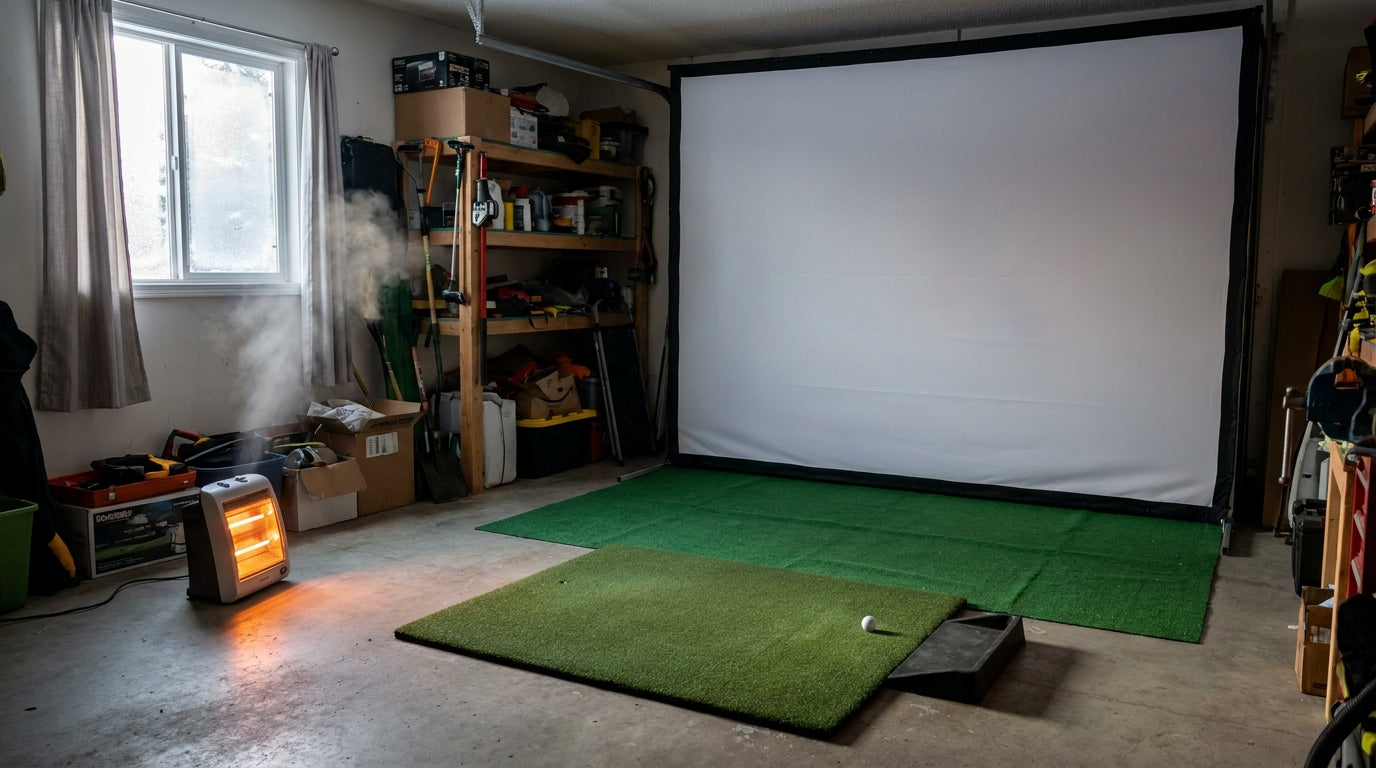
Here's the number that should make every garage golfer pause: polyester's notched impact strength measurably drops as the temperature falls toward and below freezing (Source: ASTM D256 impact testing; USPTO polyester composition patents). Translation — the exact same screen that shrugs off a 120 mph driver in July gets noticeably more brittle in January. And a garage hovering around 30°F isn't a hypothetical. It's where most DIY sims actually live.
So the worry is real, but it's also widely misunderstood. Cold alone rarely destroys a screen. What actually gets people is hitting a frozen screen before it's acclimated, plus a moisture threat almost nobody plans for. Let's break down the materials science, the real risk, and exactly how to get your screen through winter intact.
What Cold Actually Does to Impact Screen Material
A quality polyester impact screen fabric weighs around 9 oz/sq yd, with a tensile strength near 450 PSI and tear strength around 80 Newtons (Source: Canvas ETC – Golf Impact Screen Durability guide). Those specs are why a properly woven screen survives thousands of strikes. The catch is that they're measured at room temperature.
Building one now? Carl’s Place Premium impact screen — from $440.
Polyester has what materials engineers call a ductile-to-brittle transition. Specialty formulations can push that transition below 0°C, but impact strength still drops measurably as you approach freezing (Source: ASTM D256 impact testing; USPTO polyester composition patents). The fabric loses elasticity. It gets stiffer. And a stiffer screen flexes less on contact, so more of the strike energy goes into the weave instead of being absorbed.
That matters because a golf ball strike delivers roughly 500 to 2,000 Newtons depending on swing speed, while premium screens are rated for ball speeds of 200–250 mph (Source: Canvas ETC; MMI Textiles / Jason Mills). In the cold, that same force hits a more brittle surface — and your margin against a tear shrinks.
The Real Villain Isn't Cold. It's Condensation.
Ask actual garage users and the story shifts. Real-world owners report processors and electronics glitching around 30°F until internal heat warms them up — and they warn that warm-to-cold cycling on humid days causes condensation on the screen and inside the hardware (Source: Golf Simulator Forum winter garage threads).
That's the part people miss. Dry cold is annoying. Damp cold is what does damage. When a freezing screen meets warmer humid air — say you crank a space heater fast, or open the garage on a mild wet afternoon — moisture condenses right onto the fabric and your electronics. Over a season that means staining, mildew risk, and corrosion on connectors.
If you're already battling moisture and sag, our impact screen wrinkle fix tips are worth a read, because cold fabric plus damp tension is a recipe for ripples.
What the Data Says
Let's put real numbers on why weave and care matter so much in an unheated space.
First, weave density is king. Bumping a screen from 150 TPI to 200 TPI — same material, same thickness — yields about a 25% increase in lifespan (Source: Canvas ETC – Golf Impact Screen Durability guide). A tighter weave spreads impact force across more threads, which is exactly the cushion you want when the fabric is stiff and cold.
Second, screens age from more than swings. Simulated UV testing showed a 15% reduction in polyester tensile strength after 500 hours of exposure (Source: Smith et al., 2018, cited by Canvas ETC). A garage screen catching window sunlight all summer walks into winter already weakened, then gets hit with cold brittleness on top.
Third, the stakes are financial. Replacement screens run roughly $200–$500 for budget netting, $500–$1,500 for mid-range multi-layer, and $1,500–$5,000+ for premium and commercial Kevlar builds (Source: Big Horn Golfer price guide; Elite Sim Golf). A little winter care protects real money.
Golf Impact Screen Replacement Cost by Tier
Source: Big Horn Golfer 2024 price guide & Elite Sim Golf (midpoints of published ranges)
Which Screen Survives a Cold Garage Best?
Not all screens handle winter the same way. Budget single-layer netting stiffens the most and carries the highest tear risk when cold. Premium multi-layer and warp-knit builds are far more forgiving — though none of them are immune to condensation. Here's how the tiers stack up.
Impact Screen Specs & Cold-Garage Durability Factors by Tier
Swipe to compare →
| Tier | Typical thickness / weave | Rated ball speed | Cold-garage durability note |
|---|---|---|---|
| Budget netting / single-layer | ~1–2mm, lower TPI | Up to ~200 mph | Stiffens most in cold; highest tear risk — acclimate before hitting |
| Mid-range multi-layer polyester | 2mm, ~200 TPI | Up to ~225 mph | Tighter weave adds ~25% lifespan; moderate cold tolerance |
| Premium 3-layer / warp-knit | 3–4.5mm, 3-layer | Up to ~250 mph | Most resilient to cold and indentation; still vulnerable to condensation |
| All tiers (cold-weather risk) | Polyester ductile-brittle shift | N/A | Impact strength drops near/below 0°C; condensation is the main moisture threat |
If you're shopping the tiers in general, our screen material durability comparison breaks down which build survives your swing speed before cold even enters the equation.
How to Make Your Screen Survive Winter
Acclimate before you swing
This is the single biggest one. Don't walk into a 28°F garage and rip a driver into a frozen screen. Warm the space gradually for 20–30 minutes first, letting the fabric come up toward a workable temperature. A cold screen that's eased back to flexible is dramatically safer than one hit while stiff.
Manage moisture, not just temperature
Run a small dehumidifier in the bay, and avoid blasting a heater to full heat in seconds on a humid day — that fast warm-cold swing is what fogs your screen and electronics. Steady, gentle warming beats a thermal shock every time.
Store smart in the off-stretch
If you go weeks without playing, keep the screen tensioned correctly rather than slack and folded, since creases set harder in the cold. Getting tension dialed matters year-round — our tensioning system guide covers exactly how to get it right so winter sag doesn't sneak up on you.
The Bottom Line on Cold Garage Durability
A quality polyester impact screen will absolutely survive an unheated garage — the material is tougher than the panic suggests. What kills screens isn't the thermometer reading. It's swinging into stiff, unacclimated fabric, and letting condensation quietly work on the weave all season.
Acclimate first. Control the moisture. Buy a tighter weave if you're starting fresh. Do those three things and your screen shrugs off winter like it shrugs off a 110 mph 7-iron.
Building a garage sim that needs to take the cold and keep performing? Browse our impact screen collection to find a tightly woven, multi-layer build engineered to handle real winter use — not just a fair-weather range day.
Related reading: Best Golf Simulator for Winter Practice Indoors: What Actually Works When It's Cold


Not sure which simulator fits your room?
The two-minute Simulator Finder Quiz checks your space and budget against every system we carry.

Keep Reading
Related guides

golf simulatorGolf Simulator Enclosure Lighting Plan: Where to Mount Fixtures So They Never Wash Out Your Screen

golf simulatorGolf Simulator Basement Conversion Checklist: The 7 Steps to Run Before You Buy Anything

DIY golf simulatorGolf Simulator Garage Build Cost Breakdown: Every Line Item at Three Budget Tiers