
golf simulator
Golf Simulator Impact Screen Weight Capacity Guide: The Structural Numbers Every Builder Needs
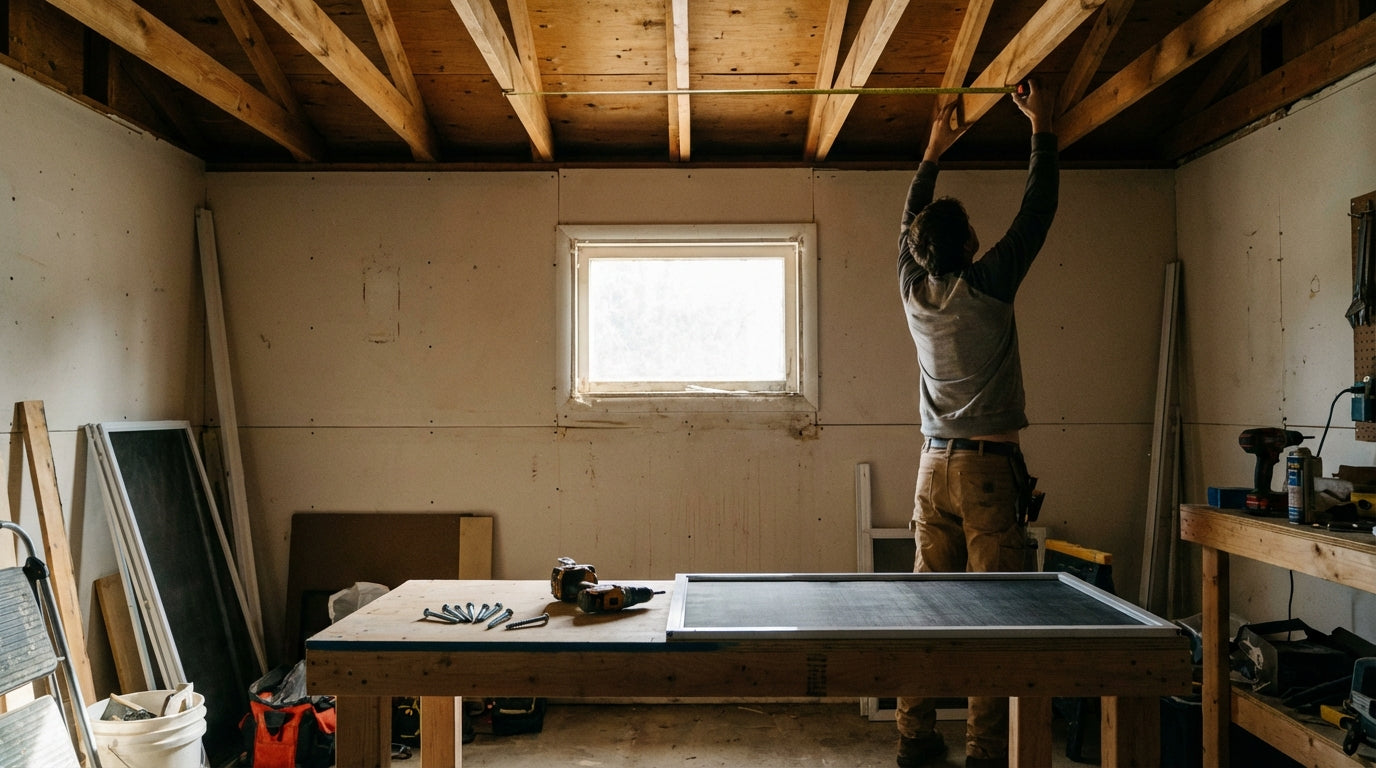
Most golfers planning a home sim spend hours on screen material and projector specs. Barely anyone checks whether their ceiling joists or wall studs can actually hold the assembly. That oversight turns a clean install into a drywall repair job.
Here's the number that should stop you cold: standard residential ceiling joists (2×6 at 16" OC) are engineered for a combined live and dead load of roughly 20–30 psf. (Source: SteelSolver.com) A golf simulator frame assembly — screen fabric, pipe frame, mounting brackets, and tensioning hardware — concentrated across a small ceiling area can approach that limit fast, especially if your anchor points miss the structural framing entirely and catch only drywall. One bad overhead anchor and you're not swinging a club. You're calling a contractor.
This guide gives you the actual weight ranges for common impact screen materials, what your frame pipe can safely span before it sags, and the structural numbers you need to verify before anything gets drilled.
How Much Does an Impact Screen Actually Weigh?
Fabric Weight by Material Grade
Impact screen fabric is measured in ounces per square yard, and the range is wider than most builders expect. Standard single-layer polyester runs 8.7–10 oz per square yard. Premium three-layer spacer materials top out at 13.85–14.04 oz per square yard. (Source: MMI Textiles / FabricUK golf simulator materials catalog)
For a standard 10×10 ft screen — roughly 11 square yards — that translates to a finished fabric weight of about 6–7 lbs at the entry level and 9–11 lbs for a premium three-layer build. Before you account for frame pipe, connectors, or attachment hardware.
Why Total Assembly Weight Is What Actually Matters
The screen fabric is light. The issue is the complete assembly load. A 10-ft wide EMT frame with connectors, carabiners, and a tensioned screen can reach 25–40 lbs total. Every anchor point shares that load. If you're running ceiling-mounted eye bolts, each one needs to thread into structural framing — not just drywall — or you're relying on fastener geometry that isn't designed for sustained overhead static load.
For a breakdown of how different attachment hardware distributes load across the frame, the impact screen attachment system guide ranks every mounting method and explains which works for which setup.
Frame Material: What Can Span Your Bay Without Sagging?
Frame pipe is where a lot of DIY builds quietly go wrong. PVC is cheap, easy to cut, and easy to source. But it has a hard structural limit: PVC Schedule 40 at 1.5" diameter starts to deflect visibly on unsupported horizontal runs over 6–8 feet. (Source: Golf Simulator Forum community build data) That sag drops the top frame bar directly into the impact zone — reducing screen tension and accelerating wear on the upper edge where the ball hits most.
For anything over 9 ft wide, you need a different material. EMT conduit at 3/4" handles spans up to 10 ft cleanly. Step up to 1" EMT and you're solid to 12 ft. For the widest bays or maximum rigidity across the top bar, 1.5" steel square tube can span 16 ft without intermediate support.
The cost gap between PVC and EMT is modest: a complete DIY EMT conduit frame runs $200–$380 in materials versus $80–$150 for an equivalent PVC build. (Source: HomePerformanceLab.com / Golf Simulator Forum) For a bay spanning 10–12 ft, the extra $100–$200 buys substantially better rigidity and a screen that stays tensioned where you set it. Our DIY frame build guide — PVC vs. Lumber vs. EMT covers the full material tradeoffs if you're still deciding.
Max Unsupported Horizontal Span Before Deflection by Frame Pipe Material
Source: Golf Simulator Forum community builds + material deflection properties (comparative estimates for guidance)
Ceiling and Wall Mounting: The Load Numbers That Matter
Ceiling Joists
Standard residential 2×6 ceiling joists at 16" OC are engineered for a combined load of roughly 20–30 psf. (Source: SteelSolver.com) Step up to 2×8 joists and that capacity jumps to approximately 60 psf total — about 600 lbs per linear foot on a 10-ft span. (Source: JustAnswer Structural Engineering / SteelSolver Ceiling Joist Span Chart)
The practical takeaway is simple: every overhead anchor must thread directly into a joist. Drywall anchors are not structural for this application. A simulator frame that feels solid with toggle bolts can fail progressively under the repeated vibration of swing after swing. Find the joists, confirm with a finish nail if needed, and drill into framing every time.
Wall Studs and Lag Bolt Sizing
For wall-mounted frame brackets, lag bolt diameter is your critical variable. A 5/16" lag screw provides over 100 lbs of pullout resistance per inch of thread embedment in wood. A 3/8" lag screw exceeds 200 lbs per inch of embedment. (Source: EngineeringExpress.com) Three inches of embedment with a 3/8" lag gives you roughly 600 lbs of pullout capacity before failure — well above what any static screen load requires.
Use 3/8" lags as your standard for wall brackets. Drive them at least 2.5–3 inches into actual stud material — not just drywall depth — and you're structurally covered for any screen assembly weight. For bracket positioning strategy and how to prevent the lateral frame shift that builds up over thousands of swings, the impact screen frame anchoring tips post covers the full approach.
By the Numbers: Structural Data for Simulator Builders
- 6–11 lbs: Finished weight range for a standard 10×10 ft impact screen — from single-layer entry-level polyester to premium three-layer spacer material. (Source: MMI Textiles / FabricUK)
- 20–30 psf: Combined load capacity of standard residential 2×6 ceiling joists at 16" OC. Simulator frame assemblies can approach this limit if weight is concentrated at only a few anchor points instead of distributed across multiple joists. (Source: SteelSolver.com)
- ~600 lbs pullout: Capacity of a single 3/8" lag screw with 3 inches of wood stud embedment — the structural benchmark for wall-mounted frame brackets in simulator bays. (Source: EngineeringExpress.com)
- 6–8 ft: The max unsupported horizontal span for PVC Schedule 40 at 1.5" before visible sag occurs on the top frame bar. Anything wider needs EMT or steel. (Source: Golf Simulator Forum)
Impact Screen Materials: Weight and Load Comparison
Golf Simulator Impact Screen Materials Comparison
Swipe to compare →
| Material Type | Fabric Weight | 10×10 Screen Weight | Ball Speed Rating | Layers | Cost |
|---|---|---|---|---|---|
| Standard Single-Layer Polyester | 8.7–10 oz/sq yd | ~6–7 lbs | Up to 200 mph | 1 | $ |
| Mid-Grade Poly Blend | 12.26–12.59 oz/sq yd | ~8–9 lbs | Up to 225 mph | 1–2 | $$ |
| Premium Poly Spacer (3-layer) | 13.85–14.04 oz/sq yd | ~9–11 lbs | Up to 250 mph | 3 | $$$ |
| Nylon/Hybrid (2-layer w/ cushion) | ~12–13 oz/sq yd (est.) | ~8–10 lbs | Up to 250 mph | 2 | $$$ |
If you're comparing material tiers beyond just weight, the screen material durability comparison covers long-term wear performance and which tier actually survives heavy daily use.
The Pre-Drill Checklist: 5 Things to Verify Before You Mount
- Locate every joist and stud — Use a quality stud finder, then confirm with a finish nail before drilling overhead. Drywall anchors are not rated for sustained overhead structural loads.
- Know your joist size — 2×6 and 2×8 joists have very different load capacities. Check attic or basement access to confirm your actual framing before loading any ceiling anchor.
- Use the right lag bolts — 3/8" diameter minimum for wall frame brackets, driven at least 2.5–3" into actual stud material. Drywall depth doesn't count toward embedment.
- Match frame pipe to your bay width — PVC for bays under 9 ft, 1" EMT for 9–12 ft, steel square tube for anything wider or when extra rigidity across the top bar matters.
- Calculate total assembly weight before anchoring — Screen fabric + frame pipe + connectors + hardware. A 10-ft wide premium screen assembly can hit 35–45 lbs. Know the number before you choose anchor spacing and count.
Find the Right Screen for Your Frame
Once the structure is sorted, the screen is the whole point. Carl's Place impact screens are built for standard DIY bay dimensions, rated for real ball speeds, and engineered on materials that hold up to daily use without sagging or prematurely wearing. Browse the full lineup and match the right screen to your frame size.
Not sure which simulator fits your room?
The two-minute Simulator Finder Quiz checks your space and budget against every system we carry.


Keep Reading
Related guides

enclosure sizingGolf Impact Screen for Tall Golfers: The Height-Based Sizing Guide Nobody Publishes

buying guideHow to Choose the Right Golf Impact Screen (And Why It Matters More Than Your Launch Monitor)

ball containmentGolf Impact Screen vs Curtain Enclosure Sides: Which Panels Actually Need Screen Material?