
golf simulator
Golf Simulator Impact Screen Side Flaps: What They Actually Do (and When You Need Them)
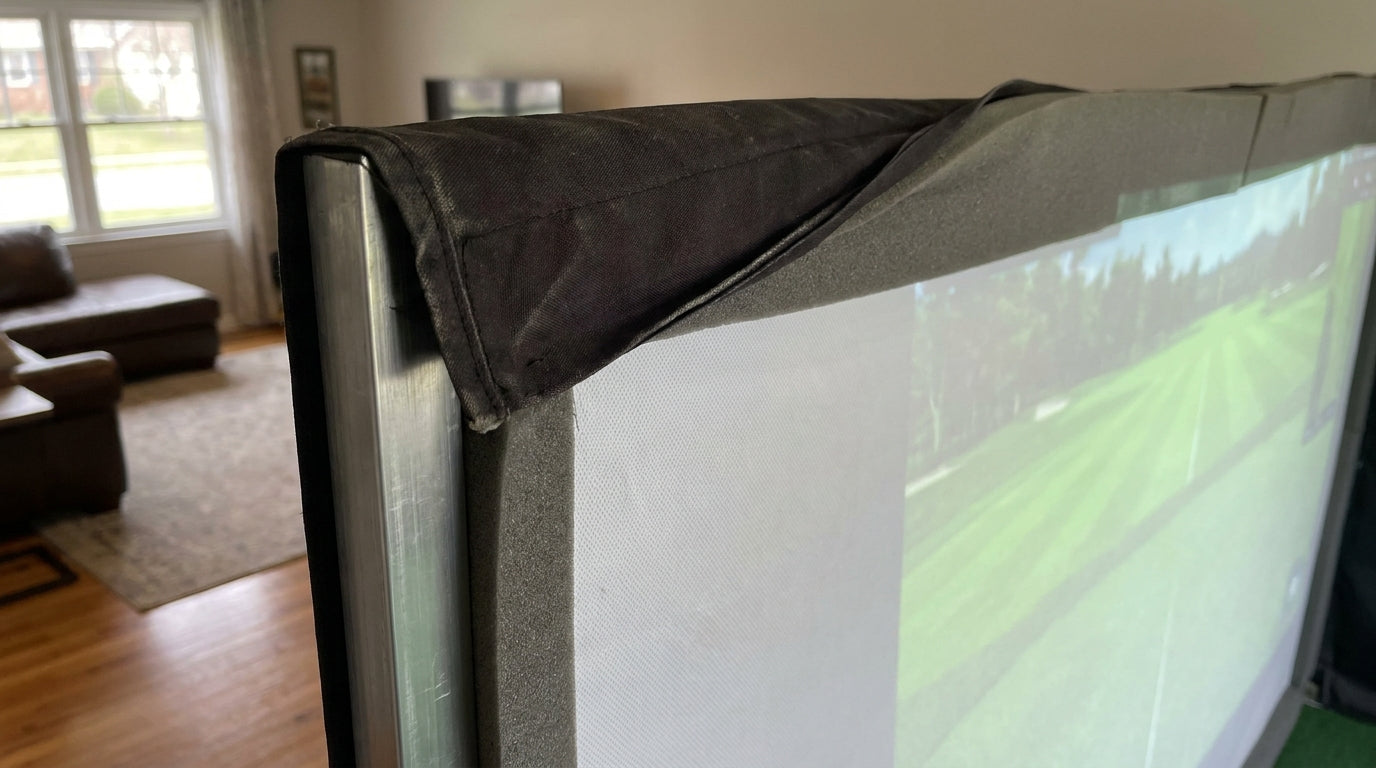
Here's something most golf simulator builders learn the hard way: the most important upgrade on your impact screen might be the part that isn't even the screen. Golf simulator impact screen side flaps are a cheap add-on most people skip — right up until a shanked wedge finds the bare metal frame.
And the data backs up the worry. Side misses — not raw ball speed — are described as the number one cause of property damage in home simulator builds. (Source: Home Performance Lab, Golf Simulator Space Requirements, 2026)
Toe hooks and shanks sail right past the edge of the screen, and steep wedge mishits catch the side of the enclosure at full speed. So why do so many people obsess over screen material and ignore the four inches of exposed frame around it? Let's fix that.
What Golf Simulator Impact Screen Side Flaps Actually Are
On a Carl's Place screen, the "Classic with Flaps" finish adds 7-inch nylon flaps edged with a 1-inch strip of loop fasteners running all the way around the screen. (Source: Carl's Place, Premium Golf Impact Screens product spec)
Ready to shop impact screens?
Browse the full Carl's Place lineup — every screen ships ready to mount with real size specs.
Shop Carl's Place Impact Screens →Those flaps fold back and cover your enclosure frame instead of leaving it bare. Better still, they create pockets you can slide foam safety cushions into — so the frame edge is wrapped, hidden, and padded all at once.
Compare that to the plain Classic finish, which uses only 2.5-inch black vinyl edging with grommets and leaves the metal frame exposed at the perimeter. (Source: Carl's Place finishing options spec) That exposed strip is where most of the trouble starts.
The Three Problems Side Flaps Solve
1. Catching the shots that miss the screen entirely
Your screen handles dead-center strikes all day. It's the off-center stuff that's scary. A bad toe hook or a full shank doesn't hit the screen — it goes around it, toward the frame, the wall, or whatever's behind your bay.
The flaps extend coverage past the screen's printed area, giving those stray balls something soft to hit instead of bare aluminum or drywall.
2. Sealing the light bleed around the frame
That perimeter gap doesn't just let balls through — it lets light leak around the edges, washing out your image and killing contrast. The flaps wrap and hide the frame edge, closing the gap the same way a proper blackout layer does behind the screen.
If light bleed is already driving you crazy, pair flaps with a blackout backing — we break that down in our guide to how a black backing layer kills light bleed.
3. Protecting the frame (and the wall behind it)
Average driver ball speed runs 130–170 mph, and entry-level impact screens are rated for ball speeds up to 250 mph — energy that an off-center shot can carry straight into an unprotected metal frame. (Source: Up Your Club Driver Ball Speed Chart & Canvas ETC Impact Screen Materials Guide)
The flap pockets hold foam safety cushions against that frame so the impact gets absorbed instead of denting your enclosure or cracking the wall. Recommended side-wall padding is 3 lb memory foam at a minimum 2-inch thickness. (Source: Home Performance Lab, 2026) The flaps are what keep that foam in place.
What the Data Says
Here's the part that surprises people: flaps are cheap insurance. Upgrading the Carl's Place Preferred screen to the Classic-with-Flaps finish carries just a $56 upcharge, versus $26 for a loop-fastener-only edge and $0 for the base Classic finish. (Source: Big Horn Golfer / Carl's Place product listings)
Now weigh that against a 14–15 ft enclosure room width — the practical side clearance recommended to give off-center shots somewhere to go before they reach a wall. (Source: Home Performance Lab, 2026) Not everyone has that much room, which makes perimeter protection more important, not less.
And screen prices climb fast as you move up tiers, so protecting the investment matters:
Carl's Place Impact Screen Price by Tier (base, before finish upgrades)
Source: Carl's Place pricing via Big Horn Golfer & Canvas ETC materials guide (high-end range $1,500+)
A $56 flap upgrade on a $400–$600 screen is a rounding error compared to one trip to the hardware store to patch a punched wall.
Classic vs. Classic With Flaps, Side by Side
If you're staring at the two finish options and can't tell what you're actually paying for, here's the plain-English breakdown:
Classic Finish vs. Classic with Flaps — What Each Solves
Swipe to compare →
| Feature | Classic Finish | Classic with Flaps |
|---|---|---|
| Edge construction | 2.5" vinyl edging + grommets | 7" nylon flaps + 1" loop fastener strip |
| Catches off-center / shanked shots past screen edge | No extra coverage | Flaps extend coverage around perimeter |
| Seals light bleed around frame | Frame gap left exposed | Flaps wrap and hide the frame edge |
| Holds foam safety cushions on frame | Not supported | Cushions insert into flap pockets (sold separately) |
| Typical upcharge (Preferred tier) | $0 (base) | +$56 |
When You Actually Need Side Flaps
Flaps aren't mandatory for everyone. If you've got a wide, dedicated room with soft walls and you rarely miss the screen, the plain Classic finish is fine. Save the $56.
But you should strongly consider flaps if any of these sound like you:
Your bay is tight — under that 14–15 ft comfort width — so a side miss has nowhere to go but the wall. You're a higher-handicap player or still grooving a swing, which means more shanks and toe hooks. Or your screen sits in a finished room where a dented frame or scuffed drywall is a real problem.
Your frame matters here too. A flimsy frame takes off-center hits worse than a rigid one — we cover that trade-off in steel vs. PVC frame material. And if you're fuzzy on what your screen can survive in the first place, start with our breakdown of what a ball speed rating actually means.
The Bottom Line
Side flaps don't make your screen hit better or look sharper. They do something more boring and more valuable: they keep your worst swings from costing you money.
For roughly the price of a sleeve and a half of premium balls, you wrap your frame, seal the light gap, and get a pocket for real foam padding. On a build you've spent hundreds or thousands on, that's the easiest yes on the spec sheet.
Ready to spec yours out? Browse our impact screens collection and choose the finish that matches how — and where — you actually swing.


Not sure which simulator fits your room?
The two-minute Simulator Finder Quiz checks your space and budget against every system we carry.

Keep Reading
Related guides

golf simulatorGolf Simulator Hitting Mat Sizing Guide: Exact Dimensions for 10x12, 12x15, and 16x18 Rooms

golf simulatorGolf Simulator Enclosure Cost to Build: Every Line Item, DIY vs Pre-Made (2026 Numbers)

golf simulatorGolf Simulator Room Electrical Plan: Where Every Outlet Goes Before the Frame Closes Up