
ceiling mount setup
Golf Simulator Impact Screen Ceiling Mount Setup: How to Hang From Joists When There's No Wall
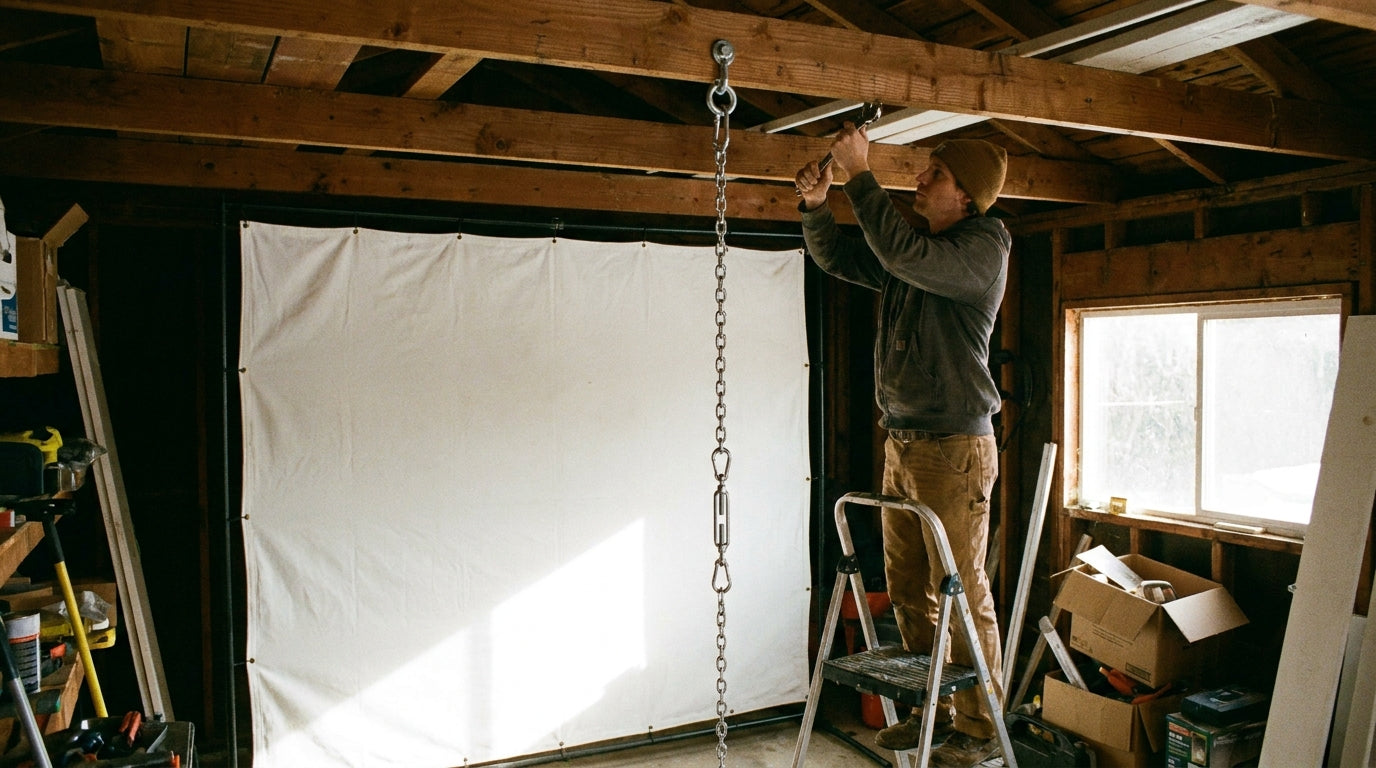
Here's the number that sends most sim builders scrambling: the average U.S. garage ceiling is only about 8.6 feet tall (Source: Houzz survey of U.S. homeowners, via PlayBetter). That's a full foot under the 9–10 feet most simulators actually need for a clean driver swing. So when there's no back wall to bolt to and no vertical room to spare, you stop fighting the ceiling and start hanging from it.
A golf simulator impact screen ceiling mount setup lets you suspend the whole screen from your joists, reclaiming every usable inch and skipping bulky floor frames entirely. Done right, it's rock solid. Done wrong, it sags, swings, and rattles your teeth on every strike. Let's do it right.
Why Hang the Screen From the Ceiling at All?
Two reasons. First, space — as the garage numbers above show, hanging hardware is thinner than a steel or PVC frame footprint, so you claw back height and depth. Second, some rooms simply have no wall where the screen needs to live, like an open basement bay or a garage with a door behind the hitting zone.
Ready to shop impact screens?
Browse the full Carl's Place lineup — every screen ships ready to mount with real size specs.
Shop Carl's Place Impact Screens →The good news is the physics are forgiving. Major screens from brands like Carl's Place, SIGPRO, and OptiShot are rated to survive ball speeds of 250 MPH or higher without tearing (Source: GolfingSim / Impact Screen Ball Speed Rating guide). Meanwhile PGA Tour ball speed averages around 175 MPH, and most amateurs live in the 130–150 MPH range (Source: GolfingSim, citing PGA Tour data). Your screen isn't going to blow through. On a hanging setup, sag and swing are the real enemies — not the golf ball.
Step 1: Find and Load Your Joists Correctly
Your entire ceiling mount lives or dies on the joists. Use a quality stud finder to locate them, then confirm by driving a small test hole — you want solid wood, not just drywall and hope.
Once located, the numbers make load planning easy. A typical 1/4-inch lag screw driven into solid wood joists offers shear strength exceeding 150 lbs per fastener, with at least 1.5 inches of thread engagement recommended (Source: Canvas ETC — How To Install Hanging Golf Impact Screen). Multiply that across four to six anchor points and you have a wide safety margin over the couple hundred pounds a screen-and-frame assembly weighs.
Always drill pilot holes, and always drive into the meat of the joist, not the edge where it can split. If you're layering this onto an existing frame, our frame anchoring tips cover how to stop the whole rig from creeping after your first swing.
Step 2: Choose Eye Bolts, Chain, and Turnbuckles
This is where you overbuild on purpose. One documented DIY ceiling build used eye bolts rated for 2,400 lbs lag-bolted into roof trusses to suspend a frame, turf, and screen weighing roughly 300 lbs total (Source: Gungho Golf DIY Impact Screen Enclosure build log). That's about an 8x safety factor — exactly the kind of margin pros aim for on anything overhead.
Your hardware stack, top to bottom:
- Eye bolts / lag eye screws into the joists (rated well beyond your total load)
- Chain to bridge the gap from ceiling to screen top
- Turnbuckles to fine-tune each anchor and pull the top edge dead level
Chain plus turnbuckles is the winning combo because it's adjustable. You'll never get every anchor at the perfect height on the first try — the turnbuckle lets you correct that without re-drilling anything.
Step 3: Nail the Drop Distance and Tension
Drop distance is the length of chain that gets your screen top down to the right height while the bottom still clears the floor. Get it wrong and you either drag the screen on the ground or leave a swinging gap.
Leave a 2–3 inch gap on each side of the screen (Golfbays recommends 5–7.5 cm) so bungees have room to pull it taut, and tension it "smooth and slightly loose, not drum tight" (Source: Golfbays Impact Screen FAQs / Gungho Golf). A screen pulled drum-tight actually rebounds balls harder and stresses the grommets. A little give absorbs the strike.
For the exact top-edge height math that keeps your image square and your swing safe, pair this with our installation height guide, and if you're squeezing under a low ceiling, our low-ceiling basement guide covers sizing when height is the enemy.
What the Data Says
Ceiling installs are labor — you don't want to re-hang often. That's why screen durability matters more here than almost anywhere else. Entry-level screens typically last 20,000–50,000 ball strikes before visible wear, while a premium 3-layer screen like the SIGPRO Premier is rated for over 200,000 impacts (Source: GolfingSim impact screen durability guide). When the mounting work is this involved, the longer-lasting screen pays for itself.
Impact Screen Durability by Tier (ball strikes before visible wear)
Source: GolfingSim impact screen durability guide (mid-range value is an interpolated industry estimate)
Height is the other planning number. Match your ceiling to your swing before you buy a single eye bolt — here's the quick reference:
Recommended Ceiling Height & Overhead Clearance by Golfer Height
Swipe to compare →
| Golfer height | Recommended ceiling height | Notes |
|---|---|---|
| Under 6 ft | 9 ft minimum | Workable for most; leaves 6–12 in swing-arc buffer |
| 6 – 6.5 ft | 10 ft | Preferred standard for unrestricted driver swings |
| Over 6.5 ft | 11 ft | Needed to clear full swing arc without altering motion |
| Any (avg U.S. garage) | 8.6 ft actual | Below minimum — a key reason to ceiling-mount the screen |
Don't Cheap Out on the Screen Itself
You just spent an afternoon in the joists. The last thing you want is to tear it all down in six months because you bought the thinnest screen on the shelf. The durability spread above tells the whole story — a premium 3-layer screen outlasts an entry-level one by roughly 4x to 10x in ball strikes.
Before you commit, weigh the tiers against how often you actually play in our screen material durability comparison. For a mount this permanent, buy once.
The Bottom Line
A ceiling mount isn't harder than a wall build — it's just a different set of numbers. Load your joists with margin to spare, overbuild your eye bolts and chain, leave that 2–3 inch side gap, and tension smooth rather than drum-tight. Do that and your screen hangs dead level, dead quiet, and dead flat, swing after swing.
Ready to hang one? Start with a screen built to survive the effort — browse our impact screen collection and pick the tier that matches how hard you swing.


Not sure which simulator fits your room?
The two-minute Simulator Finder Quiz checks your space and budget against every system we carry.

Keep Reading
Related guides

golf simulatorGolf Simulator Enclosure Lighting Plan: Where to Mount Fixtures So They Never Wash Out Your Screen

golf simulatorGolf Simulator Basement Conversion Checklist: The 7 Steps to Run Before You Buy Anything

DIY golf simulatorGolf Simulator Garage Build Cost Breakdown: Every Line Item at Three Budget Tiers