
garage door
Golf Impact Screen Over a Garage Door: How to Hang One Without Trapping Your Car Inside
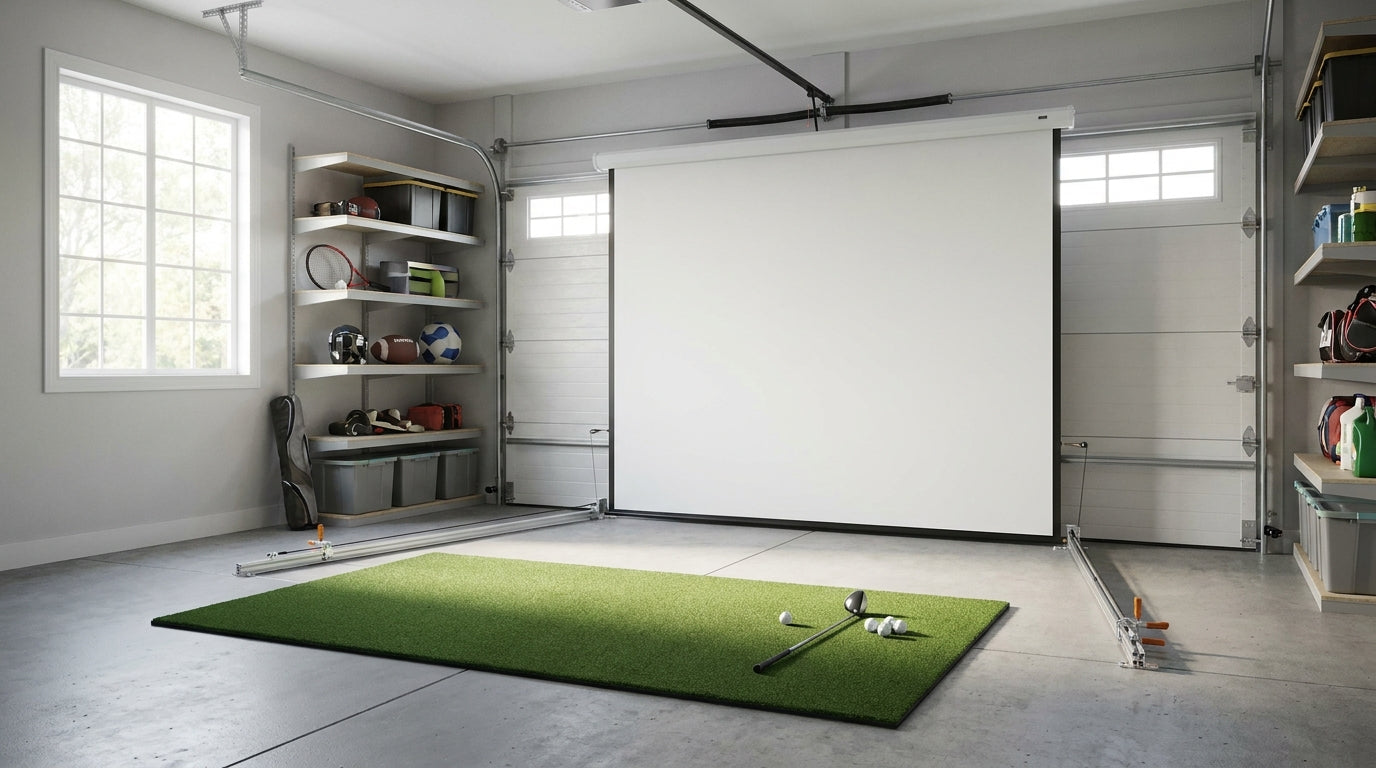
Here's the part nobody tells you: a purpose-built retractable screen that mounts in front of a working garage door runs from $1,999.99 up to $2,999.99 depending on size, and that price already includes the mounting assembly, the remote-controlled screen, and the side walls (Source: G-TRAK / Scratch Golf). That's not a cheap weekend project. But it solves a problem most garage golfers think is unsolvable — hitting into a screen without permanently giving up the one door your car drives through.
The good news is you don't always need the premium kit. The trick is understanding the clearances first. Get those wrong and your screen either pools on the floor or never reaches it. Let's break down exactly how to put a golf impact screen over garage door tracks without trapping your car inside.
Why the Garage Door Changes Everything
A normal sim room has a flat ceiling and four walls you can drill into. A garage gives you neither where it matters most. The hitting wall is the door — a 200-pound panel that needs to travel straight up on rails every time you want to pull a car in.
Ready to shop impact screens?
Browse the full Carl's Place lineup — every screen ships ready to mount with real size specs.
Shop Carl's Place Impact Screens →That means a fixed frame bolted across the opening is off the table unless you never plan to open the door again. You need a screen that either retracts out of the way or hangs far enough forward that the door can still rise behind it.
And here's the constraint that catches people: the door mechanism itself eats your ceiling. In most garages the door rails and opener drop 6 to 12 inches below the ceiling framing (Source: Home Performance Lab / PlayBetter). So when you measure for a screen, you measure to the lowest rail — not the bare ceiling. That's your real working height.
The Two Ways to Mount Over a Working Door
1. Retractable, clamped to the door tracks
The cleanest solution is a retractable screen that mounts to the door's own hardware. The G-TRAK system, for example, uses two patented brackets that clamp around the exterior of the garage door tracks and lock with a tension bolt, so the door still travels up and down underneath it. Telescoping aluminum drive tubes adjust to fit doors from 8 to 16 feet wide (Source: G-TRAK).
You drop the screen to play, roll it up when you need the door. No drilling into the ceiling, no permanent footprint.
2. Ceiling-hung, positioned forward of the door
If you'd rather build your own, hang a screen from the ceiling joists a few feet in front of the closed door. The door opens behind it. This is cheaper but demands a tensioning plan — a loose roll-up screen ripples and reads ball strikes poorly. If you go this route, read our impact screen tensioning system guide before you buy a single bungee.
The Clearance Window Nobody Mentions
Retractable garage screens are pickier about ceiling height than fixed frames. They perform best when ceiling height lands in a narrow 96"–103" (8' to 8'7") range; go outside that window and the screen either pools on the floor or fails to reach it (Source: G-TRAK installation specs).
That's because a moving screen needs to hang from a fixed roller and still touch the floor under tension. Too tall and it stops short. Too short and it bunches up. A fixed screen you can simply cut to size — a retractable one has to fit the geometry.
If your garage ceiling is genuinely low, the same sizing logic from our low-ceiling basement screen guide applies here too.
What the Data Says About Garage Depth
Height gets all the attention, but depth is what actually kills most garage builds. You can hang the prettiest screen in the world and still be unable to swing.
The minimum tee-to-screen distance is 10 feet, with 12 feet recommended for full shot tracking — which means a screen hung in front of the door still needs roughly that much room behind it for you to stand and swing (Source: Home Performance Lab). Most retractable golf screen setups call for a minimum 9' x 12' footprint and 9-foot ceilings to function at all, with 15 feet of depth ideal (Source: Bighorn Golfer / Indoor Golf Outlet).
A standard single-car garage is often around 20 feet deep. Subtract the screen position, the hitting zone, and a little safety buffer, and you can see why depth — not the door — is usually the real limit.
Garage Golf Simulator Space Requirements (Minimum Dimensions)
Source: Home Performance Lab — Golf Simulator Space Requirements (2026)
The Numbers, Side by Side
Before you buy anything, measure your garage against this. The minimum column is the floor — below it, the screen technically fits but the experience suffers. Aim for the recommended column if you can.
Garage Setup Dimensions: Minimum vs. Recommended vs. Ideal
Swipe to compare →
| Dimension | Minimum | Recommended | Ideal |
|---|---|---|---|
| Ceiling height | 9 ft | 10 ft | 10–11 ft |
| Room width | 10 ft | 12–14 ft | 14–16 ft |
| Room depth | 15 ft | 18 ft | 20 ft+ |
| Tee-to-screen distance | 10 ft | 12 ft | 12 ft+ |
Keeping Tension on a Screen That Has to Move
This is where DIY garage builds fall apart. A fixed screen stays taut forever. A screen that rolls up and down loses tension over time, and a loose screen wrinkles, ghosts the image, and lets balls deflect unpredictably.
Clamp-on systems like the G-TRAK keep tension because the telescoping tubes hold the screen rigid against the door tracks even as it moves. If you build your own ceiling-hung version, plan for a weighted bottom bar and bungee tensioning on all four sides — not just the top.
One more reality check for garage golfers: temperature swings. A screen that goes slack in summer heat and tight in winter cold ages faster, so if your garage isn't climate-controlled, read up on cold garage screen durability before committing.
The Renter-Friendly Reality
If you rent, or you simply don't want hardware clamped to your door, you can skip the door entirely and freestand a screen a few feet in front of it. The door opens behind the frame, the frame breaks down when you move out, and nothing touches the structure.
It costs you a little depth — the freestanding frame sits forward of the door — but it's the lowest-commitment path into garage golf. Either way, the screen material doing the work is the same impact-rated fabric a permanent build uses.
Bottom Line
A golf impact screen over a garage door is absolutely doable — you just have to respect three numbers before anything else: your true ceiling height under the door rails, your tee-to-screen depth, and the tension plan for a screen that has to move. Hit those and the door stays a door.
Whether you're clamping to the tracks or freestanding in front of them, it all starts with a screen built to take a flush driver. Browse our impact screens and match the material to your garage before you measure twice and cut once.
Related reading: Golf Impact Screen for a Two-Car Garage: How to Size, Center, and Hang One Across the Wide Bay


Not sure which simulator fits your room?
The two-minute Simulator Finder Quiz checks your space and budget against every system we carry.

Keep Reading
Related guides

golf simulatorGolf Simulator Hitting Mat Sizing Guide: Exact Dimensions for 10x12, 12x15, and 16x18 Rooms

golf simulatorGolf Simulator Enclosure Cost to Build: Every Line Item, DIY vs Pre-Made (2026 Numbers)

golf simulatorGolf Simulator Room Electrical Plan: Where Every Outlet Goes Before the Frame Closes Up