
golf simulator
Golf Impact Screen for Outdoor Patio Setup: Can It Actually Survive Outside?
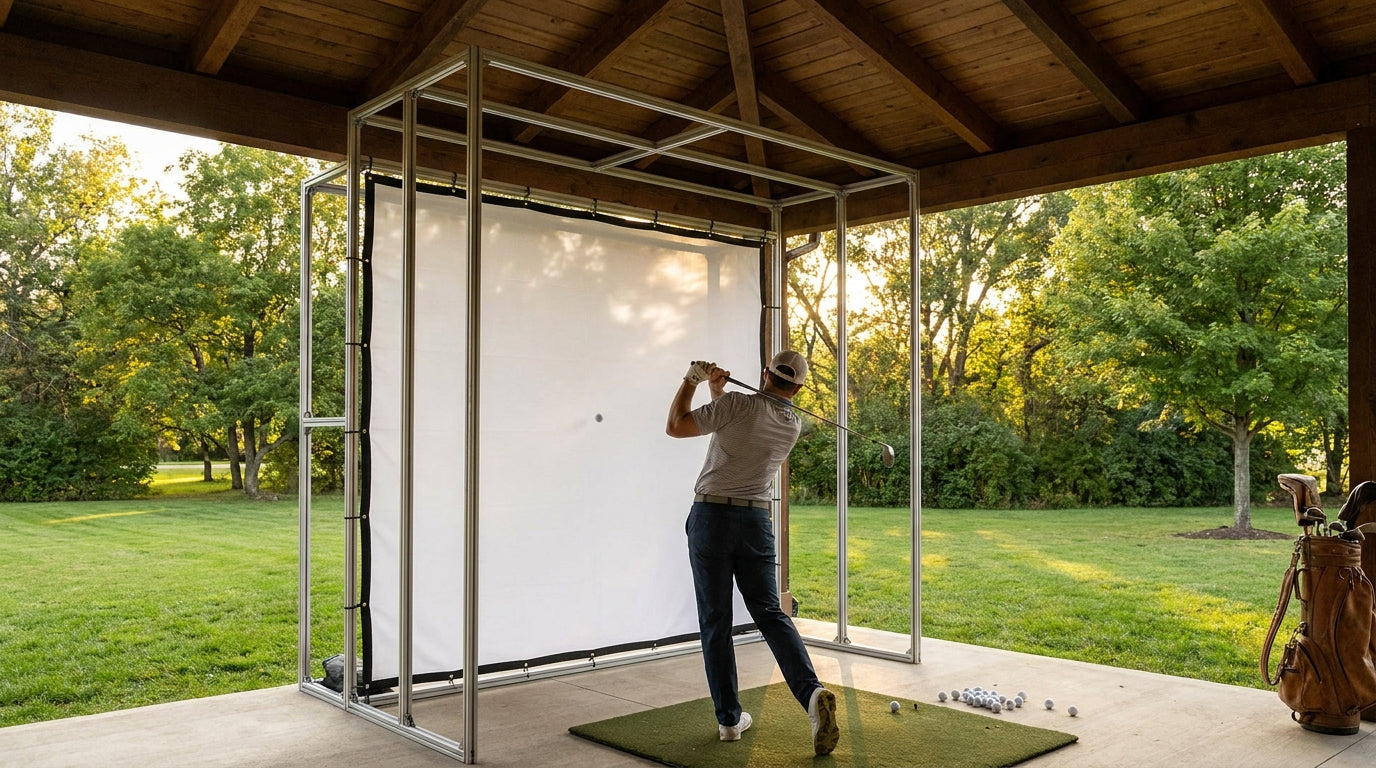
Here's a number that kills most backyard golf dreams before the first swing: an unanchored impact screen becomes essentially unusable in wind above 10 mph. (Source: Home Performance Lab, 'Best Outdoor Golf Simulator Setup (2026)') Not a storm. Not a 40 mph gust. A light breeze that barely nudges the flag on your putting green.
At that point the screen turns into a sail. It pulls off the velcro, deforms under impact, and flaps around like a wet bedsheet.
So can you actually run a golf impact screen for outdoor patio setup? Short answer: yes — but only if you respect what's really trying to destroy it. The fabric is the tough part. Everything around it is the problem.
Building one now? Carl’s Place Preferred impact screen — from $299.
The Screen Isn't Your Weak Point
Let's kill the biggest myth first. Most people assume an outdoor screen fails because golf balls punch through it. They don't.
Quality impact screens are built to absorb ball impacts exceeding 200 mph, and even hot outdoor drives commonly land in the surface around 150 mph. (Source: Canvas ETC & Home Performance Lab) The material can take your driver all day long.
What it can't take is the sky. Wind, UV, and moisture are what shorten a patio screen's life — not shot count. Specialized polyester-blend screens average a lifespan exceeding 10,000 impacts under typical use, but sun and moisture accelerate fading and degradation long before you ever reach that number. (Source: Canvas ETC, 'Golf Impact Screen Durability')
If you've read our take on cold garage durability, this is the same lesson turned up to eleven. Temperature swings are rough on a screen. Full weather exposure is worse.
What the Data Says: Weight Is Your First Filter
Outside, thickness and fabric weight matter more than they ever would in a finished basement. A heavier weave resists sag, handles tension better, and survives repeated impact when it's fighting the elements too.
Most impact screens run 1mm to 3mm thick and start around $175 for bare material. (Source: Canvas ETC & Home Performance Lab) But the meaningful spec for an outdoor bay is fabric weight — measured in ounces per square yard. Here's how the tiers stack up.
Golf Impact Screen Material Weight by Tier
Source: Canvas ETC / SIGPRO / Carl's Place material specs
For a covered patio, don't even look below the heavy-duty tier. That 12–18 oz range is where a screen has enough mass to hold tension and shrug off impact when it's also dealing with humidity and temperature swings.
The Five Things Trying to Kill Your Patio Screen
Every outdoor build fails at one of five points. Nail all five and the screen lasts. Miss one and you're shopping for a replacement by next season.
Outdoor/Patio Impact Screen Durability Factors: What to Look For
Swipe to compare →
| Risk Factor | Threshold / Spec | What to Look For |
|---|---|---|
| Wind | Unusable above ~10 mph unanchored | Walled + roofed bay, ground stakes, tension cables |
| UV fade | Degrades/yellows with sun exposure | UV-treated or UV-coated polyester (not untreated nylon) |
| Ball impact | Rated 200+ mph / 10,000+ impacts | 13–18 oz heavy-duty or 3-layer spacer polyester |
| Moisture/frame | Rust and mildew shorten life | Rust-resistant aluminum frame, quick-dry weave |
| Projection light | 107,527 lux day vs 5,100 lumen projector | Covered/shaded bay or switch to tablet/data display |
Notice how many of these point back to the same fix: build a real, walled, roofed bay. Wind, moisture, and projection all get solved by enclosing the space. Which brings us to the least obvious problem of all.
Covered Isn't Optional — Here's the Math
Even if your screen could survive open air, you still couldn't see the image. This is the part people forget.
A clear day delivers roughly 107,527 lux of ambient light, while premium projectors max out near 5,100 lumens. (Source: Home Performance Lab) That's not a close fight — daylight outguns your projector by a factor of twenty. Point a projector at an open-air screen at noon and you'll see a faint gray smudge, if anything at all.
So "covered" isn't just about protecting the fabric from rain and sun. It's the only way to get a usable picture. A roof and side walls give you the shade you need, plus the wind protection the screen demands. If daylight projection still won't work for your bay, a launch monitor paired with a tablet or laptop data readout is a legitimate fallback — you lose the big screen, but you keep the numbers.
Sealing up that bay creates its own headache, though: trapped moisture. Before you close in the space, read our guide on humidity and mold prevention — everything there applies double outdoors.
What Genuinely Outdoor-Rated Gear Looks Like
There's a real gap between a repurposed indoor screen and equipment actually engineered for the elements. The benchmark example: the Net Return Pro Series V2 is rated for 250,000 shots at ball speeds up to 225 mph, using UV-treated commercial polyester on a rust-resistant aluminum frame. (Source: Home Performance Lab / The Net Return)
Notice the two words that make it outdoor-capable: UV-treated and rust-resistant. That's the spec sheet you're hunting for. Untreated nylon and a raw steel frame will fade and corrode outside no matter how tough they feel indoors.
Budget accordingly. A full covered, outdoor-capable build lands somewhere between $5,944 and $8,144 once you factor in the enclosure, mounting, and weather-rated components. (Source: Canvas ETC & Home Performance Lab) That's a real project — closer to a small structure than a screen you tack to a wall.
And whatever you build, anchor it like your setup depends on it, because it does. Our frame anchoring tips matter even more outside, where wind is actively fighting your tension every day.
The Bottom Line
A golf impact screen for outdoor patio setup absolutely works — but only inside a covered, walled bay with a UV-treated, heavy-duty screen on a rust-resistant frame. The fabric was never the risk. Wind, sun, moisture, and daylight are.
Build the enclosure first, then hang the right screen. Do it in that order and you'll be hitting drivers in the backyard for years, not weeks.
Ready to spec a screen tough enough to live outside? Browse our impact screen collection and start with the heavy-duty weights — your patio build deserves the fabric that lasts.
Related reading: Golf Simulator Impact Screen Outdoor Setup Tips: What You Need to Know Before Taking Your Sim Outside


Not sure which simulator fits your room?
The two-minute Simulator Finder Quiz checks your space and budget against every system we carry.

Keep Reading
Related guides

golf simulatorGolf Simulator Enclosure Lighting Plan: Where to Mount Fixtures So They Never Wash Out Your Screen

golf simulatorGolf Simulator Basement Conversion Checklist: The 7 Steps to Run Before You Buy Anything

DIY golf simulatorGolf Simulator Garage Build Cost Breakdown: Every Line Item at Three Budget Tiers