
converting spare room to golf simulator
Converting a Spare Room to a Golf Simulator: The Complete Setup Guide
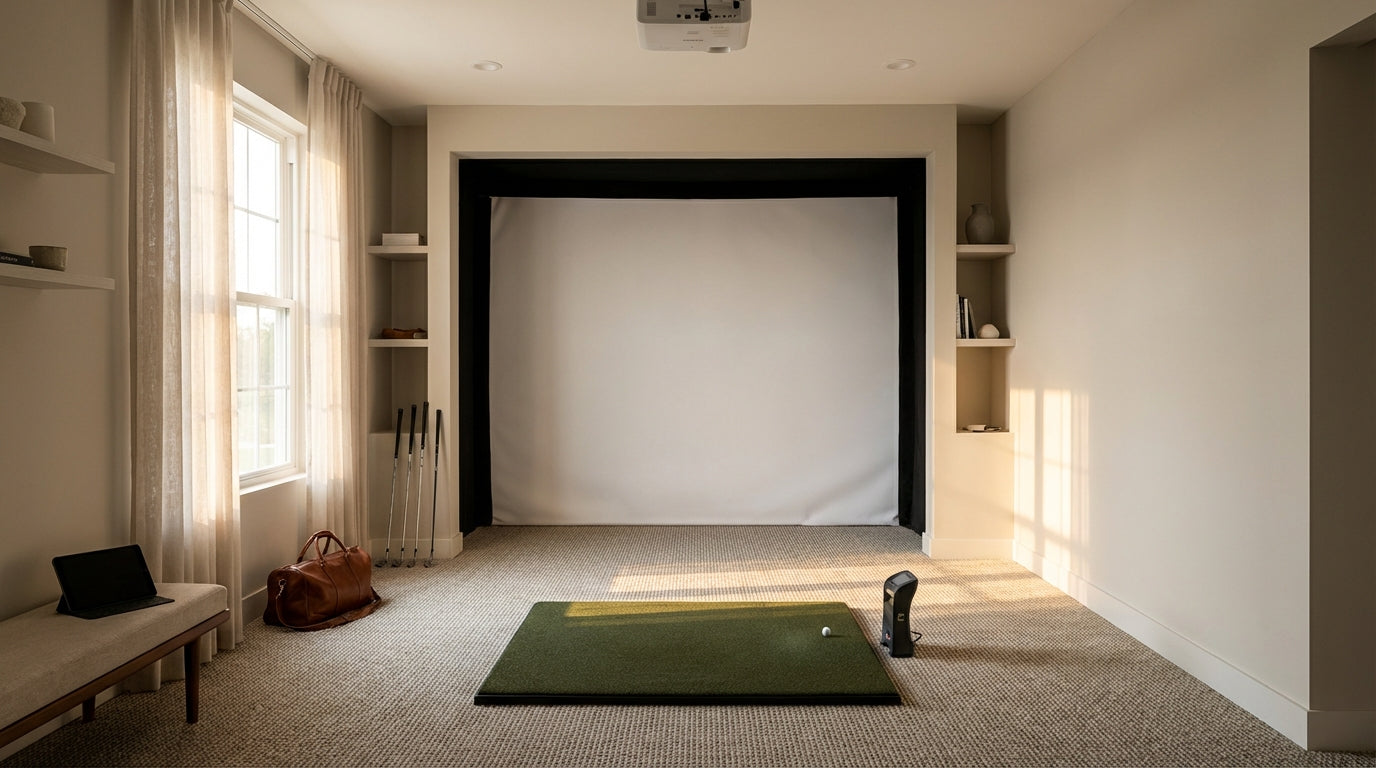
Here's the thing nobody tells you before you start clearing out the guest furniture: the standard 8-foot ceiling in most spare bedrooms is below the minimum recommended for a full, unrestricted golf swing. Take a proper backswing with a 7-iron in that room and you will hit ceiling before you hit ball. (Source: Indoor Golf Design / Rapsodo Ceiling Height Guide)
That one measurement changes everything — from the clubs you can swing, to the screen width that fits, to how you position your launch monitor. And yet, spare room simulator builds are surging, because a dedicated room offers something a garage or basement rarely can: year-round, climate-controlled, walk-in-and-play access. No warm-up time. No excuses. Just golf.
Here's what you actually need to know before you commit to the build.
Building one now? Carl’s Place Preferred impact screen — from $299.
Start Here: Measure Your Ceiling Before You Buy Anything
The rule is straightforward. You need 9 feet minimum for irons and wedges with a restricted swing, and 10 feet for a full, unrestricted swing with driver. (Source: Indoor Golf Design / Rapsodo Ceiling Height Guide)
Most spare bedrooms sit at 8 feet. That's not a dealbreaker — an iron-focused setup is a genuinely useful game-improvement tool, and approach shot practice is where most golfers drop the most strokes anyway. But go in with clear expectations. If you need to hit driver regularly, you're either hunting for a room with a higher ceiling or accepting real limitations upfront.
Before spending a dollar on equipment, read our ceiling height requirements guide — it breaks down exactly what each ceiling height allows and what it rules out.
Free tool — 30 seconds
Will a simulator fit your room?
Enter your room’s length, width, and ceiling height — the calculator tells you instantly what fits and exactly which screen size to order.
Check my room size →Room Dimensions: The Ranges That Actually Work
The ideal dedicated simulator room is 14 ft wide × 18 ft deep × 10 ft ceiling. The absolute minimum functional footprint is 10 ft wide × 13 ft deep × 8 ft ceiling. (Source: Indoor Golf Design / Rain or Shine Golf Room Size Guide)
Most spare bedrooms are 10–12 ft wide — right in the tight-but-workable zone. Depth matters just as much: you want at least 5 feet of clearance behind your hitting position and 8–10 feet from your stance to the screen. Measure both dimensions before you pick a screen size.
Sizing Your Screen for a Tighter Room
In a narrower spare room, you're likely looking at a 9 ft or 10 ft wide impact screen instead of the 12–14 ft setups common in spacious garages. That's completely fine — you still get a full-size projected image and room to swing. The goal is matching the screen to the room, not buying the biggest screen that exists. Our guide on selecting the right golf screen size for your simulator room walks through exactly how to measure and spec it out for tighter rectangular spaces.
Flooring: The Carpeted Room Problem (And the Fix)
Unlike a garage or basement with concrete, your spare bedroom almost certainly has carpet. That creates two specific challenges: you need a firm, stable surface under your hitting mat, and you need to protect the existing carpet from wear and mat movement.
The top-recommended solutions for carpeted spare rooms are carpet tiles placed over existing carpet and interlocking foam tiles — both create a stable platform, reduce ball-bounce noise, and protect the subfloor without any permanent modification. (Source: Carl's Place Golf Simulator Flooring Guide / Greatmats.com)
Do not drop your hitting mat directly onto soft carpet. The mat will sink and shift during your swing, which kills stance consistency and tears through carpet in months. See our full golf simulator room flooring guide for all the options with real cost comparisons.
Wall Protection: Don't Learn This the Expensive Way
Spare bedroom walls are standard drywall — and they don't handle errant golf shots well. A topped ball, a chunked chip, or even normal side netting movement can scuff, dent, or punch right through an unprotected wall. In a spare room with shared walls, this matters more than in a detached garage.
The standard protection setup: foam padding along the side walls adjacent to your screen frame, rubber wall protectors directly behind the screen, and side netting to catch any balls that miss the screen edges. Budget a few hundred dollars for protection materials — far cheaper than drywall repair, repainting, and the argument that follows.
Spare Room vs. Garage vs. Basement: An Honest Comparison
The spare room wins on convenience and climate control. The garage wins on ceiling height and swing freedom. The basement wins on light control and sound isolation. Here's how they actually compare across every factor that matters for a simulator build:
Spare Room vs. Garage vs. Basement: Simulator Space Comparison
Swipe to compare →
| Factor | Dedicated Spare Room | Garage | Basement |
|---|---|---|---|
| Typical ceiling height | 8–9 ft (limiting) | 9–12 ft (ideal) | 8–9 ft (limiting) |
| Temperature control | Built-in HVAC (excellent) | Requires add-on HVAC | Naturally stable (good) |
| Ambient light control | Blackout curtains needed | Hardest to darken | Naturally dark (best) |
| Sound isolation from home | Low (shared walls) | High (detached) | Moderate (underground) |
| Flooring surface | Carpet — needs hitting mat platform | Concrete — needs full turf | Concrete — needs turf/foam |
| Wall protection needs | High (drywall damage risk) | Moderate | Moderate |
| Typical setup cost premium | Base | +$1,000–$3,000 HVAC | +$500–$2,000 framing/egress |
| Best for | Convenience, year-round use | Space + swing freedom | Budget + light control |
By the Numbers: What the Data Actually Says
Home golf simulator builds aren't a niche hobby anymore. The market data backs that up:
- The global golf simulator market is projected to grow from $1.92 billion in 2025 to $4.7 billion by 2034, a CAGR of 10.1%. (Source: Fortune Business Insights / Polaris Market Research)
- North America holds 40.7% of global golf simulator market share in 2025 — the dominant regional segment, driven largely by residential room conversions. (Source: Straits Research)
- A well-executed home simulator installation can increase perceived home value by $10,000–$30,000 in golf-enthusiast communities, with homeowners recouping 30–60% of their investment on resale. (Source: IndoorGolfCaves.com)
- The minimum ceiling height for a full unrestricted swing — 9 to 10 feet — is above what most spare bedrooms provide, making ceiling clearance the single most critical spec to verify before purchasing anything. (Source: Indoor Golf Design / Rapsodo Ceiling Height Guide)
What Does a Spare Room Build Actually Cost?
Setup cost depends almost entirely on how serious your build gets. A budget spare room setup with an entry-level launch monitor and screen can run around $4,000. A mid-range dedicated room with a quality impact screen, enclosure, and solid launch monitor is closer to $15,000. High-end builds with premium screens, short-throw projectors, and top-tier simulation software run $30,000+. Full luxury custom installs hit $55,000.
Home Golf Simulator Setup Cost by Tier
Source: IndoorGolfCaves.com / Rain or Shine Golf / Virtual Tee Golf — 2026 cost guides
Ready to Build? Start With the Right Screen
The impact screen is the foundation of any simulator room — it determines image quality, ball absorption, and how every other component gets arranged around it. For a spare room build, that means choosing the right width for your narrower dimensions, the right material for your projector type, and the right edge finish for a clean install in tighter quarters.
Browse our full collection of impact screens built specifically for home room setups:
Planning the whole bay? Use Build Your Bay: pick your room size, screen and mat, and we match every part (enclosure, framing, back cover, hitting mat) and add it all to your cart in one click.


Not sure which simulator fits your room?
The two-minute Simulator Finder Quiz checks your space and budget against every system we carry.

Keep Reading
Related guides

golf simulatorGolf Simulator Enclosure Lighting Plan: Where to Mount Fixtures So They Never Wash Out Your Screen

golf simulatorGolf Simulator Basement Conversion Checklist: The 7 Steps to Run Before You Buy Anything

DIY golf simulatorGolf Simulator Garage Build Cost Breakdown: Every Line Item at Three Budget Tiers