
ceiling height requirements golf simulator home setup
Ceiling Height Requirements for a Golf Simulator Home Setup: The Numbers That Actually Matter
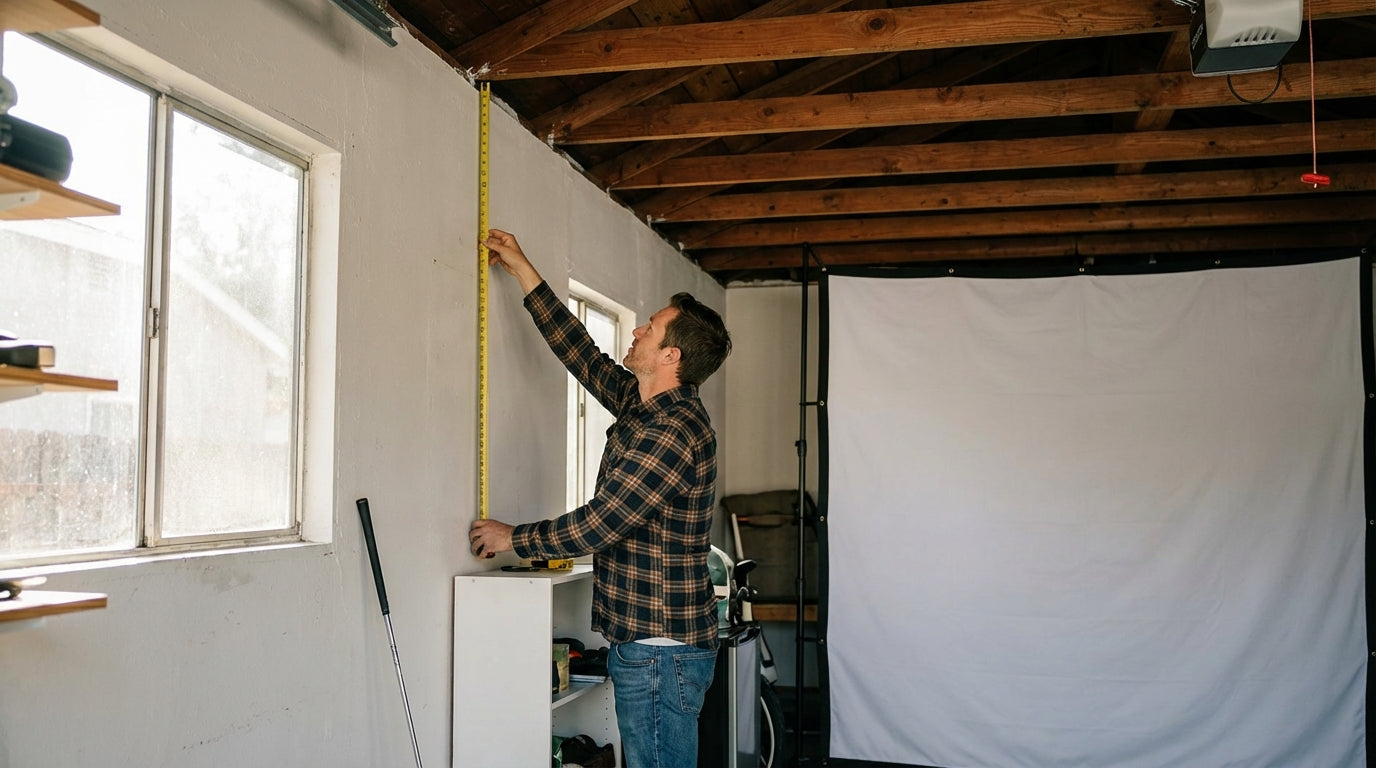
TrackMan — the gold standard in launch monitor data — puts the hard minimum ceiling height for a golf simulator at 10 feet. Not 9. Not 9.5. Ten feet. And their reasoning goes beyond physical clearance: they've documented that even the awareness of a low ceiling measurably changes your swing mechanics — club speed, attack angle, dynamic loft, all of it. (Source: TrackMan official blog — 'How Much Room for a Golf Simulator')
Your brain starts protecting you before you've ever touched the ceiling. That's the part most ceiling-height guides skip entirely.
Whether you're eyeing a garage, a spare bedroom, or a bonus room above the kitchen — here's the real breakdown. Numbers by club type, by your height, with no filler.
Why "10 Feet" Is Both Right and Incomplete
The 10-foot recommendation isn't wrong. But it assumes a full driver swing by an average-height golfer. Change either variable and the requirement shifts.
OptiShot lists 8.5 ft as its minimum ceiling clearance — the lowest stated minimum of any major golf simulator brand. (Source: OptiShot / Golfers Authority) But OptiShot runs a camera-based system, not radar. It doesn't need the overhead clearance that a radar-based launch monitor requires. The moment you move to a TrackMan, SkyTrak+, or Garmin R10, you're back to needing real headroom.
The actual minimum depends on three things: your launch monitor type, the clubs you plan to swing, and how tall you are. All three. Not just the ceiling number.
Free tool — 30 seconds
Will a simulator fit your room?
Enter your room’s length, width, and ceiling height — the calculator tells you instantly what fits and exactly which screen size to order.
Check my room size →By the Numbers — What the Data Actually Says
Club shaft length is the most direct physical variable. A standard driver runs 45–48 inches. A 45-inch shaft is workable at 9 ft for a 5'10" golfer. A 48-inch shaft bumps that requirement to 10 ft. A 50-inch long-drive shaft needs 11 ft of clearance. (Source: IndoorGolfDesign.com — 'How Tall of a Room Do You Need for a Golf Simulator')
Real-world forum data confirms this isn't theoretical. A 6'4" golfer with a 9 ft garage ceiling consistently clips the ceiling on driver swings. A 5'10" golfer at 8'9" ceiling height — using an elevated mat — can swing driver without contact. (Source: GolfSimulatorForum.com) The interaction between your height and your ceiling is non-linear. Nine feet is not automatically safe, and 8'9" is not automatically impossible.
There's also a housing reality worth knowing: only 16.6% of new single-family homes built in 2023 had full or partial basements — down sharply from prior decades. (Source: Eye on Housing / U.S. Census Bureau Survey of Construction, 2024) Basement prevalence is heavily regional — states like Minnesota and Iowa reach 63.9% while Southern states are near zero. If you're in Florida, Texas, or anywhere in the Sun Belt, you're working with above-grade space, making ceiling height a sharper constraint than it is in the Midwest.
Minimum Ceiling Height by Club Type
Here's how the requirements stack up by club, assuming a 5'10" golfer with standard shaft lengths. These are floor minimums — not "you'll be comfortable" numbers.
Minimum Ceiling Height Required by Club Type (for a 5'10" golfer)
Source: IndoorGolfDesign.com; GolfWorkoutProgram.com; manufacturer specs
Wedges and short irons are the most forgiving. Eight feet works if you're only practicing your short game. The jump happens at long irons and especially at driver. That 48-inch shaft is where most above-grade setups run into trouble.
If you're planning an iron-focused setup, 9 ft is a real option. If you want a full-bag setup including driver, 10 ft is the actual target — not just a recommendation.
Ceiling Height by Golfer Height
The chart above assumes an average-height golfer. Add six inches to your frame and the whole thing shifts up. Here's the industry consensus by golfer height:
Swipe to compare →
| Golfer Height | Bare Minimum Ceiling | Recommended Ceiling |
|---|---|---|
| Under 5'8" | 8.5 ft | 9 ft |
| 5'8" – 6'0" | 9 ft | 9.5–10 ft |
| 6'0" – 6'3" | 9.5 ft | 10 ft |
| 6'3" – 6'5" | 10 ft | 10.5 ft |
| Over 6'5" | 10.5 ft | 11 ft+ |
If you're over 6'3", treat 10 ft as your minimum, not your target. Real golfers have documented consistent driver ceiling contact at 9 ft for taller players — it's not a close call. Under 5'8", you have more flexibility than most guides let on. An 8.5 ft ceiling is workable for irons, and 9 ft gives you a full-bag setup with actual margin.
What to Do If You're Borderline on Height
Let's say your ceiling is 9 ft and you're 6'1". You're in the grey zone. Here are your real options:
Lower your hitting surface. Recessed mat systems sink the hitting surface 1–2 inches into the floor, effectively buying you clearance without touching the ceiling. It's an actual engineering fix. Our golf simulator mat guide covers which setups are compatible with tighter spaces.
Shorten your driver shaft. A 44-inch driver instead of 45–46 inches meaningfully cuts your clearance requirement. Most golfers notice minimal performance difference at simulator distances anyway.
Go irons-only for sim work. Counterintuitive maybe — but a simulator is excellent for iron accuracy, shot shaping, and swing consistency. Save driver for the range. Plenty of serious golfers run this deliberately.
Whatever your ceiling situation, the other room dimensions matter just as much as height. Our complete room setup guide covers width, depth, and lighting in full detail. If you're working with a garage specifically, our small garage simulator guide covers the most space-efficient setups available.
The Bottom Line
Here's the short version: under 9 ft limits you to short irons and wedges. At 9 ft, most irons are fine but driver is risky depending on your height and shaft length. At 10 ft, you have a real full-bag setup with margin. Over 10 ft, you're in great shape.
Measure twice. The last thing you want is to have your launch monitor, mat, and frame all wired up — and clip your driver on the first swing.
When you're ready to choose your impact screen — the anchor piece of any home golf simulator — browse our impact screen collection. Sized and built for exactly the room dimensions we've been talking about.
Not sure which simulator fits your room?
The two-minute Simulator Finder Quiz checks your space and budget against every system we carry.


Keep Reading


