
artificial turf golf simulator room
Best Flooring for a Golf Simulator Room: Rubber, Turf, Foam, or Hardwood?
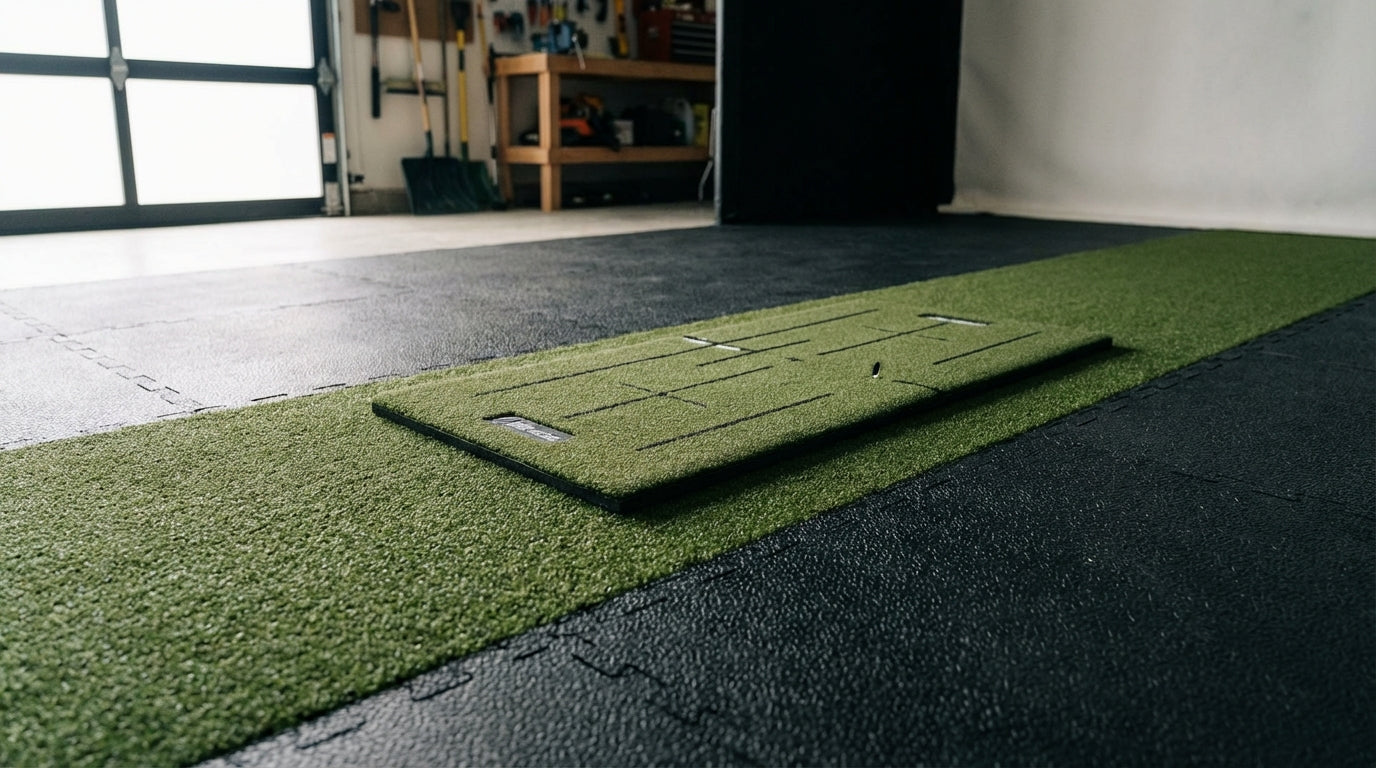
Most people building a home golf simulator obsess over the launch monitor, the projector, the impact screen. Floors? Usually an afterthought. That's a mistake you'll notice the moment you swing — or the moment your spouse hears you swinging at 10pm.
Here's the number that reframes the whole decision: a half-inch rubber stomp mat under your hitting mat can reduce perceived impact noise by 35–50% — roughly 10 decibels — compared to bare concrete or hardwood. (Source: Second Skin Audio) That one floor choice could be the difference between a setup your household tolerates and a permanent source of friction. Floor material also affects mat stability during your swing, ball bounce behavior, and how your back and knees feel after two hours of ball-striking.
Here's how the four main flooring types actually stack up — with real cost data, lifespan numbers, and a clear recommendation for most builds.
The Four Flooring Types Worth Considering
Rubber Tiles: The Workhorse Pick
Rubber interlocking tiles are the default recommendation for good reason. They absorb shock, cut impact noise at the source, stay stable under a hitting mat, and land around $3.50 per square foot — a sweet spot between upfront cost and long-term performance that foam and hardwood can't match.
Ready to shop impact screens?
Browse the full Carl's Place lineup — every screen ships ready to mount with real size specs.
Shop Carl's Place Impact Screens →Expect 10–20 years of useful life out of a quality rubber floor with routine maintenance. (Source: InHomeflooring / FlooringInc) That's comparable to artificial turf lifespan at roughly half the cost per square foot. The noise benefit is also real: specialist rubber flooring solutions can reduce impact noise by up to 50% versus bare concrete floors. (Source: PaviGym / GrytFit)
The one thing rubber doesn't do is look like a golf course. If aesthetics matter, use rubber as a base layer across the full room and add a turf strip through the hitting lane — best of both worlds without the full-room turf price tag.
Artificial Turf Strips: Best Feel in the Hitting Bay
A turf strip through your hitting area gives you realistic ball roll, a natural feel underfoot, and something that actually looks like a setup worth using. Quality residential turf lasts 10–15 years — and because your basement or garage doesn't face UV exposure or heavy foot traffic, it'll typically outlast the same product on an outdoor sports field. (Source: US Turf / Big Bully Turf)
The catch is price. At around $6.33 per square foot with foam backing, quality artificial turf runs about four times the cost of foam tiles. For a 10×10 hitting lane, that's $633 versus $150 — a gap that matters when you're sizing a full build budget.
The move most experienced builders land on: rubber tiles across the entire room, turf strip through the hitting lane only. You get course-feel where it counts without covering every square foot at turf prices.
Foam Tiles: Budget and Temporary Setups Only
Foam interlocking tiles are cheap (~$1.50/sq ft), easy to install, and a reasonable place to start if you're still testing whether you'll actually use the thing. That's the full case for them.
The problem is longevity. Foam compresses and degrades within 2–5 years under regular use. Thin foam can also create subtle instability under a hitting mat — you'll feel your stance shift slightly on downswings, which affects feel and can mess with tracking data. (Source: GrytFit / Rubbmat / FlooringInc) For any permanent build, foam is false economy.
Hardwood: Great Aesthetic, Wrong Spot Under the Mat
Hardwood is beautiful and lasts 30–40 years. In the periphery of a finished simulator room — the viewing area, any wall-adjacent space — it's a legitimate choice. Under your hitting mat, it's the worst option on this list.
Hard surfaces reflect impact noise rather than absorb it. The hitting mat will migrate over time. Every downswing sends vibration directly through to the subfloor. At approximately $12 per square foot installed, you're paying premium prices for a surface that makes your setup noisier where it matters most. If you already have hardwood in the room, rubber underlayment between the floor and your hitting mat is non-negotiable.
By the Numbers
The research makes a clear case for rubber as your primary floor layer:
- A 1/2-inch rubber stomp mat reduces impact noise by ~10 dB — cutting perceived noise by 35–50%. (Source: Second Skin Audio)
- Quality rubber flooring lasts 10–20 years with proper maintenance, versus just 2–5 years for foam tiles. (Source: InHomeflooring / FlooringInc)
- Specialist rubber flooring can reduce impact noise by up to 50% compared to bare concrete. (Source: PaviGym / GrytFit)
- Quality artificial turf costs ~$6.33/sq ft — roughly 4× the price of foam tiles at ~$1.50/sq ft. (Source: Virtual Golf Simulator 2026 / SimTurf)
Estimated Cost Per Square Foot by Flooring Type (Golf Simulator Room)
Source: Virtual Golf Simulator 2026 guide / SimTurf / Greatmats / industry cost estimates
Golf Simulator Flooring Comparison: Rubber vs Turf vs Foam vs Hardwood
Swipe to compare →
| Flooring Type | Est. Cost/Sq Ft | Lifespan | Noise Reduction | Ball Bounce Behavior | Best Use |
|---|---|---|---|---|---|
| Rubber Tiles | ~$3.50 | 10–20 years | Up to 50% (10 dB) | Absorbs impact — ideal base layer | Under turf or hitting mat; garage/basement builds |
| Artificial Turf | ~$6.33 | 10–15 years | Moderate (backing-dependent) | Realistic roll, low bounce — closest to course feel | Hitting bay and stance area |
| Foam Tiles | ~$1.50 | 2–5 years | Low (compresses over time) | Soft — can cause mat instability | Budget builds; temporary setups |
| Hardwood | ~$12.00 | 30–40 years | Low (reflective surface) | Hard bounce — poor under hitting mat | Finished room aesthetics; periphery only |
Noise Is Why This Decision Actually Matters
If you're building in a basement or garage with living space nearby, noise bleed is the friction point that kills late-night sessions faster than anything else. The floor is a key variable. If you've already looked into sound dampening for your impact screen setup, the floor is the natural next layer — rubber under the hitting area handles a significant portion of impact noise at the source before it ever reaches the walls or ceiling joists.
Flooring Budget for a Typical 10×15 Simulator Room
For a 150 sq ft room with a dedicated hitting bay, here's a realistic breakdown:
- Rubber tiles, full room (150 sq ft @ $3.50): ~$525
- Turf strip in hitting lane (3×10 ft @ $6.33): ~$190
- Total flooring budget: ~$715
Under $750 for a complete, durable, noise-reducing floor. Less than most mid-range launch monitors. Worth getting right on the first pass rather than ripping it all up six months in.
One more thing while you're in planning mode: your floor and hitting mat work as a system. A quality mat on poor flooring underperforms. The guide on extending the life of your golf simulator mat covers how to make sure both ends of that equation are dialed in.
Common Flooring Mistakes to Avoid
- Foam under the hitting mat: Soft foam creates instability on downswings. Use rubber here, full stop.
- Turf wall-to-wall: Expensive and unnecessary. Turf through the hitting lane, rubber everywhere else.
- Skipping underlayment on hardwood: If you have hardwood in the room already, rubber between the floor and hitting mat is non-negotiable — not a nice-to-have.
- Going too thin on rubber: Minimum 3/8-inch thickness. Go 1/2-inch for basements or any space where noise bleed is a real concern.
For the bigger picture on what sinks simulator builds before they really get going, the 7 most expensive golf simulator room mistakes is worth a read before you buy anything.
The Bottom Line
Rubber tiles as your base layer across the full room. Artificial turf through the hitting zone. That's the answer for 90% of home simulator builds — it handles noise, durability, and feel without pushing your budget into uncomfortable territory.
Get the floor right, then put the rest of your budget toward the part of the setup that drives the biggest day-to-day difference: a quality impact screen that holds up to years of hard ball strikes.
→ Browse impact screens at GolfingSim.com and build the rest of the room out from there.
Planning the whole bay? Use Build Your Bay: pick your room size, screen and mat, and we match every part (enclosure, framing, back cover, hitting mat) and add it all to your cart in one click.


Not sure which simulator fits your room?
The two-minute Simulator Finder Quiz checks your space and budget against every system we carry.

Keep Reading
Related guides

golf simulatorGolf Simulator Enclosure Lighting Plan: Where to Mount Fixtures So They Never Wash Out Your Screen

golf simulatorGolf Simulator Basement Conversion Checklist: The 7 Steps to Run Before You Buy Anything

DIY golf simulatorGolf Simulator Garage Build Cost Breakdown: Every Line Item at Three Budget Tiers