
apartment golf simulator
Best Golf Simulator Setup for Apartments: What Actually Works in Small Spaces
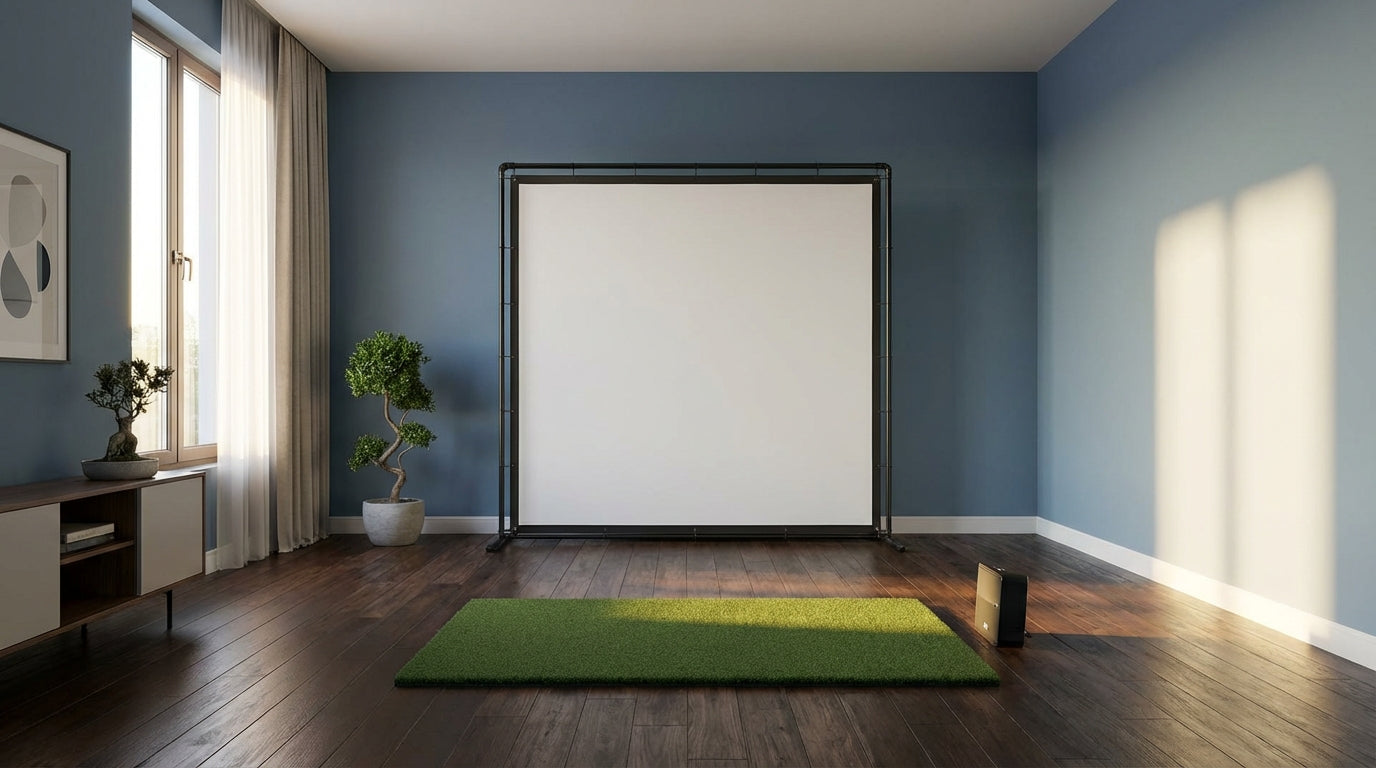
Most apartment golfers assume they're disqualified before they start. No garage, 8-foot ceilings, neighbors three feet away through shared walls. Here's the fact that changes the math: the minimum footprint for a functional golf simulator is roughly 10 feet wide by 12 feet deep — 120 square feet. That's a spare bedroom with the furniture pushed out. The global golf simulator market hit $1.74 billion in 2024 and is projected to reach $3.81 billion by 2033, driven in part by urban golfers who refuse to wait for a backyard. (Source: Straits Research) Apartment setups are real, and they work — if you know what to prioritize.
The Ceiling Height Reality Check
What "Minimum" Actually Means
The number you'll see everywhere is 9–10 feet for a full, unrestricted driver swing indoors. That's accurate. (Source: Indoor Golf Design / Rapsodo) But 8 feet isn't an automatic dealbreaker — it just changes your game plan. At 8 feet, irons are comfortable, mid-irons work fine, and drivers require an abbreviated backswing. Woods are off the table entirely.
Ready to shop impact screens?
Browse the full Carl's Place lineup — every screen ships ready to mount with real size specs.
Shop Carl's Place Impact Screens →Before you write off your apartment, measure your actual ceiling — not what your lease says. Older buildings routinely run 9 feet or higher. You might have more room than you assumed.
The Overhead Obstacles Nobody Talks About
Ceiling fans, light fixtures, and HVAC vents eat into your real clearance by 6–18 inches. A 9-foot ceiling with a fan directly in your swing path is effectively 7.5 feet. Map your overhead obstacles before you spec any gear — moving your hitting position three feet sideways often solves the problem entirely. For exact clearance numbers by club type, our ceiling height requirements guide has every number you need before you commit to a layout.
Free tool — 30 seconds
Will a simulator fit your room?
Enter your room’s length, width, and ceiling height — the calculator tells you instantly what fits and exactly which screen size to order.
Check my room size →Minimum Space Requirements: The Numbers Are More Forgiving Than You Think
Here's what a functional apartment simulator actually needs:
- Width: 10 feet minimum — 12 feet if you want comfortable side clearance
- Depth: 12 feet tee-to-screen, with at least 7 feet behind the ball for your full swing arc (Source: Carl's Place / Shop Indoor Golf)
- Ceiling: 9 feet for unrestricted swings, 8 feet if you're sticking to irons
If depth is your limiting factor, push the screen close to the wall and prioritize a radar-based launch monitor. Radar units don't need the strict tee-to-screen geometry that camera systems require. Our launch monitor placement distance guide breaks down exact minimums by unit type — essential reading if you're working with a shallow room.
Impact Screen vs. Net: The Apartment Noise Equation
This is the decision most apartment golfers get backwards. A hitting net feels like the obvious call — cheaper, more portable, easier to remove before a landlord inspection. But in an apartment, a cheap net is often louder than a quality impact screen.
A ball striking taut nylon produces a sharp crack and an unpredictable ricochet. A multi-layer impact screen absorbs the strike — the ball drops straight to the floor, absorbed rather than bounced. The low-frequency thud that travels through floors and ceilings is what triggers noise complaints, and a multi-layer screen reduces impact noise by approximately 42% compared to single-layer polyester. (Source: Acoustic Geometry) The screen upgrade pays for itself in neighbor goodwill alone.
Impact Screen vs. Net: Apartment Setup Comparison
Swipe to compare →
| Factor | Impact Screen | Hitting Net |
|---|---|---|
| Noise on ball strike | Dampened thud (~85–95 dB with quality screen) | Sharp crack + ricochet (~95–105 dB) |
| Ball projection / course play | Yes — full simulator experience via projector | No — ball flight not visible |
| Minimum depth needed | 10–12 ft tee-to-screen recommended | 8–10 ft (net can sit closer) |
| Bounce-back / safety | Ball drops to floor after impact | Ball can rebound unpredictably |
| Rental friendliness | Freestanding enclosure — no wall damage | Portable nets easiest to fully remove |
| Entry-level cost | ~$300–$800 for screen alone | ~$100–$300 for basic net |
| Launch monitor compatibility | Works with all major units (Mevo, R10, Uneekor) | Works with all; no projection needed |
| Accuracy impact | Screen distance affects some camera-based LMs | No effect on radar-based LMs |
By the Numbers: What the Data Actually Says
- 9–10 ft of ceiling clearance required for an unrestricted driver swing indoors. At 8 ft you're limited to irons and forced to abbreviate your backswing. (Source: Indoor Golf Design / Rapsodo)
- 120 sq ft minimum (10×12 ft) for a functional setup — a footprint that fits most spare bedrooms with furniture cleared out. (Source: Carl's Place / Shop Indoor Golf)
- ~100 dB at 6 feet — the approximate sound level of a driver strike into a simulator screen, roughly equivalent to a jackhammer. Irons land at 85–90 dB. (Source: Sim Golf Lab)
- 42% noise reduction from multi-layer screens vs. single-layer polyester — the highest-ROI noise mitigation step available without touching a wall. (Source: Acoustic Geometry)
Golf Simulator Setup Cost by Tier (Apartment-Relevant)
Source: Rain or Shine Golf / About Golf / Carl's Place pricing data
Managing Noise Without a Construction Project
You're not going to soundproof an apartment wall with double drywall and Green Glue — your landlord will have strong opinions. But partial treatment still moves the needle. A combined approach of quality screen, foam underlayment, and a few acoustic panels can cut perceived noise by 30–60% without touching a single wall. (Source: My Golf Simulator)
- Multi-layer impact screen — step one, full stop. Absorbs the ball strike rather than reflecting it.
- Hitting mat with foam underlayment — reduces the low-frequency floor vibration that travels straight down to neighbors below. Rubber gym tiles underneath add another absorption layer.
- Acoustic foam panels — hang 4–6 panels on the wall behind the screen to catch residual sound that passes through the screen material.
- Practice during reasonable hours — mid-day weekend sessions will do more for neighbor relations than any piece of gear you buy.
For the full breakdown of products and placement strategies for every noise source in a home simulator, our impact screen sound dampening guide covers it all without requiring you to demolish a wall.
Apartment-Friendly Gear That Actually Works
Screens and Enclosures
Go freestanding. A freestanding enclosure with a tensioned impact screen means zero wall damage, full portability, and a setup you can break down if you move. Wall-mounted frames in a rental are a security deposit problem waiting to happen.
Launch Monitors
For tight rooms, radar-based units (Garmin R10, Bushnell Launch Pro) outperform camera-based units because they have no strict tee-to-screen distance requirements. Camera-based systems like the Uneekor need a specific setup geometry that's hard to achieve in a shallow apartment room.
Hitting Mats
Get a mat with a substantial foam base — not a thin strip of turf. Thin mats on hard floors transfer every impact directly downward to your neighbors. Mat quality matters as much as screen choice when it comes to noise.
Is an Apartment Golf Simulator Actually Worth It?
If you're serious about your game and you're only making it to a range once or twice a month, yes — the math works. The entry screen tier runs $4,000–$5,000 all-in and gets you real ball data, full course simulation, and year-round practice access regardless of weather. The golf simulator market's growth from $1.74B to a projected $3.81B tells you exactly how many people are arriving at the same conclusion.
An apartment setup isn't a compromise. It's a different kind of build — same outcome, different constraints. With a multi-layer screen, a radar launch monitor, and a freestanding enclosure, you have everything you need.
Ready to build your apartment simulator? Browse our full range of impact screens for home setups — including compact options built for tight spaces, low ceilings, and renters who want zero wall damage.
Tight on space? Browse compact golf simulator packages and enclosures built to fit small rooms and apartments.
Planning the whole bay? Use Build Your Bay: pick your room size, screen and mat, and we match every part (enclosure, framing, back cover, hitting mat) and add it all to your cart in one click.


Not sure which simulator fits your room?
The two-minute Simulator Finder Quiz checks your space and budget against every system we carry.

Keep Reading
Related guides

golf simulatorGolf Simulator Enclosure Lighting Plan: Where to Mount Fixtures So They Never Wash Out Your Screen

golf simulatorGolf Simulator Basement Conversion Checklist: The 7 Steps to Run Before You Buy Anything

DIY golf simulatorGolf Simulator Garage Build Cost Breakdown: Every Line Item at Three Budget Tiers