
golf simulator
Golf Simulator Launch Monitor Placement Distance Guide: Get the Numbers Right Before You Buy
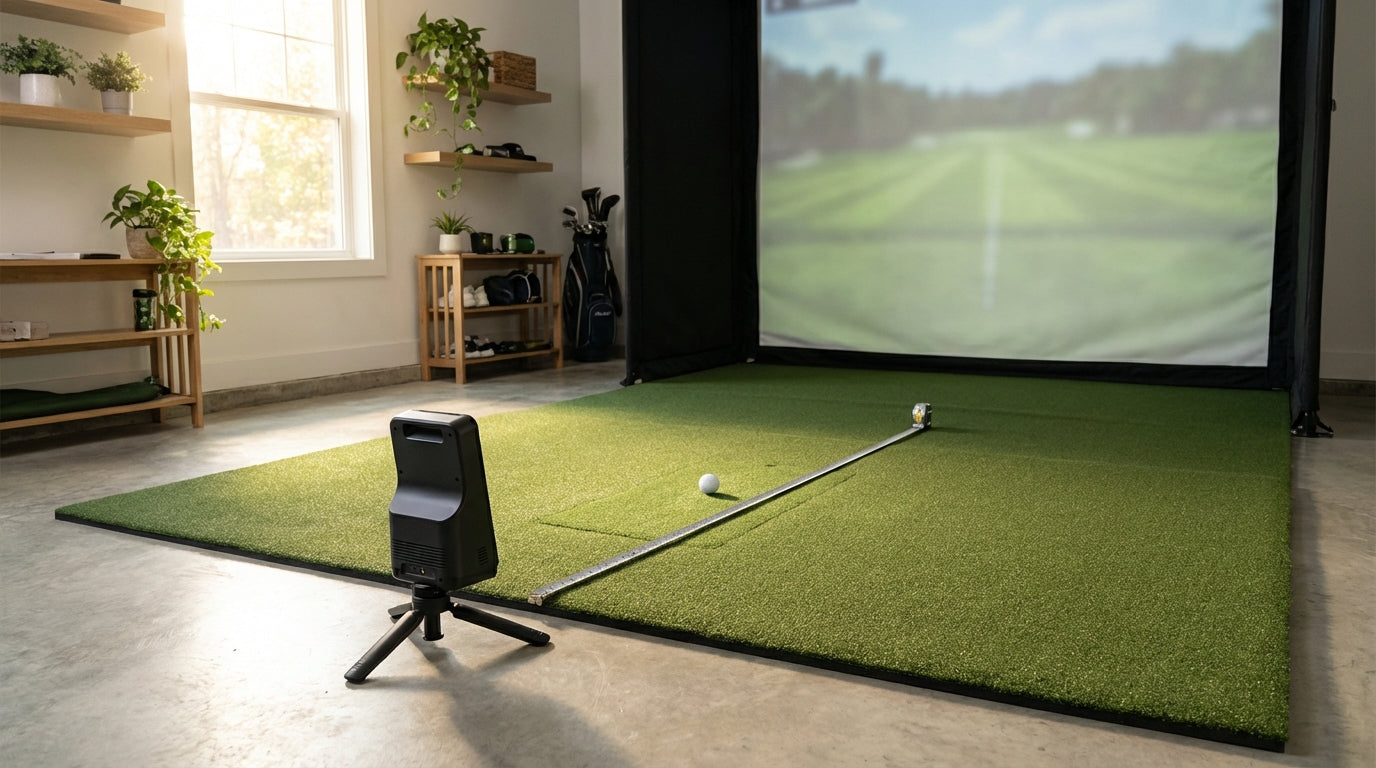
The global golf simulator market hit $1.74 billion in 2024 and is projected to nearly double by 2033. (Source: Straits Research Golf Simulators Market Report 2024) Most of that growth is happening in garages, basements, and spare rooms across North America — fixed spaces with fixed walls and a ceiling that's exactly as tall as it is. And here's the mistake that derails more home builds than anything else: picking a launch monitor before checking whether the room can physically accommodate proper launch monitor placement distance requirements.
Get placement wrong and your shot data is compromised — carry distances inflated or clipped, spin readings drifting sideways, and you're making real swing decisions based on numbers the unit wasn't designed to produce at that distance. Get it right, and every dollar you spent on hardware actually earns its keep.
This is the exact placement data for every major launch monitor type — radar, camera side-mounted, and ceiling-mounted — why the requirements differ by as much as 6 feet of room depth, and how your launch monitor choice directly shapes which impact screen sizes will actually fit your space.
Building one now? Carl’s Place Preferred impact screen — from $299.
Why Placement Distance Makes or Breaks Indoor Accuracy
Every launch monitor is built around a specific method of capturing ball data. That method has a physics constraint baked into how it works — a constraint that determines how far the unit needs to sit from the ball, from the screen, and from any hard surfaces behind it.
Radar units — Trackman, FlightScope, Foresight GC3 — track the ball in flight. They need a minimum flight distance to gather enough data points before the ball hits the screen. Put the screen too close and the radar doesn't get enough flight time to produce accurate carry or spin readings. It's not a firmware limitation. It's physics.
Camera-based systems capture data at impact. They read spin, face angle, and ball speed from the frame of contact, before the ball has moved more than a few inches. Room depth becomes far less critical because the measurement window closes almost instantly after the club connects.
This distinction isn't academic. It's the reason two golfers with identical square footage can have completely different equipment options — and why the order of operations matters: measure your room first, then pick your launch monitor.
Radar Systems: The Room-Eaters
Radar is the dominant technology at the premium end of the market. Outdoors, or in a large commercial bay, it delivers excellent accuracy. In a tight residential space, the numbers get uncomfortable fast.
Trackman 4
Trackman's indoor normalized mode requires the unit to sit approximately 8–10 feet behind the ball — about 2.5 meters per manufacturer specification — with a minimum of 13 feet of ball flight distance to the screen for accurate carry readings. Add a hitting mat, player stance room, and screen frame depth, and you're looking at a firm 15–18 feet of total room depth required. (Source: Journal of Sports Sciences – Trackman 4 Indoor Reliability Study, Tandfonline 2024)
A standard two-car garage at 20–22 feet deep can handle this — barely, once you account for everything else. A finished basement with a drop ceiling at 10 feet of depth? It's not happening.
FlightScope Mevo+ and Mevo Gen2
The Mevo line is explicit in its documentation: 8 feet behind the ball plus 8 feet of ball flight equals a hard minimum of 16 feet total room depth. (Source: FlightScope Official Product Specifications) That's a firm number, not a starting point. Plenty of buyers discover this after the unit is on the mat and the carry distances look suspiciously wrong.
If tight depth is already a concern, check out the guide on best golf simulators for small garages — it covers exactly which configurations work when you're constrained on room depth.
Camera-Based Systems: Where the Space Savings Get Real
Side-mounted camera systems — Foresight GCQuad, SkyTrak, SkyTrak+ — sit beside the hitting area rather than behind the ball. They capture ball and club data optically at the moment of impact. Required room depth drops to 10–12 feet. (Source: Uneekor Official FAQs and EYE XO Product Manual)
That's not a subtle difference. A 6-foot reduction in required depth is the difference between a spare bedroom being viable and being a no-go, or a shallow garage bay becoming a real simulator room.
Here's the counterintuitive part: camera systems often outperform radar on spin accuracy indoors. In independent Golf Laboratories testing, GCQuad delivered a spin rate deviation of 82.4 RPM versus Trackman 4's 175.8 RPM — roughly 2x more spin variability for radar under controlled indoor conditions. (Source: Golf Laboratories Independent Testing, cited by GolfSpan and PlayBetter) Radar spin depends on flight tracking. When room depth pushes the screen closer than ideal, that accuracy erodes. Camera systems capture spin at impact, so tight rooms don't degrade their readings the same way.
For a full head-to-head on technology types, the radar vs. camera launch monitor guide covers every trade-off in detail.
Overhead Camera: A Ceiling Mount That Rewrites the Depth Math
The Uneekor EYE XO takes yet another approach. It mounts to the ceiling 9–10.5 feet above the hitting area, positioned just 3.5 feet behind the ball. Minimum room depth: 10 feet. Minimum ceiling height: 9.5 feet. (Source: Uneekor Official FAQs and EYE XO Product Manual)
That 38% reduction in required depth versus radar is exactly why overhead camera units dominate tight residential installs. You're trading portability and simple tabletop setup for a permanent ceiling-mounted fixture — but in a dedicated room where depth is the binding constraint, it's often the right call.
By the Numbers: What the Data Says
- $1.74B → $3.81B — golf simulator market growing at 9.1% CAGR through 2033, with residential setups driving unit volume. Most first-time buyers are working in fixed-dimension spaces where placement requirements are a hard constraint. (Source: Straits Research Golf Simulators Market Report 2024)
- 46.6% of the global golf simulator market sits in North America, with the residential segment generating the majority of unit growth — garages, basements, and spare rooms with walls that don't move. (Source: Grand View Research Golf Simulator Market Report 2025)
- 16 feet — FlightScope Mevo+ minimum total room depth requirement per official specifications. Many buyers assume their 14-foot basement will work just fine until the manual makes the number explicit. (Source: FlightScope Official Product Specifications)
- 82.4 RPM vs. 175.8 RPM — GCQuad camera system versus Trackman 4 radar spin deviation in controlled indoor testing. In tight rooms where screen proximity degrades radar flight tracking, camera systems consistently hold their accuracy advantage. (Source: Golf Laboratories Independent Testing)
Minimum Total Room Depth Required by Launch Monitor Type
Source: FlightScope specs (flightscope.com); Uneekor FAQs (uneekor.com); Trackman indoor study (Tandfonline 2024); Rain or Shine Golf / PlayBetter comparative guides
Launch Monitor Placement Requirements by Technology Type
Swipe to compare →
| Launch Monitor / Type | Placement Position | Min Behind-Ball Distance | Min Room Depth | Min Ceiling Height |
|---|---|---|---|---|
| Trackman 4 (Radar) | Floor, behind ball, inline | 8–10 ft (2.5 m normalized) | 15–18 ft | 9 ft |
| FlightScope Mevo+ (Radar) | Floor, behind ball, inline | 7–8 ft | 16 ft | 9 ft |
| Rapsodo MLM2PRO (Hybrid) | Floor, behind ball | 7–8 ft | 12 ft | 9 ft |
| Foresight GCQuad (Camera) | Floor, beside hitting area | Adjacent to ball | 10–12 ft | 9 ft |
| SkyTrak / SkyTrak+ (Camera) | Floor, beside hitting area | Adjacent to ball | 10 ft | 9 ft |
| Uneekor EYE XO (Overhead Camera) | Ceiling mount, 3.5 ft behind ball | 3.5 ft behind, 9–10.5 ft above | 10 ft | 9.5 ft minimum |
How Your Launch Monitor Choice Determines Your Screen Setup
This is where the placement math flows directly into your screen selection. Your launch monitor's minimum room depth sets a hard ceiling on which impact screen sizes and enclosure depths can physically fit — and how much space is actually left for you to swing a club.
Running a radar system means committing to 15+ feet of usable depth minimum, before the screen frame, enclosure structure, mat, and stance room consume their share. In most cases, radar rooms are large enough to accommodate wider screens — 10 feet and up. The primary constraint is ensuring the screen sits at the right working distance from the hitting position, not too close to degrade carry accuracy.
Camera systems at 10–12 feet change the math entirely. You may have just enough room for a 9-foot screen with tight clearance on both sides. Every inch matters. Choosing the right screen width, aspect ratio, and enclosure depth in that context isn't a preference decision — it's a spatial engineering problem. Our guide on converting a spare room to a golf simulator walks through the full planning process from wall to wall.
One more constraint that doesn't show up in the depth table: ceiling height. Every system on the list requires a minimum of 9 feet for a full swing. Overhead camera mounts push that to 9.5 feet. If your space sits at 8.5 feet, that narrows your launch monitor options before depth even enters the conversation.
The right order: measure your room dimensions first. Work backward to the launch monitor types that fit. Then find the screen that completes the setup. It's a more constrained process than most buyers expect — but get the order right and everything else falls cleanly into place.
When you're ready to match a screen to your setup, browse Carl's Place impact screens built for residential simulators — available in multiple sizes and materials to pair with whatever launch monitor configuration your room can support.
Related reading: Golf Simulator Room Speaker Setup Guide: Bluetooth vs. Wired, Placement, and Acoustics Explained · Golf Simulator Ceiling Height Requirements for a Garage Build: The Real Numbers Before You Buy a Frame · Golf Simulator Basement Conversion Checklist: The 7 Steps to Run Before You Buy Anything


Not sure which simulator fits your room?
The two-minute Simulator Finder Quiz checks your space and budget against every system we carry.

Keep Reading
Related guides

golf simulatorGolf Simulator Enclosure Lighting Plan: Where to Mount Fixtures So They Never Wash Out Your Screen

golf simulatorGolf Simulator Basement Conversion Checklist: The 7 Steps to Run Before You Buy Anything

DIY golf simulatorGolf Simulator Garage Build Cost Breakdown: Every Line Item at Three Budget Tiers