
ambient light rejecting golf impact screen
Ambient Light Rejecting Golf Impact Screen: Why True ALR Can’t Survive Your Driver (and What Actually Works)
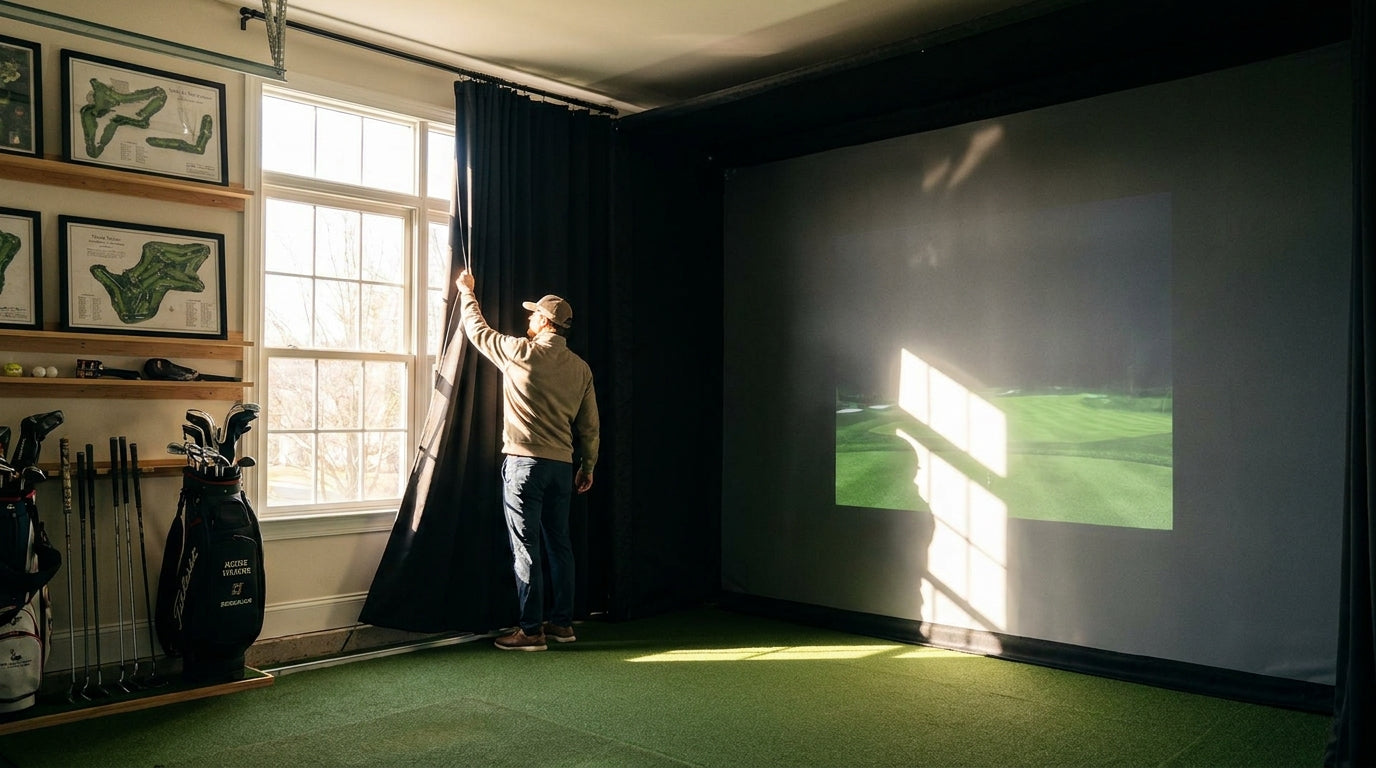
Here’s a number that stops most sim builders cold: a true ambient light rejecting (ALR) home-theater screen can reject up to roughly 90% of the light bouncing around your room (Source: Projector Display / ProjectorCentral ALR Shoot-Out). Sounds like the perfect fix for a garage bay with the lights on, right?
There’s just one problem. That same screen will tear itself apart the first time you flush a driver into it. The optical layers that make ALR work are rigid, non-woven, and built to sit flat on a wall — not to stop a golf ball doing 150 mph and let the air pass through.
So when you go shopping for an ambient light rejecting golf impact screen, you’re chasing two specs that physically fight each other. Let’s untangle what’s real, what’s marketing, and what actually beats ambient light in a sim room.
Building one now? Carl’s Place High-Contrast Gray screen — from $450.
What “Ambient Light Rejecting” Actually Means
ALR isn’t a coat of special paint. It’s a stack of microscopic optical structures — usually Fresnel or lenticular layers — engineered to bounce light from your projector toward your eyeballs while absorbing or redirecting light coming from other angles.
The catch is that this trick is directional. ALR screens reject up to about 90% of ambient light, but only inside a narrow viewing sweet spot, and only when the ambient light comes from a different direction than the projector (Source: Projector Display / ProjectorCentral ALR Shoot-Out).
Now think about a golf simulator. Your projector usually fires at the screen straight-on, from the same side you’re standing. That’s the exact geometry ALR is designed to defeat. The home-theater magic stops working before you even swing.
Why a True Ambient Light Rejecting Golf Impact Screen Doesn’t Exist (Yet)
Even if the optics cooperated, the material wouldn’t. ALR screens earn their rejection from rigid, multi-layer optical construction. That’s the opposite of the loose, woven polyester your impact screen needs to absorb a strike and breathe.
It shows up in the price, too. True ALR home-theater screens cost roughly 2–5x more than a standard matte white screen — about $600 to $1,000+ versus as little as $100 — precisely because of those fragile optical layers (Source: All In Projectors / XGIMI ALR buyer’s guides). You’d be paying a premium for a feature that dies on the first ball.
Here’s the kicker: even purpose-built impact materials stick to plain-vanilla gain numbers. Elite Screens’ ImpactWhite 360 material is rated to take ball speeds up to 200 mph, but it carries a gain of 1.0 — it’s a white impact screen, not an ALR screen (Source: Elite Screens product specs). The chart below shows why the ALR-coated impact screen column is simply empty.
Screen Gain by Type — Why Impact Screens Skip True ALR Coatings
Source: Carl’s Place, Elite Screens, ProjectorCentral ALR Shoot-Out — ALR impact screens are effectively unavailable, hence 0
What the Data Says
Strip away the marketing and the numbers point in one clear direction: on an impact screen, “ambient light rejection” is really a contrast trade-off, not a coating.
- Gray impact screens absorb roughly 40% more ambient light than white, giving you deeper blacks and better contrast in rooms with overhead lighting (Source: Carl’s Place — White or Gray Golf Impact Screens).
- That comes at a cost: gray runs a gain of about 0.6 versus 1.0 for white, so you trade brightness for contrast (Source: Home Performance Lab / Carl’s Place).
- To get the full benefit of a gray screen in a genuinely bright room, you want a projector around 5,000 lumens or more (Source: Carl’s Place — How to Control Ambient Light in a Golf Simulator).
- Durability lives in the weave: premium 3-layer screens are rated for 200,000+ impacts, while entry-level screens cap around 20,000–50,000 strikes — a 10x gap that thin, rigid ALR substrate could never close (Source: GolfingSim / Home Performance Lab).
If you want the deeper spec breakdown, our guide on impact screen brightness vs. gain explains exactly how these two numbers play off each other.
The Real Ambient Light Trick: Go Gray, Not ALR
Since a true ALR layer is off the table, screen color is your most honest lever. A gray impact screen is the closest thing to “ambient light rejection” you can actually swing into.
The gray surface soaks up stray light instead of bouncing it back at you, so your blacks stay black and the picture doesn’t wash out the moment someone flips a switch. The trade is brightness — which is why gray only makes sense if you’ve got the lumens to back it up.
Not sure which way to go? Our full breakdown on white vs. gray impact screen material walks through the decision room by room. Here’s the short version:
White vs. Gray Impact Screen — Realistic Ambient Light Control
Swipe to compare →
| Property | White Screen | Gray Screen |
|---|---|---|
| Screen gain | ~1.0 | ~0.6 |
| Ambient light absorbed | Low (reflects everything) | ~40% more than white |
| Contrast / black levels | Washes out with lights on | Deeper blacks, less washout |
| Best room | Dark, light-controlled | Garage, basement, lights on |
| Projector brightness needed | ~2,500–3,500 lumens | ~5,000+ lumens |
| Survives golf impact | Yes (woven impact material) | Yes (woven impact material) |
Building an Ambient Light Rejecting Golf Impact Screen Setup That Works
You can’t buy ambient light rejection in a single product, but you can engineer it with a few stacked moves. None of them require fragile optics.
1. Control the room first
Blackout curtains, a closed garage door, and killing direct overhead spill do more against ambient light than any screen claim. Light you never let in is light you never have to reject.
2. Match your projector to your screen
White screens are happy at roughly 2,500–3,500 lumens in a dark room. Gray screens in a bright garage want 5,000+ to punch through. Buy the projector for the room you actually have.
3. Back it with a blackout layer
A black backing kills light bleeding through the screen and bouncing off the wall behind it, which sharpens contrast from the front. We dig into this in our piece on impact screen black backing.
Stack those three and you’ll get the washed-out-image relief people think they’re buying when they search for an ALR screen — on material that actually survives your driver.
The Bottom Line
A genuine ambient light rejecting golf impact screen is a unicorn: the optics that reject light and the weave that stops golf balls can’t coexist in one surface. Stop hunting the coating and start engineering the result — gray material, enough lumens, room control, and a black backing.
Ready to pick a screen that fights ambient light the honest way? Browse our impact screens collection and match the material to your room.
Related reading: Golf Simulator Impact Screen for Multi-Sport Use: Can One Screen Really Take a Baseball, a Puck, and Your Driver? · Golf Impact Screen for Outdoor Patio Setup: Can It Actually Survive Outside?


Not sure which simulator fits your room?
The two-minute Simulator Finder Quiz checks your space and budget against every system we carry.

Keep Reading
Related guides

golf simulatorGolf Simulator Enclosure Lighting Plan: Where to Mount Fixtures So They Never Wash Out Your Screen

golf simulatorGolf Simulator Basement Conversion Checklist: The 7 Steps to Run Before You Buy Anything

DIY golf simulatorGolf Simulator Garage Build Cost Breakdown: Every Line Item at Three Budget Tiers