
golf simulator
Short Throw Projector for Golf Impact Screen: When Close Mounting Is the Right Call
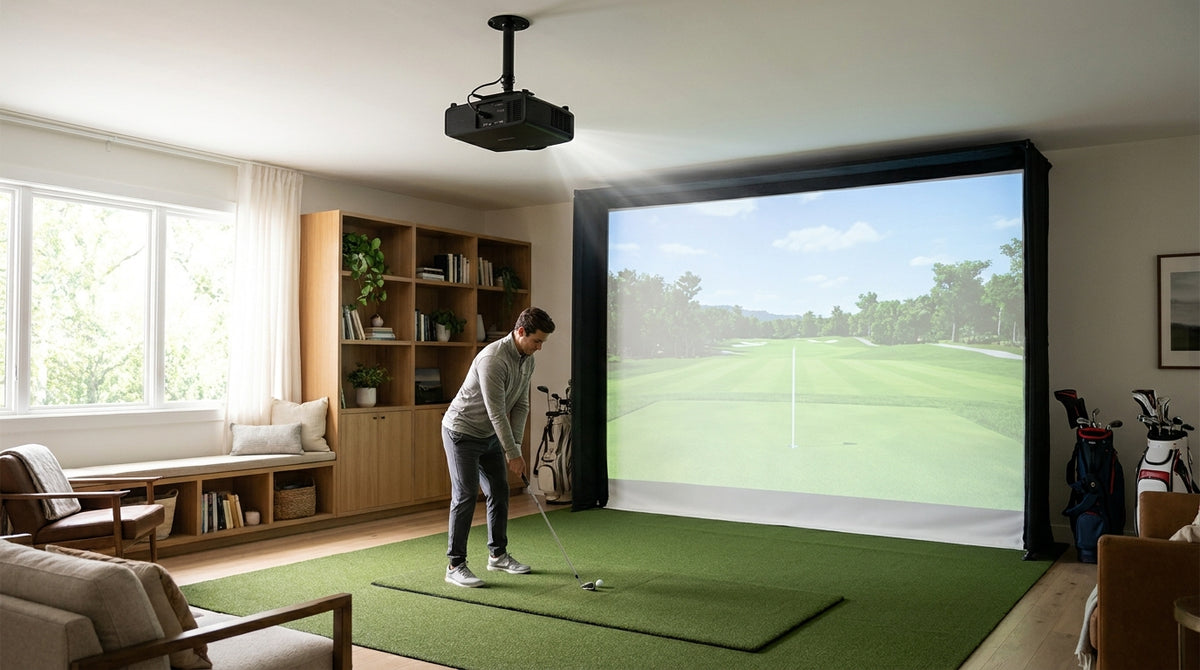
Here's the number that ends most projector debates before they start: a standard-throw projector often needs to sit 10 to 15 feet back from a 10-foot screen, while a short throw covers the same screen from just 6 to 9 feet (Source: Home Performance Lab – Golf Simulator Projector Placement Guide, 2026). In a garage or a spare bedroom, those extra feet are the difference between a crisp image and your own shadow swinging back at you.
If your room is tight, a short throw projector for your golf impact screen isn't a nice-to-have. It's usually the only projector class that physically fits. But "short throw" is a range, not a single thing, and going too short backfires hard. Let's break down the numbers.
What "Short Throw" Actually Means (Throw Ratio, Not Marketing)
Throw ratio is simple: it's the projection distance divided by the image width. A 0.8 throw ratio means the projector sits 0.8 feet back for every foot of screen width. On a 10-foot-wide screen, that's 8 feet.
Building one now? BenQ TH671ST short-throw projector — from $949.
The sweet spot for a golf simulator lands between a 0.69 and 0.89 throw ratio (Source: Top Shelf Golf – Short Throw vs Ultra-Short Throw Placement Guide). That window fills a full impact screen while still leaving room to ceiling-mount, cart-mount, or tripod the unit behind your hitting zone.
Go higher than about 1.0 and you're into standard-throw territory — great images, but the projector has to live so far back that the golfer walks straight into the beam. That's where the classic head-shadow problem comes from.
By the Numbers: Why Short Throw Wins in a Real Room
The case for close mounting is mostly geometry, and the geometry is well documented.
Short-throw projectors typically sit 6 to 9 feet from a 10-foot screen — close enough to clear the golfer's swing path, but not so close they lose image size (Source: Home Performance Lab – Golf Simulator Projector Placement Guide, 2026). Standard-throw models needing 10 to 15 feet simply don't fit in most residential builds.
Brightness has to scale with that closeness. The typical minimum for a golf sim is 3,000 ANSI lumens with a short-throw lens for a ~10-foot screen, climbing to 4,000–5,000 lumens for screens wider than 12 feet (Source: BenQ US – Golf Simulator Projector Buying Guide). Close mounting concentrates light, so under-buying lumens shows up as a dim, muddy picture fast.
And there's a hard floor on "closer is better": ultra-short-throw projectors generally don't work for golf. They sit in the ball's rebound path, they're brutally sensitive to any imperfection in the screen surface, and most cap out around a 150-inch diagonal image (Source: Home Performance Lab / Top Shelf Golf projector guides). Close is good. Point-blank is a mistake.
Typical Throw Ratio & Mounting Distance by Projector Class (10-ft screen)
Source: Compiled from Top Shelf Golf & Home Performance Lab projector placement guides (2026)
Short Throw vs Ultra Short Throw vs Standard: The Straight Comparison
The temptation in a small room is to grab whatever mounts closest. Don't. Here's how the three classes actually stack up for feeding an impact screen.
Short Throw vs Ultra Short Throw vs Standard Throw for Golf Impact Screens
Swipe to compare →
| Projector Class | Throw Ratio | Approx. Distance from 10-ft Screen | Best For / Shadow Risk |
|---|---|---|---|
| Ultra Short Throw (UST) | ~0.25–0.5 | 1–4 ft | Rarely suitable — sits in ball rebound path, ~150-in image cap |
| Short Throw (tight room) | ~0.5–0.69 | ~5–7 ft | Compact/garage rooms; low shadow risk, needs 3,000+ lumens |
| Short Throw (typical) | ~0.69–1.0 | ~7–9 ft | Most home sims; best balance of cost, coverage, low shadows |
| Standard Throw | above 1.0 | 10–15 ft | Large/commercial rooms only; high golfer-shadow risk at home |
Building a short-throw setup and need a screen that holds the image flat?
A short-throw beam is only as sharp as the surface it hits. Our impact screens ship with the tension hardware and tight-knit material that keep close-mounted projection crisp.
Shop Impact ScreensMounting Position: Where a Short Throw Actually Goes
Short throw gives you options a standard projector never will. Because it clears the swing from 6 to 9 feet out, you can ceiling-mount it just behind the tee, drop it on a rear shelf, or run a floor cart in a rental you can't drill.
The rule that matters: keep the lens out of the ball's flight and rebound path, and get it high enough that your body doesn't block the beam at address. If you're mounting from joists with no wall to work with, our ceiling mount setup guide walks through the hardware.
And whatever throw class you land on, the lumens still have to match the room. Our breakdown of the exact ANSI ranges by room and screen pairs directly with these throw numbers.
The Part Everyone Skips: Screen Match
A short throw's angled, close beam is unforgiving. Any ripple, slack, or surface flaw gets exaggerated into hot spots and soft edges. The screen matters as much as the projector.
Premium golf impact screens use three layers of tight-knit impact-resistant polyester, rated to stop balls traveling roughly 140–200 mph, with some enclosure kits handling up to 250 mph (Source: Carl's Place & Spectrum Golf – 2026 Guide to Golf Impact Screens). That tight weave is what gives a short-throw image somewhere clean to land.
Tension seals the deal. Metal grommets around the full perimeter let you pull equal tension on all sides — tight enough to look flat, loose enough to absorb impact (Source: Elite Screens & Carl's Place). Get it right and hot-spotting all but disappears. Get it wrong and no projector will save you — our hot spot fix guide covers the rest.
Bottom Line
If your room can't give a projector 10+ feet of runway, a short throw in the 0.69–0.89 throw ratio range is the move — mounted 6 to 9 feet out, pushing at least 3,000 lumens, feeding a tight, well-tensioned screen. Skip ultra short throw unless you enjoy chasing surface flaws.
Nail the throw ratio and the screen together, and a tight room stops feeling like a compromise. Browse our impact screens built to hold a short-throw image flat and take a driver at full speed.


Not sure which simulator fits your room?
The two-minute Simulator Finder Quiz checks your space and budget against every system we carry.

Keep Reading
Related guides

golf simulatorGolf Simulator Enclosure Lighting Plan: Where to Mount Fixtures So They Never Wash Out Your Screen

golf simulatorGolf Simulator Basement Conversion Checklist: The 7 Steps to Run Before You Buy Anything

DIY golf simulatorGolf Simulator Garage Build Cost Breakdown: Every Line Item at Three Budget Tiers