
fire retardant rating
Golf Simulator Impact Screen Fire Retardant Rating: What 'Fire-Rated' Actually Has to Prove
Here's a number most sim builders never see before they buy: to legally wear an NFPA 701 flame-resistant rating, a screen fabric can lose no more than 40% of its weight across ten burn specimens, and any flaming drip has to self-extinguish in under 2 seconds (Source: NFPA 701 Standard Methods of Fire Tests for Flame Propagation of Textiles and Films, via Begoodtex / OnSite Flameproofing test reports). That's the difference between a real golf simulator impact screen fire retardant rating and a vendor typing "fire-rated" into a product bullet.
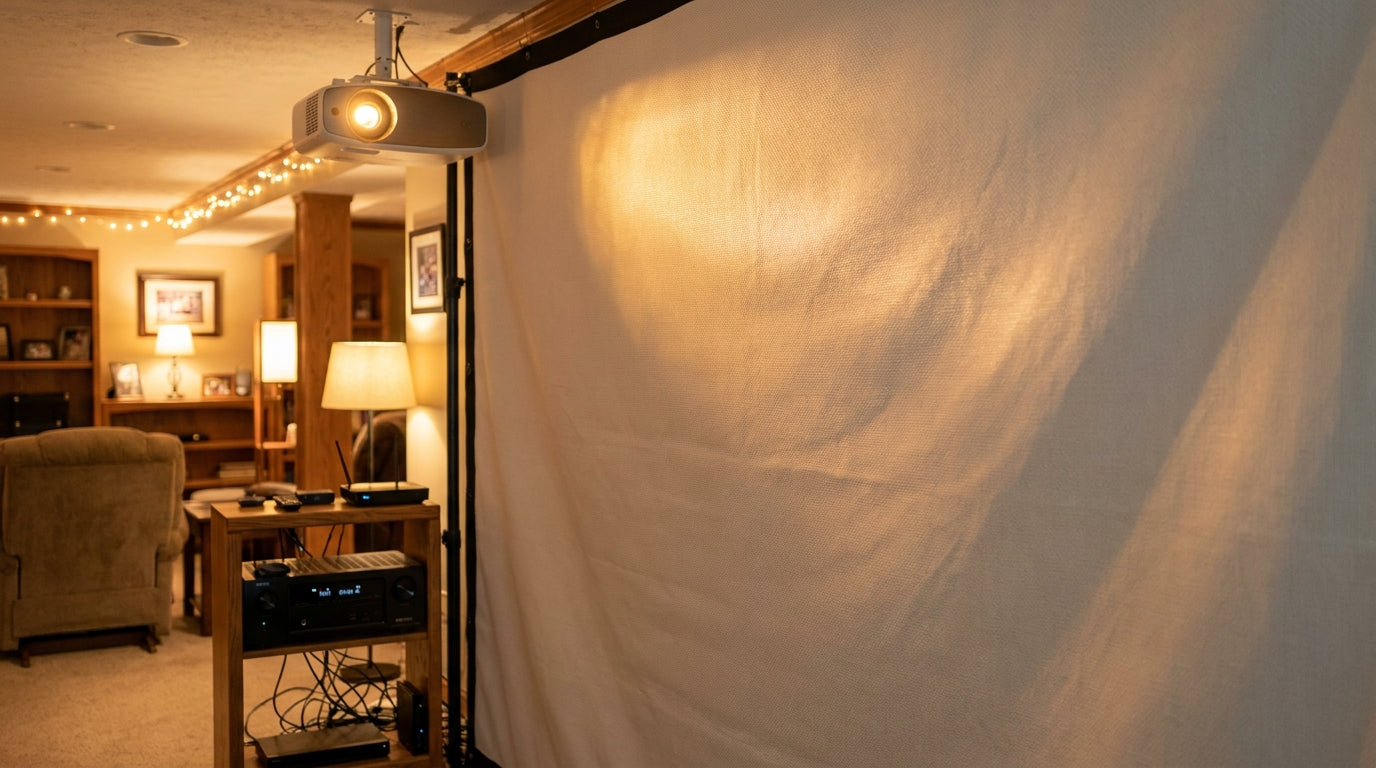
And it matters more than you'd think. You're hanging a big sheet of fabric inches from a projector that runs hot, in a sealed basement or garage, and then you're launching golf balls at it for hours. Let's talk about what the rating actually proves — and how to check it before you spend a dime.
Why fire resistance even matters in a sim room
Your screen doesn't live in open air. It lives in an enclosed room with a projector cooking away right next to it.
Building one now? Carl’s Place Preferred impact screen — from $299.
A typical simulator projector draws 200–350 watts, with the lamp running at 60–80°C internally, and it can raise room temperature 3–5°C within 30 minutes in a sealed sim (Source: OpenGolfer, Golf Simulator Room Ventilation & Heating guide). That's a concentrated, constant heat load parked a few feet from your fabric.
Add electronics, power strips, and zero airflow, and "flammable cloth" stops being a hypothetical. The fire rating isn't there for the swing — it's there for everything humming around the swing.
What a golf simulator impact screen fire retardant rating actually tests
NFPA 701 isn't a vibe. It's a pass/fail lab test with hard numbers, and a single miss on any one metric fails the whole thing.
Here's what the fabric has to survive to earn the certificate.
NFPA 701 Pass/Fail Thresholds for Flame-Resistant Screen Fabric
Source: NFPA 701-2019 Test Method 1 pass criteria (Begoodtex, OnSite Flameproofing)
Those bars are the whole game. Weight loss capped at 40%, afterflame under 2 seconds, flaming-drip burn under 2 seconds — and for folded specimens, char length can't exceed 1,050 mm (41.3 inches) (Source: NFPA 701-2019 Test Method 1 test reports, Saint Clair Textiles / OnSite Flameproofing).
Method 1, the one most impact screens are tested under, applies to lighter single-layer textiles at or below 700 g/m² (21 oz/yd²) (Source: Begoodtex NFPA 701 guide). Almost every impact-screen fabric falls in that class, so it's the right test to ask about.
What the data says about real certified screens
So what does a genuinely certified sim screen look like on the spec sheet? Heavier and better-documented than the bargain stuff.
Premium fire-rated sim screens weigh roughly 475–570 g/m² and carry certification to both NFPA 701 and the German B1 standard from SGS laboratories, with afterflame times under 2 seconds (Source: AirMesh Supply, SGS-Certified 3D Mesh K003 series specs). Two independent standards, one lab report, real product codes listed.
That dual-standard, weighty-fabric combo is the tell. It's the same "pay for the spec, not the sticker" logic we cover in our steel vs PVC frame breakdown — the cheap option looks identical in a photo and behaves nothing like it in the room.
Intrinsic FR vs. topical spray — the part nobody tells you
Two screens can both say "NFPA 701" and age completely differently. The reason is how the fire resistance got in there.
Sprayed-on retardant
Most budget "fire-rated" screens are sprayed with a topical chemical retardant after weaving. Those coatings wear off with every ball impact, oxidize over time, and can off-gas an odor (Source: AirMesh Supply / MMI Textiles – Jason Mills, golf simulator materials).
Translation: the rating was true on test day and may be meaningless a few thousand swings later. And you're hitting a lot of swings — the impact energy that strips that coating is the same force we break down in our ball speed rating guide.
Intrinsic (baked-in) FR
The better option bakes the flame resistance into the yarn during extrusion. It's part of the fiber, so ball strikes and time don't scrub it off. When a spec sheet says "raw yarn" or "solution-dyed FR," that's what you want. "FR-coated" is the phrase to be suspicious of.
How to verify it before you buy
You don't need to be a materials engineer. You need to ask for a document and read five lines. Here's the cheat sheet.
How to Verify an Impact Screen's Fire Safety Before Buying
Swipe to compare →
| Standard / Spec | What It Means | How to Verify |
|---|---|---|
| NFPA 701 | Textile flame-propagation test; <40% weight loss, <2 sec afterflame/drip | Ask for the SGS or lab test report PDF, not just a claim |
| B1 (DIN 4102) | German flame-retardancy rating common on premium sim screens | Check the certificate lists your screen fabric by product code |
| Intrinsic FR vs. topical spray | Baked-in yarn FR lasts; sprayed coatings wear off with impacts | Confirm "raw yarn / solution-dyed FR," avoid "FR-coated" |
| Fabric weight (g/m²) | Commercial fire-rated screens ~475–570 g/m² | Compare spec sheet; heavier dense weave = better thermal stability |
| Screen cost tier | Fire-rated commercial screens run ~$1,500–$5,000+ | Very cheap "fire-rated" cloth is a red flag for topical-only FR |
The single most useful move: ask the seller to email the actual test report and confirm your exact fabric code appears on it. A vendor who has one will send it in a minute. A vendor who's bluffing will get vague fast.
The bottom line
A real golf simulator impact screen fire retardant rating is a documented lab result with numbers you can check, not a phrase on a listing. Look for NFPA 701 (and ideally B1), intrinsic yarn-level FR, a fabric weight in the 475–570 g/m² range, and a report PDF that names your fabric.
Do that and the projector heat, the sealed room, and the electronics stop being a nagging worry in the back of your head every time you leave the sim on.
Want a screen where the certification is on the spec sheet, not in the fine print? Browse our vetted impact screens collection — built to take your driver and the heat around it.


Not sure which simulator fits your room?
The two-minute Simulator Finder Quiz checks your space and budget against every system we carry.

Keep Reading
Related guides

golf simulatorGolf Simulator Hitting Mat Sizing Guide: Exact Dimensions for 10x12, 12x15, and 16x18 Rooms

golf simulatorGolf Simulator Enclosure Cost to Build: Every Line Item, DIY vs Pre-Made (2026 Numbers)

golf simulatorGolf Simulator Room Electrical Plan: Where Every Outlet Goes Before the Frame Closes Up