
ceiling clearance
Golf Simulator Hitting Bay Wall and Ceiling Clearance for a Driver Swing: The Measuring Guide
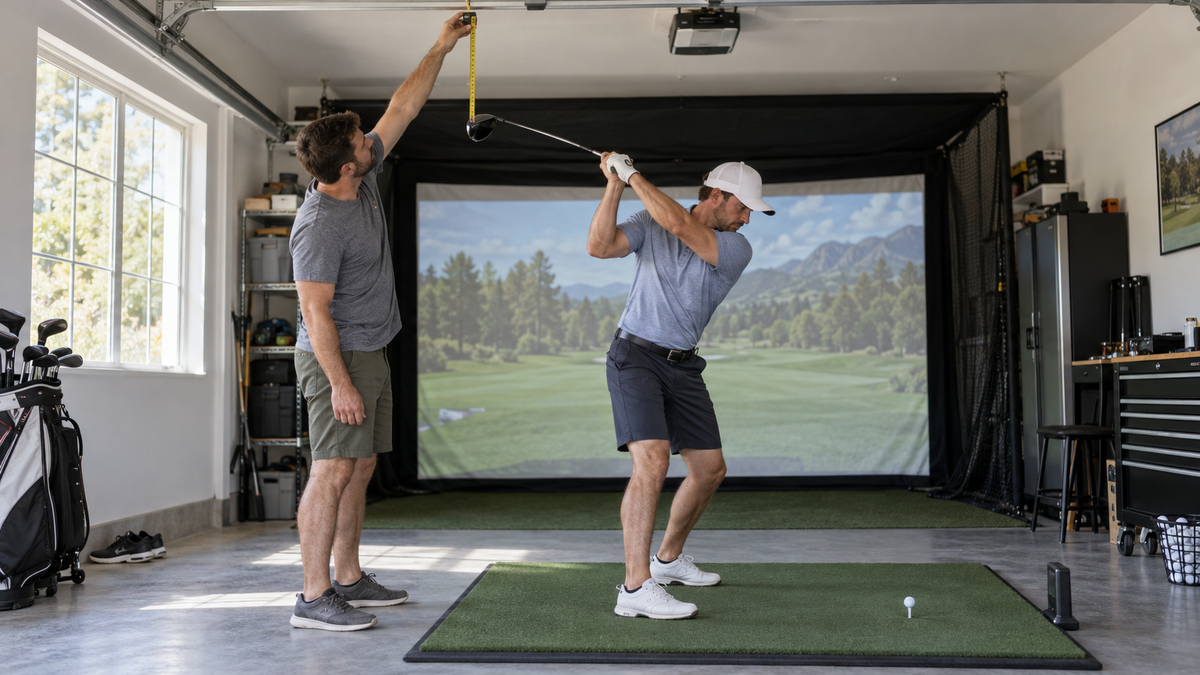
A 6-foot golfer's driver sits roughly 9.5 feet off the floor at the top of the backswing. That is before a ceiling fan, a recessed light or a frame crossbar takes a bite out of the space.
If you are planning a full hitting bay, wall and ceiling clearance for a driver swing is the measurement that decides whether the build works or turns into a rebuild. This guide gives you the numbers, a height-based table and a checklist you can run with a tape measure and your own driver.
Why Driver Clearance Is the Number That Matters
Your wedge will fit almost anywhere. Your driver will not. It is the longest club in the bag, so it traces the biggest arc, and every other club fits inside it.
Size the bay for the driver and you never think about it again. Size it for a 7-iron and you will clip the frame the first time you swing hard.
By the Numbers: What the Data Says
Published room guidance varies a little by source, but the pattern is consistent. Here is what the research shows.
- Most sources put the minimum ceiling height for a full driver swing at about 9 feet, with 10 to 11 feet ideal for an unrestricted swing. (Source: Golf Workout Program; Golfbays, 2.8m / 9.2ft minimum, 3m / 9.8ft ideal)
- Recommended room width is 10 feet minimum and 12 feet better. One launch monitor manufacturer recommends an absolute minimum of 13 feet for a comfortable swing diameter. (Source: Austad's; Foresight Sports)
- Recommended depth is 12 feet minimum and 16 feet better. Photometric launch monitors need about 13.1 feet (4.5m) and radar units about 16.4 feet (5m). (Source: Austad's; Golfbays)
- The club head reaches roughly 3 to 4 feet above head height at the top of a driver swing, so a 6-foot golfer needs about 9 to 10 feet of total clearance. (Source: Golfers Authority)
Recommended minimum vs. better room dimensions for a driver swing
Source: Austad's (width, depth); Golf Workout Program and Golfbays (ceiling; ideal shown as the midpoint of 10-11 ft)
Clearance sorted? The screen is the next thing your frame has to hold.
Shop Impact ScreensOverhead Clearance: Start With the Ceiling
Ceiling height is the hardest dimension to change later, so measure it first. Everything else can be moved, trimmed or re-framed.
Estimate it from your height
The rule of thumb is your standing height plus roughly 3.5 feet at the top of the swing. Then add a buffer. Sources advise 6 to 12 inches above the highest point of the swing. (Source: Golfers Authority; GOLFJOY; Golf Simulator Forum)
Estimated overhead clearance by golfer height (driver)
Swipe to compare →
| Golfer height | Estimated top-of-swing club height (head height + ~3.5 ft) | Recommended ceiling with 6-12 in buffer |
|---|---|---|
| 5'6" | ~9.0 ft | 9.5-10 ft |
| 5'10" | ~9.3 ft | 9.8-10.3 ft |
| 6'0" | ~9.5 ft | 10-10.5 ft |
| 6'2" | ~9.7 ft | 10.2-10.7 ft |
| 6'4" | ~9.9 ft | 10.4-10.9 ft |
These are estimates built on a published rule of thumb, not lab measurements. Your swing plane and your grip length change the answer, so treat the table as a starting point and confirm with a real swing.
Subtract what hangs down
Mats, recessed lights, beams and ceiling fans all reduce effective height. (Source: Golfers Authority; GOLFJOY; Golf Simulator Forum) Measure to the lowest obstruction in the swing zone, not to the bare ceiling. If you are building in a garage, our garage ceiling height guide covers door tracks and openers.
Side Wall Clearance: Width for Both Arcs
A right-handed golfer needs room on the right for the backswing and on the left for the finish. A left-handed golfer needs the mirror image. Build the bay symmetrical and you never have to care.
At 10 feet wide you can swing a driver, but it will feel tight. At 12 feet you stop thinking about it. Some manufacturers want 13 feet as an absolute minimum for a comfortable swing diameter. (Source: Austad's; Foresight Sports)
Under 12 feet? Mat choice matters more than you would expect. Our hitting strip vs full mat comparison shows what fits.
Depth: Where the Mat Sits Relative to the Screen
Depth sets how far the mat can sit from the screen. Driver swings feel restricted at the minimum size, so aim for the 16-foot figure if you can. (Source: Austad's; Golfbays)
Remember that the launch monitor has its own depth needs. Photometric units want about 13.1 feet and radar units about 16.4 feet, so check which one you are buying before you lock in the layout. (Source: Golfbays)
Frame Placement: Keep the Enclosure Out of the Arc
Frame posts and crossbars are the usual culprits. The screen itself is soft and forgiving, but a steel or PVC pipe is not.
Whether you hang from the ceiling or stand the frame on the floor changes where the hardware lives. Our ceiling mount vs freestanding breakdown walks through both and where each one intrudes on the swing.
The Measuring Checklist
Run these in order. It takes about 15 minutes.
- Mark the hitting position on the floor with tape. This is where the mat will sit.
- Measure floor to the lowest ceiling obstruction directly above that spot, then from the spot out to the lowest obstruction in the backswing zone.
- Measure from the mark to each side wall (or planned frame post). Note both numbers.
- Measure from the mark to the planned screen position.
- Take your longest club, a driver of about 45 inches (treat that figure as approximate), and swing slowly at full extension from the marked spot. (Source: Golfers Authority; Golf Simulator Forum)
- Have someone watch for contact on the way back, at the top and on the follow-through. Repeat with a taller buffer if you clip anything.
That last step beats any published number. Sources vary, so your own swing is the final test.
Got your measurements? Enter them in the 3D Simulator Builder to see the bay in your room before you buy.
Sizing the Screen Once Clearance Is Locked
With clearance confirmed, the screen is the piece that follows from the frame. Pick the size that fits your final inner dimensions and your golfer height, and make sure the frame leaves room for tensioning.
Ready to match a screen to your measured bay?
Browse Impact ScreensYour Next Step
Measure first, buy second. Put the numbers from the checklist next to the table above, then pick a frame and a screen that fit with room to spare. Check current prices on each product page before you order.
When the measurements are done, shop the GolfingSim impact screen collection and choose the size that fits your bay.
Shop the Gear
Impact Screens we recommend


Not sure which simulator fits your room?
The two-minute 3D Simulator Builder checks your space and budget against every system we carry.

Keep Reading


