
golf simulator
Golf Simulator Hitting Strip vs Full Mat for Small Rooms: What Fits a Bay Under 12 Feet Wide
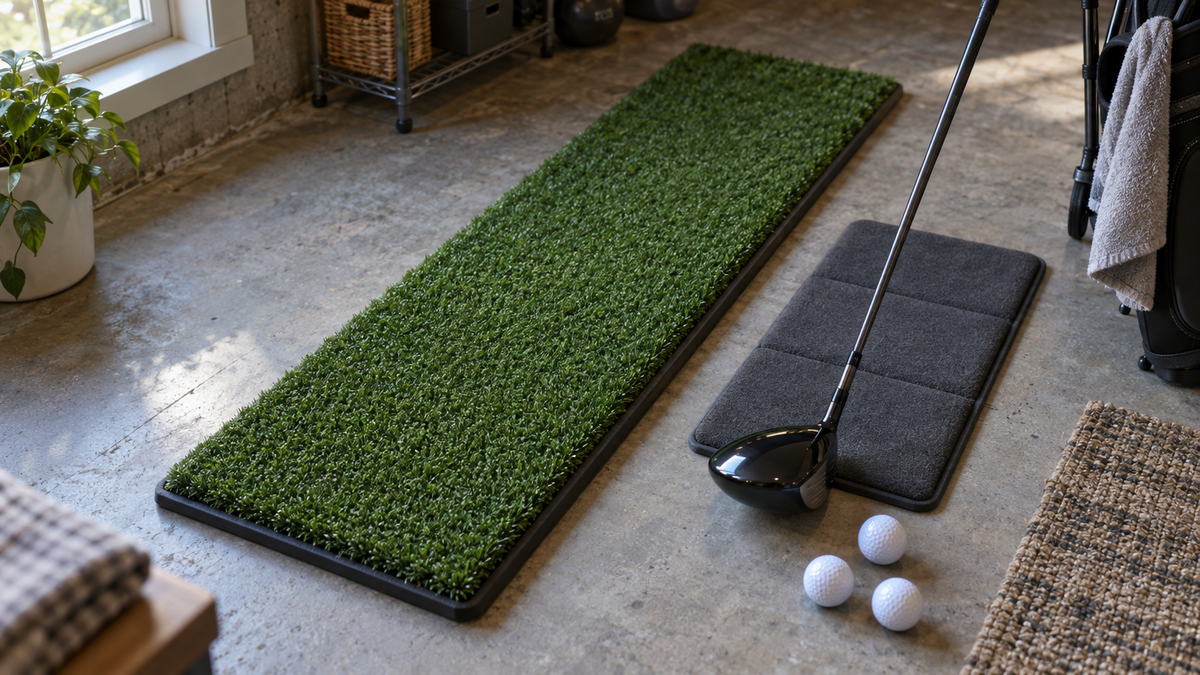
A common 4' x 7' mat can take up more than half the width of a 12-foot room. That leaves you a sliver of space for your swing, your bag and the walls you'd rather not hit.
If your bay is narrow, the golf simulator hitting strip vs full mat decision is not a minor detail. It changes how much room you have, how your joints feel after 100 swings and how much of your budget is left for the screen and enclosure. Here is how the two options compare for small rooms, and which one fits which budget.
Why Mat Footprint Matters in a Small Room
Recommended simulator room width runs from about 10 feet at the minimum to 12-13 feet preferred, and 14 feet if both right- and left-handed golfers will use it. Ceiling minimum is about 9 feet, with 10 feet comfortable for a driver. (Source: Foresight Sports and Golf Bays UK room-size guides; Golfers Authority enclosure guide)
A room under 12 feet wide sits at the low end of that range. Every foot of mat is a foot you can't use for your backswing or for a net wall.
Our hitting mat sizing guide covers exact dimensions by room size. This post answers a different question: whether you need a full mat at all.
What a Hitting Strip Actually Is
A hitting strip is a narrow piece of turf, often over a cushioned base, that covers only the strike zone. You pair it with a stance mat or bare floor under your feet.
Industry estimates put a strip at about 1.5-2 feet by 4-5 feet. That is a much smaller footprint than a full mat, and it can sit centered on the screen without shoving the rest of your setup sideways.
A full mat is one continuous surface from stance to strike. Common sizes are about 4' x 7' and 5' x 5'. (Source: Golfers Authority and Shop Indoor Golf mat guides)
Tight on width? Start with the strike zone.
Carl's Place HotShot Hitting Strips come from $79.95 to $279.95, depending on size and options.
Shop HotShot Hitting StripsHitting Strip vs Full Mat: Side by Side
Hitting strip vs full mat for rooms under 12 feet wide
Swipe to compare →
| Factor | Hitting strip | Full mat |
|---|---|---|
| Footprint | Smaller. Industry estimate: about 1.5-2 ft x 4-5 ft for the strip alone. Often paired with a stance mat. Can sit centered on the screen. | Common sizes are 4' x 7', 5' x 5', and 4' x 5' up to 6' x 10'. May need to be offset to center the ball on the screen. |
| Thickness and ceiling impact | Varies by product. Industry estimate: similar to the mat it replaces, but only over the strike zone. | About 29mm (slim mat) to 44mm (1.75 inch HotShot). Thickness reduces ceiling clearance. |
| Club and joint wear | Industry estimate: depends on turf and pad. Thin strips over hard floors can be harsh. Check that the strip is cushioned. | Industry estimate: thicker, padded mats generally absorb more impact. A single continuous surface also gives a consistent stance. |
| Lie realism | Industry estimate: realistic over the strike zone. The stance area is often a different surface. | Industry estimate: one continuous surface feels more uniform from stance to strike. |
| Price | Carl's Place HotShot Hitting Strips: from $79.95 to $279.95. | Carl's Place HotShot Golf Mat System: from $499.95 to $1,259.95. |
| Best for | Tight rooms, tighter budgets, replaceable hitting zone | Standalone setups and golfers who prioritize a consistent feel |
Club and Joint Wear: Where Strips Can Bite You
The strip's weak spot is cushioning. A thin strip laid straight on concrete can feel harsh on the wrists and elbows, and a hard floor under any turf punishes a heavy strike.
Check the padding before you buy, and think about what's under your feet. A strip on a stable base plus a soft stance surface can work well. A thin strip on bare slab is the version people regret.
Thicker padded full mats generally absorb more impact, and the one continuous surface gives you a consistent stance. That is the full mat's real advantage, and it is why some golfers accept the extra footprint.
Ball Lie Realism: Strike Zone vs Whole Surface
Over the strike zone, a good strip plays like a good mat. The ball sits on turf, the club interacts with turf, and your launch monitor reads the shot the same way.
The difference shows up at address. With a strip, your feet are on a different surface than the ball. Some golfers don't notice. Others feel the height step between stance and strike, especially with a stance mat of different thickness.
If you hit mostly irons from a consistent spot, a strip is fine. If you swap between drivers, wedges and uneven stances, the single surface feels more natural.
By the Numbers: What the Data Says
The prices below are market context, not our catalog. A slim full mat listed at 4'11" x 3'11" has 29mm total thickness (17mm turf, 12mm rubber base) and sells for about $223. (Source: retailer product listing, slim hitting mat)
Thicker mats take up more floor and add height. Our own Carl's HotShot mats come in 4' x 5', 5' x 8', 4' x 9' and 6' x 10', all 1.75 inches (about 44mm) thick. (Source: PGA Tour Superstore, Carl's HotShot Golf Simulator Hitting Mat listing)
One forum user reported that buying a strip and cutting it into a stance mat cost about half the price of a premade stance mat. Entry-level full mats can be found under $100, while a quality hitting mat can reach $2,000. (Source: Golf Simulator Forum hitting strip vs hitting mat thread; Golfers Authority)
Depth is a separate constraint. Camera-based launch monitors need roughly 14.5 feet of depth, and radar units need up to about 21 feet. (Source: PlayBetter, launch monitor space requirements) In a narrow room, that may decide your monitor before the mat does.
Approximate hitting-surface price by tier (USD)
Source: Golfers Authority and retailer and vendor listings. The $100 value is the 'under $100' ceiling cited for budget mats, not an average. Retailer and vendor figures, not independent market data.
Which Option Fits Your Budget
Tight budget: strip plus stance surface
The Carl's Place HotShot Hitting Strips run from $79.95 to $279.95. Pair one with a stance surface and you cover the strike zone without giving up floor. This is also the easiest piece to replace when the turf wears out.
Mid budget: one continuous surface
If you want a single uniform stance, the Carl's Place HotShot Golf Mat System comes in from $499.95 to $1,259.95 depending on size and options. Pick the smallest size that fits your swing, since the width is what you're trying to protect.
Full bay build: mat plus enclosure
Before you buy the mat in isolation, price the whole bay. Our enclosure cost breakdown lists every line item, and the enclosure kit guide shows what a kit includes and what you still have to add.
The Carl's Place Complete DIY Golf Bay Package (no launch monitor) runs from $3,252.70 to $3,717.70. Check the listing for exactly what is bundled before you decide what to buy separately.
The Short Answer
Choose a hitting strip if width is your problem, your budget is tight or you want a hitting zone you can replace cheaply. Choose a full mat if you value one continuous surface and have the floor space to spare.
Either way, protect your ceiling clearance and check the cushioning under whatever you swing on. The mat is the part you touch every shot, so it's worth getting right.
Once the floor is sorted, the screen is the next decision. Browse the impact screen collection to match one to your room.


Not sure which simulator fits your room?
The two-minute Simulator Finder Quiz checks your space and budget against every system we carry.

Keep Reading
Related guides

enclosure pipe frame kitGolf Simulator Enclosure Pipe Frame Kit: What Size to Buy for Your Room

enclosure kit what's includedGolf Simulator Enclosure Kit: What's Included, What's Missing, and What to Add Before You Order

enclosure build orderGolf Simulator Garage Conversion Step by Step: The Build Order That Saves You Rework