
ball return ramp
Golf Simulator Ball Return: Ramp, Turf, Tray and Screen Rebound Compared
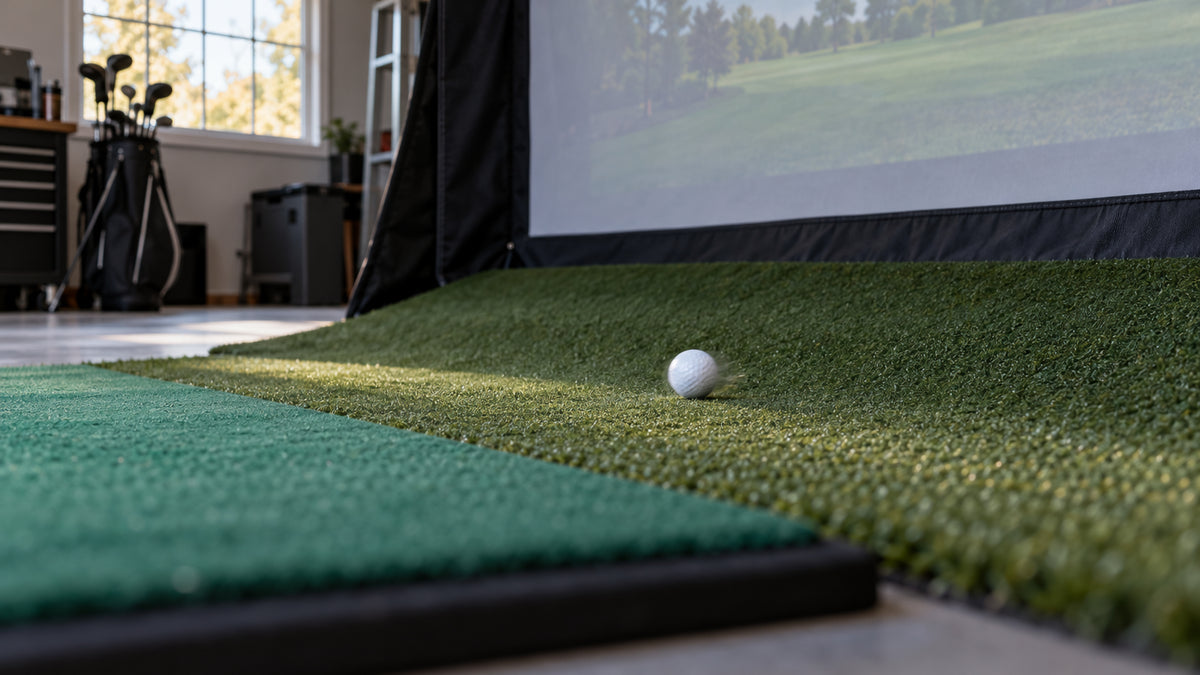
You hit a 7-iron, the ball thumps the screen, and then one of two things happens. It either dribbles back to your feet like a well-trained dog, or it skips under the bottom edge and disappears behind the enclosure. Neither outcome is luck. A good golf simulator ball return setup is just a handful of small decisions about where that ball is allowed to go after impact.
This guide walks through the four ways balls come back to you: screen rebound, a return ramp, landing turf and a ball tray. We will cover what each one does, what it will not do, and which combination suits a typical garage or basement bay.
Golf simulator ball return starts with the screen
Before you buy anything, understand that your screen is already a ball return. A taut impact screen sends the ball back toward you, and a loose one lets it drop. The goal is not to remove that rebound but to tune it so the ball stops a few feet in front of the screen instead of ricocheting past your mat.
Three things control it: how tight the screen is, how far it sits from the wall, and how far you stand from it. Get those right and most of your return problem is solved before any accessory shows up.
Tension and the bottom edge
The bottom edge matters most. Loosening or removing the bottom bungees lets the screen flex and cuts rebound force, while extra bungees along the top and sides keep the image flat (Source: The Indoor Golf Shop support article on excess ball bounce back). If you need extra bungees, the 9-inch black ball bungees are $0.40 each.
For the full distance numbers, see our breakdown of how far balls really rebound and how to stop it.
What the Data Says About Bounce-Back and Spacing
Published guidance on this is surprisingly consistent. Here are the numbers worth building around.
- Ideal bounce-back is roughly 1 to 3 feet, achieved with slight, even screen tension. An over-tight screen acts like a trampoline (Source: PlayBetter, Impact Screen Tension in Home Golf Setups).
- Stand at least 10 to 12 feet from the screen. Standing closer means more bounce-back and a higher risk of injury (Source: Carlofet, Impact Screen Bounce Back: Troubleshooting Tips; Trackman recommends 3.0 m or more).
- Leave about 12 to 16 inches behind the screen. Installers often push the screen against the wall, which is a main cause of excess bounce-back (Source: Carlofet; BenQ Australia; PlayBetter). We cover this in detail in our guide to the air gap behind the screen.
- Total room depth of about 15 feet is workable and about 18 feet is comfortable, with about 7 feet behind the golfer (Source: MyGolfSpy, How Much Space Do You Need To Build A Golf Simulator?).
Recommended spacing for bounce-back control
Source: Carlofet, PlayBetter, MyGolfSpy, BenQ. Values in feet. Screen to wall and bounce-back are midpoints of the published ranges (12 to 16 inches, 1 to 3 feet).
The Bottom Gap: Where Balls Escape
Even a well-tuned screen has a weak spot. A small gap between the screen's bottom edge and the base rail causes erratic ricochets on low shots, and balls can roll right under. Builders on the Golf Simulator Forum commonly fix this with a 2x4 along the bottom that forms a ramp to roll balls back (Source: Golf Simulator Forum build threads).
If you would rather seal the gap properly first, our guide to the impact screen bottom gap fix shows how.
Skip the lumber and buy the ramp ready made.
The Big Moss Return Ramp is $139.00 and sits at the base of your screen to roll balls back toward the mat.
Shop the Big Moss Return RampBall Return Ramp: The Fix for Rolling Shots
A return ramp is a sloped, turf-covered insert that rolls balls back toward the mat. It earns its place in setups where balls tend to run under or away from the screen, which is most garages with a hard floor and a slightly uneven slab.
It will not catch a ball that is still airborne, and it will not collect balls from a thin chip that dies at the screen. Think of it as the cleanup crew for the low, slow shots that the screen alone drops.
What a ramp does not fix
If balls are flying back at you at speed, the ramp is the wrong tool. That is a tension, spacing or distance problem, and the numbers above are where to start. Our guide to how far to stand from a golf impact screen covers the distance side.
Landing Turf: Calming the Ball and Protecting the Floor
Turf in front of the screen slows the ball and keeps it from bouncing away. It also saves your slab, since balls skipping across bare concrete are noisy and unpredictable. The Big Moss Golf Simulator Landing Turf runs from $1,816.95 to $2,379.95 depending on size and options, so it is the premium choice here.
That price makes it a purchase for dedicated bays rather than a casual garage setup. If your budget is tight, buy the ramp first and add turf later.
Ball Tray: Tidy, Not Magic
A tray collects balls near the golfer. It does not return them on its own, and that is exactly the point. It keeps balls off the floor, saves you a trip to the screen and speeds up re-teeing. The Carl's Place Ball Tray is $139.95.
Pair it with a ramp and you get a simple loop: the screen drops the ball, the ramp rolls it back, and the tray holds it until your next swing.
Which Method Fits Your Room
How balls return to the golfer: four methods compared
Swipe to compare →
| Method | How it works | Best for |
|---|---|---|
| Screen bottom gap and rebound | Loose bottom bungees let the screen flex. Rebound is about 1 to 3 ft and some balls roll under. | Low cost; needs a ramp or barrier to be reliable |
| Return ramp | A sloped, turf-covered insert (or a DIY 2x4 ramp) rolls balls back toward the mat. | Setups where balls roll under or away from the screen |
| Landing turf | Turf in front of the screen slows the ball and keeps it from bouncing away. | Protecting the floor and calming the ball |
| Ball tray | A tray or catch area collects balls near the golfer and does not return them on its own. | Tidy storage and quick re-teeing |
For most home bays the order is simple. Tune the screen first, since it costs nothing. Add a ramp if balls still escape, a tray if you are tired of bending down, and turf when you want the full finished look.
Plan the Whole Bay Before You Buy Parts
Ball return is one piece of a bay that also has to handle depth, swing clearance and screen distance. If you are laying out a room from scratch, Build your simulator in 3D and check the spacing above against your real dimensions before ordering anything.
Shop the Gear
Impact Screens we recommend


Not sure which simulator fits your room?
The two-minute 3D Simulator Builder checks your space and budget against every system we carry.

Keep Reading


