
concrete wall mounting
Golf Impact Screen Mounting on Concrete Wall: The Anchor Guide for Basements and Garages
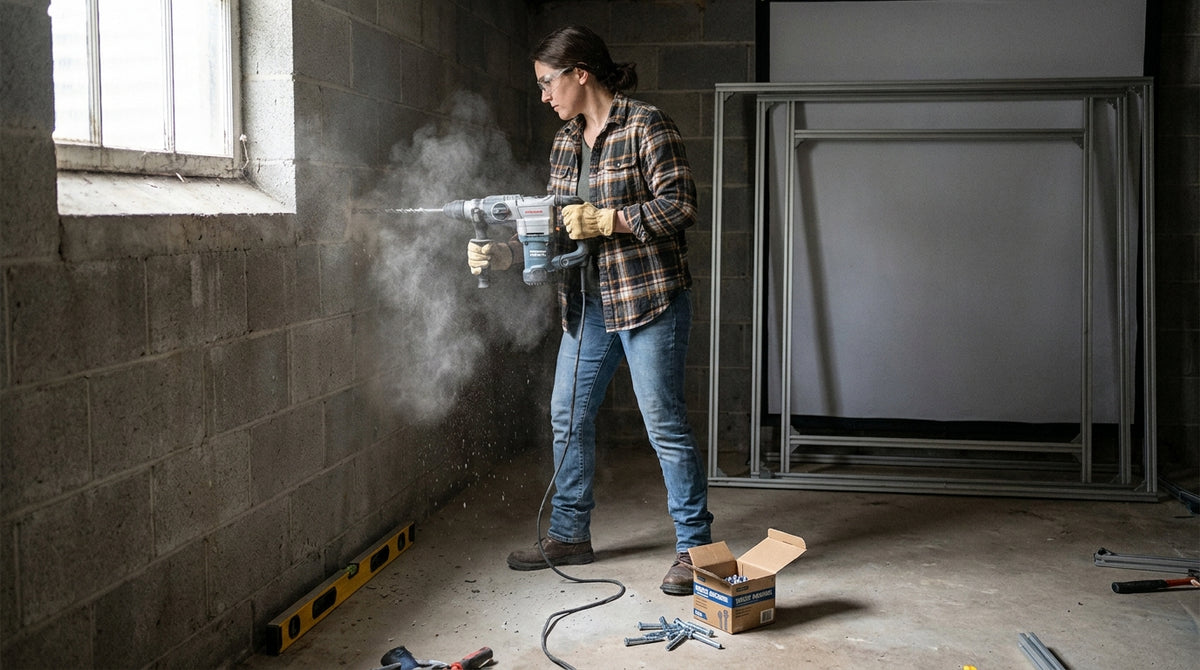
Here's the number that should calm your nerves before you drill: a single 3/8" wedge anchor set 2-1/2" deep into ordinary cured concrete has an ultimate pullout strength of about 5,445 lbs (Source: Eugene Fasteners / Concrete Fasteners wedge anchor load tables). Your tensioned impact screen doesn't pull with even a fraction of that.
So why do concrete mounts fail? Not because the anchors are weak. They fail because someone spaced them wrong, drilled too close to a mortar joint, or set them in green concrete. Mounting a golf impact screen on a concrete wall is less about brute strength and more about doing four small things correctly.
Let's walk through exactly how to do it.
Why Concrete Changes the Whole Game
Most impact screen guides assume you're hitting wood studs. You find the stud, drive a lag bolt, done. Concrete, cinder block, and brick throw all of that out the window.
Ready to shop impact screens?
Browse the full Carl's Place lineup — every screen ships ready to mount with real size specs.
Shop Carl's Place Impact Screens →There are no studs to find. Instead, you're anchoring into a solid (or hollow) masonry face, which means the failure mode isn't a stripped screw — it's the anchor pulling a cone of concrete out with it, or cracking a block near an edge. The good news is that poured concrete is dramatically stronger than any wood connection. The catch is that it's far less forgiving of bad placement.
You also can't just eyeball it. A garage or basement wall that looks like solid concrete might be cinder block with hollow cores, and that completely changes which anchor you reach for.
By the Numbers: What Your Anchors Actually Hold
The engineering here is almost comically over-built for a screen frame, which is exactly why so many builders overthink it. Look at the real load tables.
A 3/8" wedge anchor at 2-1/2" embedment carries roughly 5,445 lbs pullout and 5,955 lbs shear in 2,500–3,000 PSI concrete (Source: Eugene Fasteners / Concrete Fasteners wedge anchor load tables). Apply the standard 4:1 engineering safety factor and you still get about 1,361 lbs safe working pullout and 1,489 lbs shear (Source: Concrete Fasteners / UCAN wedge anchor spec sheets). That's per anchor. A four-anchor frame corner has a working margin measured in tons.
For context on what that hardware is absorbing: premium simulator screens are rated for ball speeds up to 250 MPH (Source: SIGPRO / Shop Indoor Golf enclosure specs). The screen fabric takes the ball; your anchors take the repeated jolt transmitted through the frame. If you want the full breakdown of those forces, our max ball speed rating guide digs into what actually reaches the wall.
Ultimate Holding Strength of 3/8" Concrete Anchors (2-1/2" embedment)
Source: Eugene Fasteners / Concrete Fasteners wedge anchor load tables (2,500–3,000 PSI concrete, 4:1 safety factor)
The takeaway: anchor count for a screen frame isn't about raw strength. It's about spreading the load along the frame so no single point pulls through, and keeping every anchor away from the parts of the wall that actually are fragile.
Building your enclosure from scratch? Start with the right screen for the frame you're anchoring.
Shop Impact ScreensWedge vs Sleeve vs Tapcon: Pick the Right Anchor
Four anchor types cover almost every concrete-wall sim build. The one you choose depends on whether your wall is solid poured concrete or hollow block, how close you are to edges, and whether you ever want to remove the frame.
Wedge anchors are the pro pick for permanent, heavy-duty static loads. Tapcon-style concrete screws are lighter-duty but removable — and Tapcon claims its large-diameter screws run up to 20% stronger than comparable wedge or sleeve anchors (Source: Tapcon / Online Fence Store anchor comparison). For crumbly block or tight edges, adhesive/epoxy anchors buy you the most flexibility.
Concrete Anchor Types for Mounting a Golf Impact Screen Frame
Swipe to compare →
| Anchor type | Best use / holding power | Spacing & edge rule (3/8") |
|---|---|---|
| Wedge anchor | Highest holding power; permanent, heavy-duty full-swing loads | 10x dia spacing (~3.75"); 5x dia edge, min 1-7/8" |
| Sleeve anchor | Distributes load over larger area; lowers crack risk in brick/block | ~6x dia spacing; keep off mortar joints |
| Tapcon (concrete screw) | Light-to-medium duty; removable; up to 20% stronger large-dia claim | Follow bit-matched pilot depth; avoid edges/joints |
| Adhesive/epoxy anchor | Max flexibility near edges; good for cracked or thin block | Edge distance as low as 1.5x dia in sound concrete |
Spacing, Edges, and the Mortar-Joint Trap
This is where most concrete mounts go sideways. The strength numbers above only hold if you respect spacing.
Minimum concrete anchor spacing is 10 anchor diameters center-to-center — many pros use 12x — and wedge anchors need at least 5 diameters, never closer than 1-7/8", from an unsupported edge (Source: Fastenere / Hilti / ACI 318-19 spacing guidance). For a 3/8" anchor that's roughly 3.75–4.5" between anchors and a healthy buffer off any edge.
The sneaky part in a block wall: mortar joints are the weakest zone on the wall. When a frame corner happens to land near a joint, drill into the solid face of the block instead — not the seam. If you can't avoid it, that's exactly where a sleeve or epoxy anchor earns its keep. It's the same structural thinking we lay out in the impact screen weight capacity guide.
Don't Anchor Green Concrete
One quiet killer in new builds: wedge anchors should not be installed in concrete less than 21 days old, and their ratings assume roughly 2,500–3,000 PSI cured concrete (Source: UCAN wedge anchor datasheet). Set anchors in a freshly poured garage slab or new foundation wall and you're gambling with numbers that simply don't apply yet. Wait it out.
Keeping the Screen Taut When You Can't Hit Studs
A rigid frame bolted to concrete is only half the job — the screen still has to stay drum-tight. Because you can't sink anchors just anywhere on a masonry face, plan your frame so tension bungees or straps pull toward solid, well-anchored corners rather than mid-span points with no backing.
A stiff steel frame helps enormously here; it carries tension between anchor points so the wall doesn't have to. If you're still choosing frame stock, the trade-offs matter, and our tensioning system guide covers how to dial it in without over-stressing any single anchor.
Budget-wise, this hardware is the cheap part of the build. Standalone impact screens run roughly $135 to $468 depending on single-, dual-, or triple-layer construction, and full DIY wall enclosures land around $670–$1,060 for a 16'x9' build (Source: Big Horn Golfer / Gungho Golf DIY build guides). A handful of quality anchors is a rounding error against that — so don't cheap out on the four things holding your screen to the wall.
The Short Version
Concrete is the strongest wall you can mount to. Use wedge anchors for solid poured concrete, keep 3/8" anchors about 4" apart and well off edges and mortar joints, wait 21 days on fresh pours, and let a rigid frame carry the tension. Do that and your screen isn't going anywhere.
Ready to build a wall setup that lasts?
Pick a screen tier built for real full-swing loads, then anchor it to concrete the right way.
Shop Impact ScreensNot sure which simulator fits your room?
The two-minute Simulator Finder Quiz checks your space and budget against every system we carry.


Keep Reading
Related guides

enclosure sizingGolf Impact Screen for Tall Golfers: The Height-Based Sizing Guide Nobody Publishes

buying guideHow to Choose the Right Golf Impact Screen (And Why It Matters More Than Your Launch Monitor)

ball containmentGolf Impact Screen vs Curtain Enclosure Sides: Which Panels Actually Need Screen Material?