
2026
Best Golf Simulators for Small Garages (2026) — Space-Saving Setups That Actually Work
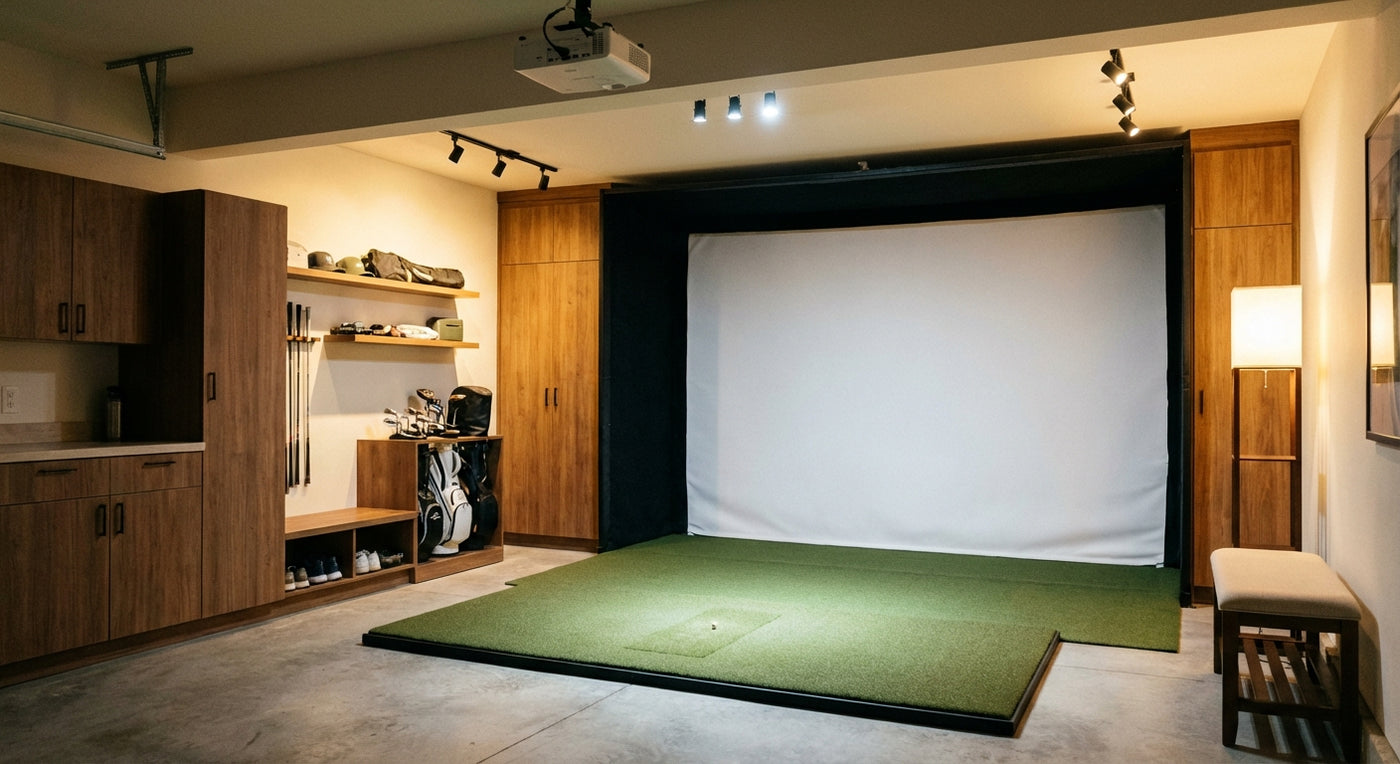
Quick answer
A small-garage sim needs roughly 10–12 ft of depth, 6–8 ft of width, and a 7.5–8 ft ceiling.
Tighter than that? Some setups work down to about 8×10 ft — it comes down to your exact numbers. Check your garage in 30 seconds:
Will my garage fit? →The Small Garage Challenge
You want a golf simulator. Your garage is cozy. 10x12? Maybe 8x10? Most setup guides assume unlimited space. You dont. So what actually works in tight quarters?
The truth: small garage simulators are totally viable — thousands of home builders have done it. You just need to choose equipment strategically. The wrong launch monitor or screen combo will swallow your space. The right setup? Professional-grade simulator in a footprint that fits.
Space Requirements: What You Actually Need
Minimum Space for a Simulator
- Hitting distance: 7-9 feet minimum (from mat to screen)
- Width: 6-8 feet for shoulder room
- Height: 7.5-8 feet minimum
If your garage is 8x10, youre looking at 70-80 sq ft of usable space. A simulator will consume 60-70 of that for hitting. Thats okay — its the constraint youre working with.
The Height Question
This is the killer. You need:
- 7-7.5 feet for golf swing clearance
- 6 inches for screen mounting
- 3-6 inches of breathing room
If your ceiling is under 7 feet, a simulator is tough but possible. Check our complete ceiling height guide for exact measurements based on your height.
Best Launch Monitors for Small Garages
In tight space, your launch monitor matters as much as the screen. You want something compact, accurate, and requires minimal hitting distance.
1. SkyTrak Plus (Best Budget Pick)
- Ceiling-mounted option (saves floor space)
- Works with 7 feet of hitting distance
- $2,000-2,500
- Compatible with Unreal Engine for photorealistic graphics
Downside: Slightly lower accuracy than premium models, but more than adequate for small garages.
2. Uneekor QED (Best All-Around)
- Ultra-compact footprint
- Ceiling or wall mount — your choice
- 8+ feet of hitting distance recommended
- Excellent ball spin data
- $3,000-3,500
Real advantage: Uneekor gear is built for tight spaces. They know their market.
3. Garmin R10 (Most Compact)
- Smallest launch monitor available
- Requires only 7 feet of space
- $3,000
- Velcro or ceiling mount
Gotcha: Lower accuracy than Uneekor, but solid for casual play.
Screen Options for Tight Spaces
Impact Screens (Recommended)
An impact screen is better than a net for small garages because:
- Takes up less floor space (hangs on wall)
- More durable (no bounce-back issues)
- Professional feel, minimal deflection
Best for small garages: Carl's Place Standard Impact Screen in the smallest size (8x10 or 10x10). Wall-mounted, 10x10 = 10 ft width, 10 ft height. Hitting zone only needs 7-9 feet out. See our full impact screen guide to compare all options.
Golf Nets (Budget Alternative)
- Cheaper ($400-800)
- Portable placement
- Downside: Takes more floor space, louder impact
If you go this route, choose a reinforced net with a glued-down hitting mat.
Small Garage Setup Example
Here's what works in a 10x12 garage:
- SkyTrak Plus (ceiling-mounted) — $2,200
- Carl's Place 10x10 Impact Screen — $1,400
- Premium hitting mat — $200
- Basic enclosure frame — $300
Total: ~$4,100
Layout: 7.5 ft hitting distance, 8 ft width (shoulder room), screen on back wall, launch monitor ceiling-mounted, minimal extra space but it WORKS.
Pro Tips
- Mount everything that can be mounted — Save floor space with ceiling mounts and wall storage
- Use vertical space — Wall shelving for equipment, overhead ball storage
- Consider portable setup — Adjustable mounts so launch monitor can move for weekend garage work
- Ventilation matters more in tight spaces — Install a small fan or ensure AC reaches the space
- Need the full picture? Read our complete golf simulator room setup guide for lighting, flooring, and layout tips.
- Test before committing — Try a simulator before dropping $4K+ on equipment
The Bottom Line
A golf simulator absolutely works in a small garage. Thousands have done it. The keys:
- Measure ceiling height first (non-negotiable)
- Choose space-efficient launch monitor (SkyTrak Plus, Uneekor, or Garmin R10)
- Mount your screen on the wall, not the floor
- Maximize vertical space for storage
- Expect tight hitting area — thats okay
Ready to build? Start by measuring your space carefully, then reach out. We'd love to help you design a setup that fits your garage.
Let's make it work. ⛳
Not sure which simulator fits your room?
The two-minute Simulator Finder Quiz checks your space and budget against every system we carry.


Keep Reading


