
buyer's guide
Best Golf Simulator Impact Screens for Home Setups (2026 Buyer's Guide)
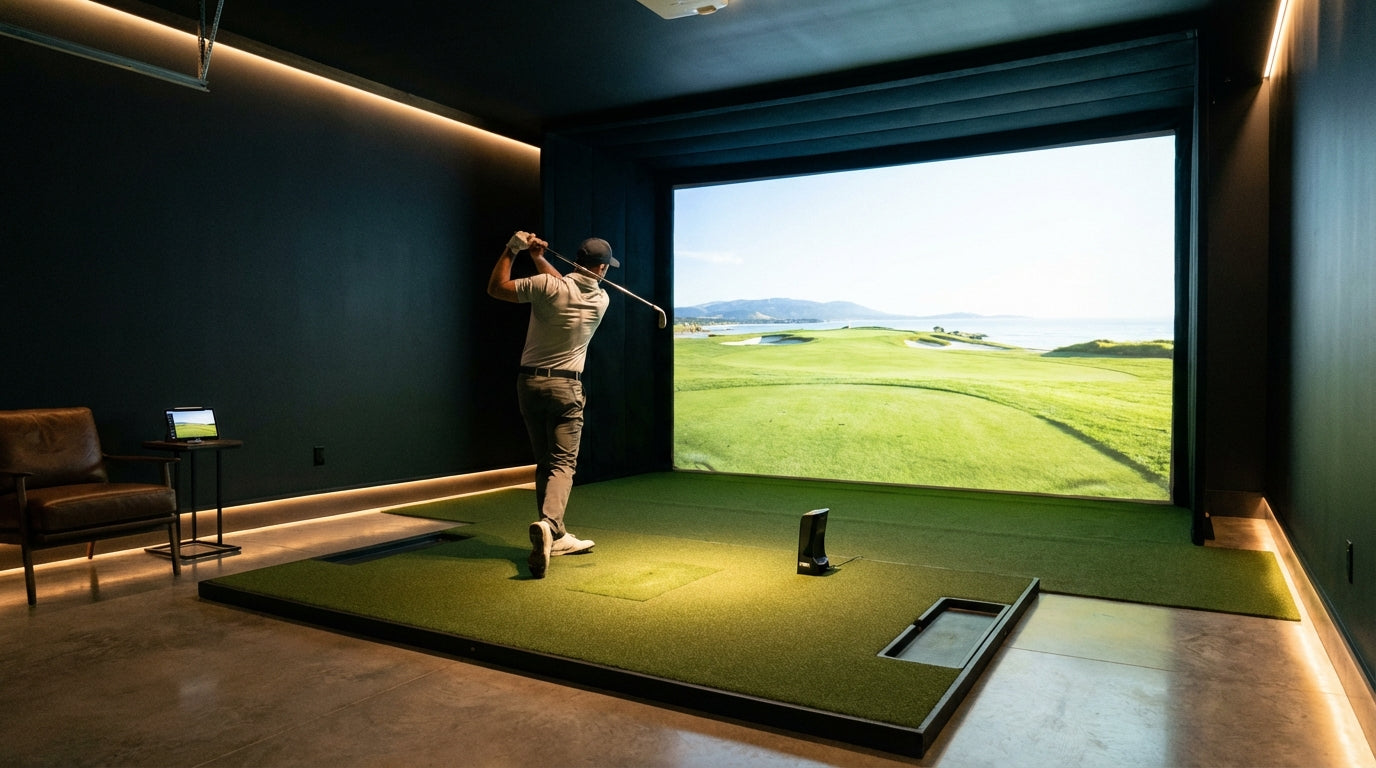
If you've been piecing together a home golf simulator, you've probably hit this question at some point: do I actually need an impact screen, or can I just use a net?
It's a fair question. Nets are cheaper upfront. They stop the ball. They look like they'd work. But if you want to use a projector and actually see where your shots go — at Pebble Beach, TPC Sawgrass, or wherever your fantasy round takes you — you need an impact screen. Full stop.
Choosing the best golf simulator impact screen for a home setup isn't as simple as buying the biggest one that fits your wall, though. There are real differences in durability, flatness, projector performance, and long-term wear that are worth understanding before you spend a few hundred dollars on something you'll be hitting thousands of balls into.
This guide breaks it all down.
Impact Screen vs. Golf Net: What's Actually Different?
A golf net and an impact screen both stop the ball. That's where the similarities end.
Ready to shop impact screens?
Browse the full Carl's Place lineup — every screen ships ready to mount with real size specs.
Shop Carl's Place Impact Screens →A net is a mesh that catches balls. It absorbs impact through flex and bounce. You see the ball hit it and… that's it. No data, no course visuals, just your backyard or garage.
An impact screen is a taut, woven panel — usually polyester or nylon — stretched flat across a frame. It's specifically designed to hold a projection image without rippling, while also absorbing repeated ball impacts at full swing speed without tearing, fraying, or leaving permanent ball marks.
That last part is where most cheap screens fail. Low-quality impact screens develop a pattern of ball marks over time — little indentations that scatter your projected image and make every shot look like you're playing through a snowstorm. Good screens are engineered to resist this.
Bottom line: If you're building a simulator with a projector and launch monitor, you need an impact screen. If you're just working on swing mechanics or distance without visuals, a net gets the job done for less money. But for any real simulator experience? Screen all the way.
What Makes a Great Golf Impact Screen?
Not all screens are built equal. Here's what actually matters:
Material and Weave
The best impact screens use a tight woven construction — multiple layers of polyester bonded together. This does two things: it spreads the force of impact across a wider area (so no single spot takes a beating), and it creates a smooth, consistent surface for projection.
Avoid single-layer or loosely woven screens. They're cheaper for a reason.
Impact Resistance (Ball Marks)
This is the real differentiator. Over months of use, some screens develop a grid of small impact craters that scatter projected light. A quality screen — like the Carl's Place woven impact screen — holds its surface integrity after thousands of shots. The material is designed to return to flat after each impact rather than deforming permanently.
If a screen's product listing doesn't mention impact durability or talk about ball mark resistance, that's a red flag.
Projector Compatibility and Screen Gain
Your impact screen is also your projection surface. Screen gain refers to how well it reflects projected light back at your eyes. Too high and you get hotspots. Too low and the image looks washed out, especially in a room with ambient light.
Most quality golf simulator screens have a gain of around 1.0–1.2, which gives you a bright, even image without glare. The texture also matters — a slightly textured surface reduces hotspots compared to a perfectly smooth screen.
Size: Get It Right for Your Space
Standard impact screens come in widths from 8 feet to 16+ feet. For a home setup, most people land on a 10'x8' or 12'x9' screen — but the right size depends entirely on your room dimensions.
You need to account for the projector throw distance (how far back it sits) and your swing arc. Check out our complete guide to golf simulator room setup for the full breakdown on spacing — it covers everything from projector placement to hitting mat position.
And don't overlook ceiling height. A lot of people build their setup and then realize their driver swing clips the ceiling on the follow-through. If you're building in a garage, our ceiling height guide for garage golf simulators will save you a headache.
Frame and Mounting
The screen itself is only part of the equation. How you mount it matters almost as much. A screen that's not properly tensioned will ripple when hit and distort your projected image.
Options range from DIY wood frames (cheapest, but can bow over time) to metal enclosure kits designed specifically for golf simulators. For a permanent setup, a proper enclosure with bungee attachment points around the screen perimeter gives you the best tension and the cleanest look.
Our Top Pick: Carl's Place Impact Screen
If you want a recommendation without all the research: Carl's Place makes the best golf simulator impact screen for home use. Full stop.
Carl's Place has been making golf simulator screens longer than almost anyone, and it shows. Their woven polyester construction is legitimately durable — we're talking years of heavy use without the ball-mark degradation that plagues cheaper alternatives.
Key reasons it stands out:
- Consistent flatness — The tight weave holds tension well and doesn't sag over time
- Excellent projection quality — The screen gain and texture are dialed in for projector use
- Impact durability — Designed specifically for golf simulator ball speeds, not repurposed projector screen material
- Multiple size options — Available from 8 feet wide to custom dimensions
- Grommets and bungees included — Easy to mount on any frame system
It's not the cheapest screen you'll find. But when you're hitting hundreds of balls per session, cheap screens become expensive screens within a year. The Carl's Place holds up.
You can browse the full range of impact screens here — we carry the standard woven version as well as the premium enclosure kits.
Common Impact Screen Mistakes to Avoid
Buying too small. A screen that doesn't fully cover your field of play means stray shots going into the wall (or worse). Measure your space and buy a screen with at least 12 inches of margin on each side of your hitting area.
Skipping the enclosure. If you're building a dedicated space, a full enclosure baffles sound (golf simulators can be loud), contains ball bounce-back, and gives your screen the proper tension it needs. It also looks a thousand times better than a screen bolted to a wall.
Not considering ambient light. Impact screens work best in low-light rooms. If your simulator space has windows, you'll want blackout curtains or shades. Even a small amount of daylight can wash out your projected image.
Choosing a screen for aesthetics, not function. Some screens look amazing in photos but have weird textures that create hotspots or don't have the right gain for projectors. Always prioritize screens built specifically for golf simulator use — not photography backdrops or home theater screens.
Building Your Full Setup
Once you've sorted the screen, the next pieces fall into place. Most home simulator setups also include a launch monitor (for ball and club data), a projector, simulator software, and a hitting mat.
If you're working with a tighter budget, our post on building a budget golf simulator under $2,500 shows how to prioritize your spending to get the most from a modest investment. Spoiler: the screen is not where you want to cut corners.
Final Thoughts
The best golf simulator impact screen for a home setup is the one that's properly sized for your space, built for durability (not just looks), and optimized for projection use. Carl's Place hits all three marks and it's what we recommend to anyone building a serious home simulator.
The screen is the heart of your simulator — it's the thing you look at every single shot. Get it right and everything else gets better: the image, the experience, the motivation to actually use the thing you built.
Ready to pick yours? View our full selection of impact screens here →
Not sure which simulator fits your room?
The two-minute Simulator Finder Quiz checks your space and budget against every system we carry.


Keep Reading
Related guides

golf simulatorGolf Impact Screen Max Ball Speed Rating: What Your Screen Really Survives at 110+ MPH

corner setupGolf Simulator Impact Screen for a Corner Setup: How to Angle It Without Wrecking Your Bounce-Back

golf simulatorGolf Simulator Impact Screen for a Shed: How to Size, Hang, and Tension It Right