
ceiling height
How Much Ceiling Height Do You Actually Need for a Garage Golf Simulator? (2025 Guide)
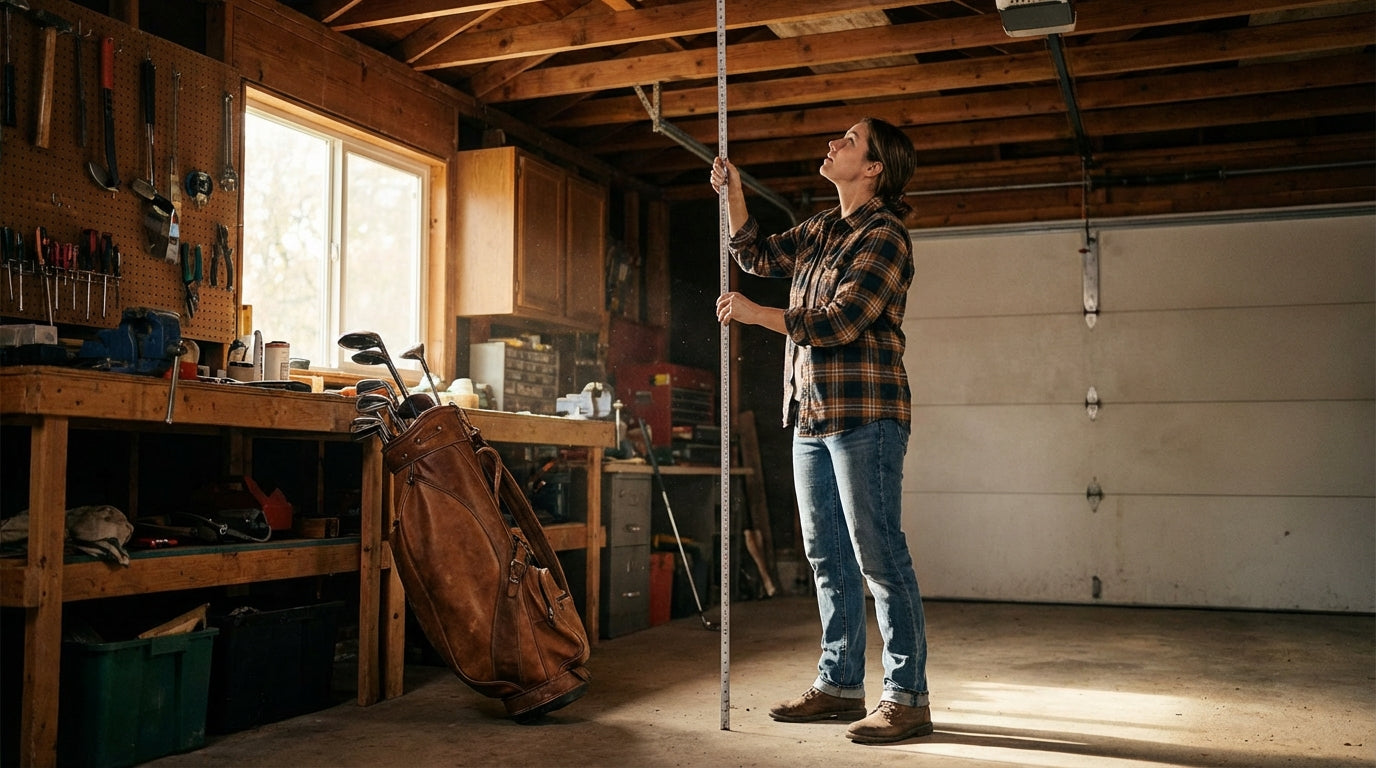

The Question Everyone Asks (But Few Answer Correctly)
"I have 9-foot ceilings in my garage. Is that enough for a golf simulator?"
We hear this daily. And most websites give you a lazy answer like "you need 9-10 feet" without explaining why, how to measure it correctly, or what happens if you are an inch short.
So here is the real breakdown — from actual installations, not spec sheets.
Free tool — 30 seconds
Will a simulator fit your room?
Enter your room’s length, width, and ceiling height — the calculator tells you instantly what fits and exactly which screen size to order.
Check my room size →The Honest Numbers
Minimum Ceiling Height: 8.5 Feet
Technically, you can swing a driver with 8.5 feet of ceiling height — but it depends on three factors:
- Your height: If you are 6 feet 2 or taller, you need more clearance than someone 5 feet 8
- Your swing: Do you have an upright swing or a flatter one?
- The launch monitor: Overhead units (like Uneekor or ProTee) need 9-9.5 feet minimum
Comfortable Ceiling Height: 9 Feet
9 feet is the sweet spot for most golfers. It allows:
- Full driver swings without fear of hitting the ceiling
- Overhead launch monitor mounting (most need 9-10 feet)
- Some forgiveness if your mat compresses over time
Ideal Ceiling Height: 9.5-10 Feet
This gives you breathing room for:
- Tall golfers (6 feet plus) with driver swings
- Overhead units that need precise mounting
- Future-proofing if you change launch monitors
How to Measure Correctly (Most People Get This Wrong)
Step 1: Measure Finished Floor to Ceiling
Do not measure from concrete. Measure from the top of whatever flooring you will use:
- Hitting mat thickness: usually 1-2 inches
- Turf or carpet: 0.5-1 inch
- Platform (if building one): 2-4 inches
Example: Your garage ceiling is 9 feet (108 inches). Your hitting mat is 1.5 inches thick. Your actual clearance is 106.5 inches.
Step 2: Account for Enclosure Drop
If you are using an impact screen with an enclosure, the top bar sits below the ceiling:
- Carls Place DIY enclosures: top bar sits 4-6 inches below ceiling
- SIG enclosures: frame sits 3-5 inches below ceiling
- Custom builds: varies by design
Step 3: Test Your Actual Swing
Before you buy anything:
- Stand in your garage with a driver
- Take your normal swing (slowly at first)
- Have someone watch or video you
- Note where the clubhead reaches at its highest point
Add 3-4 inches of buffer to that number.
What If You Are Close? (8.5-9 Feet)
Option 1: Shorter Clubs
Use a 3-wood or hybrid for indoor practice. You lose some distance data but gain full swings without risk.
Option 2: Flatter Swing Adjustment
Some golfers naturally adapt a flatter swing indoors. It is not ideal for transferring to the course, but it works for practice.
Option 3: Different Launch Monitor
If you have 8.5 feet, skip overhead units (Uneekor, ProTee, Falcon) and go with:
- SkyTrak+: Sits on the ground, works with 8-foot ceilings
- Garmin R10: Portable, ground-based, works anywhere
- FlightScope Mevo+: Ground-based, accurate, space-friendly
What About Width and Depth?
Ceiling height gets all the attention, but do not ignore:
- Width: 10 feet minimum, 12+ feet ideal (for left/right misses)
- Depth: 12 feet minimum (launch monitor to screen), 15+ feet ideal
The Florida Factor
Living in Florida (like us at GolfingSim), garages often have:
- Higher ceilings (9-10 feet is common in newer homes)
- Garage door tracks that eat up 6-12 inches of ceiling space
- Humidity that makes you want a retractable screen for airflow
Measure carefully around garage door hardware.
Bottom Line
8.5 feet: Possible with ground-based launch monitors
9 feet: Comfortable for most golfers
9.5-10 feet: Ideal, opens up all launch monitor options
Still not sure? Take our Room Size and Fit Guide — answer 5 questions and get specific recommendations for your space.
Questions about fitting a golf simulator in your garage? Email us at team@golfingsim.com or call (561) 818-7395. We have installed simulators in hundreds of garages across Florida and can help you figure out exactly what will work in your space.
Not sure which simulator fits your room?
The two-minute Simulator Finder Quiz checks your space and budget against every system we carry.


Keep Reading


