
Carl's Place
How to Choose the Right Golf Impact Screen Material (Standard vs. Preferred vs. Premium)
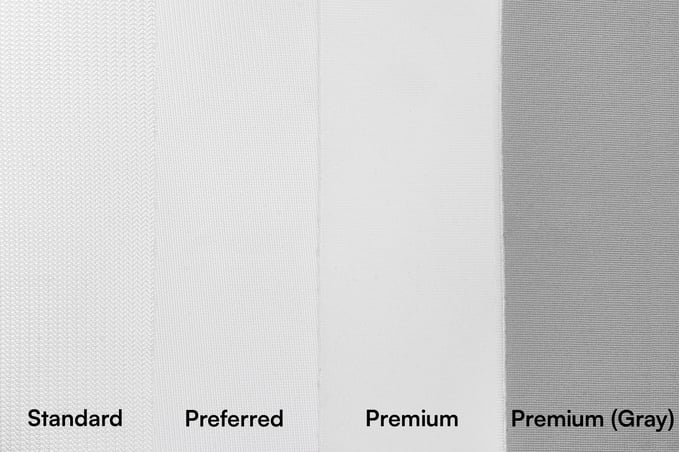
Most golfers spend weeks researching launch monitors and software — then grab whatever impact screen is on sale and call it a day. That's backwards. The golf impact screen material you choose determines how good your simulator actually looks and how long it lasts. Get it wrong and you're staring at a blurry, washed-out image every session. Get it right and your sim looks like a broadcast.
Here's the thing: all quality impact screens are made from the same base material — polyester. But not all polyester is created equal. Weave tightness, number of layers, surface coatings — these all change how the screen performs. Let's break it down.
Why Polyester Is the Gold Standard for Golf Impact Screen Material
You might wonder why every reputable screen manufacturer uses polyester. Simple: it's the only material that checks all the boxes at once.
Ready to shop impact screens?
Browse the full Carl's Place lineup — every screen ships ready to mount with real size specs.
Shop Carl's Place Impact Screens →Polyester mesh handles the impact of a golf ball traveling at 200+ mph without tearing. It stretches just enough to absorb the hit and spring back into shape. It holds up to years of use without sagging, fading, or degrading. And most importantly — it's white enough to project a crisp, vibrant image when paired with a quality projector.
Natural fabrics like canvas absorb too much impact and don't recover well. Netting-style materials stop the ball but can't project an image. Polyester mesh threads that needle perfectly.
All Carl's Place impact screens — which we carry here at GolfingSim — are made from 100% heavy-duty polyester. But the construction varies significantly between tiers. That's where your decision actually lives.
The 3 Tiers of Golf Impact Screen Material — What Actually Differs
You've got three main options: Standard, Preferred, and Premium. Here's what each one actually means in terms of material construction.
Standard Impact Screen
The Standard is built from 100% heavy-duty polyester with an open, loosely woven construction. The weave is more open than the higher tiers — you can hold it up to the light and see through it slightly. That open weave does two things: it reduces ball impact resistance slightly (though it's still tested to 250 mph), and it creates a slightly softer surface that's less ideal for ultra-HD projection.
For golfers who are just getting into simulation or building their first setup on a budget, the Standard gets the job done. It's durable, it'll hold up to the shots you hit into it, and it's an excellent way to get your foot in the door with golf simulation without spending a ton of money. Image quality is solid. Ball speeds up to 250 mph are handled fine. It's just the starting point, not the ceiling.
Preferred Impact Screen
The Preferred steps up with 100% heavy-duty polyester that's more tightly woven — and critically, it adds a silicone reinforcement layer. That silicone coating does two things: it strengthens the fibers without adding bulk, and it creates a smoother, more uniform projection surface.
The tighter weave means fewer gaps between fibers, which translates directly to better image sharpness. Colors are punchier. Fine details in the course graphics come through cleaner. Still rated to 250 mph, but the overall construction is beefier.
Most serious home simulator builders land here. It's the sweet spot of price, durability, and image quality. If you're pairing with a 4K projector, the Preferred is where you really start to see the difference.
Curious about how screen size affects image quality too? Check out our guide on how to choose the right golf simulator screen size — screen dimensions and material work together.
Premium Impact Screen
The Premium is the pinnacle. Three full layers of heavy-duty, tight-knit impact-resistant polyester. Not one layer, not two — three. The result is a screen surface that's measurably smoother than anything below it.
That smoothness matters enormously for image quality. Every bit of surface texture or fiber gap that the projector light has to pass through introduces diffusion — which softens and muddies the image. The triple-layer Premium construction essentially eliminates that diffusion. What you get is as close to projecting onto a solid white wall as a fabric screen can get.
The Premium is roughly an eighth of an inch thick — you can actually feel the padding when you squeeze it. That thickness makes a real difference beyond image quality. The thinner Standard and Preferred screens produce more of a loud slap when the ball hits. The Premium? More of a dull thud. If your sim is in a shared space or you're hitting late at night, that noise reduction matters.
There's another benefit to the thicker material: ball dimples. On thinner screens, you'll clearly see where each ball impacts the surface. With the Premium, those dimples are much less noticeable because the extra padding absorbs and distributes the force better.
This is the screen for golfers running a 4K laser projector who want to maximize every dollar they put into their setup. It's also the most durable tier — three layers of tight polyester take significantly more abuse over time. Still tested to 250 mph, but in practice the material just lasts longer under repeated high-speed impacts.
Bonus Option: HC Gray — The Golf Impact Screen Material for Bright Rooms
If your sim space gets natural light — a garage with windows, a basement with egress windows, a room with recessed overhead lighting — the HC Gray (High-Contrast Gray) deserves serious consideration.
HC Gray is a specialized version of the Premium-level construction, but made with a darker gray polyester instead of white. That gray base dramatically improves contrast and color saturation when ambient light is present. On a standard white screen, ambient light washes out blacks and muddies colors. On HC Gray, the darker material absorbs ambient light rather than scattering it, which preserves contrast ratio even in imperfect lighting conditions.
The tradeoff: HC Gray requires a brighter projector to compensate for the darker surface. In a fully light-controlled room, white screens will always win on raw brightness. But if you can't kill all the light, HC Gray gives you your image quality back.
Check our full rundown of the best golf simulator impact screens for home setups to see how these tiers perform across different room configurations.
What the Data Says About Golf Screen Material and Image Quality
Surface smoothness is the number one driver of projected image quality on golf impact screens. A tighter weave reduces light diffusion by up to 40% compared to open-weave alternatives. (Source: Carl's Place product testing data)
Golf balls commonly exceed 150 mph in home simulator setups, with tour-speed swings reaching 185+ mph. All Carl's Place screen tiers are tested to 250 mph — well above the threshold where material selection becomes a safety concern. (Source: Carl's Place specifications)
Polyester retains approximately 95% of its tensile strength after 10,000 repeated impacts at medium velocity, making it the top-performing synthetic fabric for repeated-impact applications. (Source: textile industry durability benchmarks)
Side-by-Side: Golf Impact Screen Material Comparison
Swipe to compare →
| Standard Golf Screen |
Preferred Golf Screen |
Premium Golf Screen |
High Contrast Gray Golf Screen |
|
|---|---|---|---|---|
| Cost | See Pricing | See Pricing | See Pricing | See Pricing |
| Sizes | Customizable | Customizable | Customizable | Customizable |
| Smoothness for Crisp and Clear Image |
Good | Great | Excellent | Excellent |
| Thickness | Above Average | Above Average | Excellent | Excellent |
| Durability | Good | Great | Excellent | Excellent |
| Noise Dampening | No | No | Yes | Yes |
| Ball Speed Rating | 250 mph | 250 mph | 250 mph | 250 mph |
How to Get the Most Life Out of Your Impact Screen
All impact screens are wearable items — by their nature, they'll wear out with use. But a few simple habits will dramatically extend the lifespan of any tier:
- Stand at least 10 feet back. The closer you are, the more force the screen absorbs on each hit.
- Leave 12 inches of space behind the screen. The screen needs room to flex backward on impact. If the ball pushes the screen into a wall or frame behind it, that creates a pinch point that accelerates wear.
- Use clean clubs and clean golf balls. Dirt and cuts on golf balls act like sandpaper on the screen material. Inspect your balls regularly.
- Dry immediately after cleaning. If you need to clean your screen, use a clean white rag with soapy water. Dry the screen with fans as quickly as possible to avoid water stains.
- Steam out wrinkles carefully. All Carl's Place screens are cut and sewn to order (not sitting on a shelf collecting deeper wrinkles). A garment steamer with a guard attachment will safely remove shipping wrinkles without risking heat damage.
Which Golf Impact Screen Material Is Right for You?
Here's the quick decision tree:
Light-controlled room + tight budget? Standard gets the job done.
Light-controlled room + 4K projector? Preferred is your sweet spot.
Dedicated sim room + best-possible image? Premium, no question.
Room with windows or ambient light? HC Gray.
One thing worth knowing: the screen material decision interacts with your whole room setup. Ceiling height, projector throw distance, room lighting — they all factor in. If you're still dialing in your space, our ceiling height guide for home golf simulator setups is worth a read before you finalize your screen choice.
All of these screens attach with loop fasteners (velcro) for easy installation and adjustment. Setup is genuinely straightforward — no tools required beyond some basic wall anchors.
The bottom line: don't let the screen be an afterthought. It's literally the biggest thing your eyes are going to be looking at every single session. Pick the right golf impact screen material for your room and your projector, and your whole sim experience upgrades instantly.
Pick the Best Golf Screen Material for Your Use
Carl's Place offers 4 different impact screens:

Carl's Standard Golf Screen offers an inexpensive impact screen that still protects shots up to 250 mph.

Carl's Preferred Golf Screen gives you a tighter weave for a smoother picture. It gives you noticeably better image definition (a commercial and home favorite).

Carl's Premium Golf Screen offers three layers of tight-knit polyester for the smoothest, sharpest projection surface available. The gold standard for dedicated sim rooms.

Carl's HC Gray (High-Contrast) Screen uses a darker gray material that dramatically improves contrast in rooms with ambient light. Premium-level construction with bright-room performance.
Not sure which simulator fits your room?
The two-minute Simulator Finder Quiz checks your space and budget against every system we carry.


Keep Reading


