
basement golf simulator
Golf Simulator Screen for Basement Setup: What You Need to Know Before You Buy
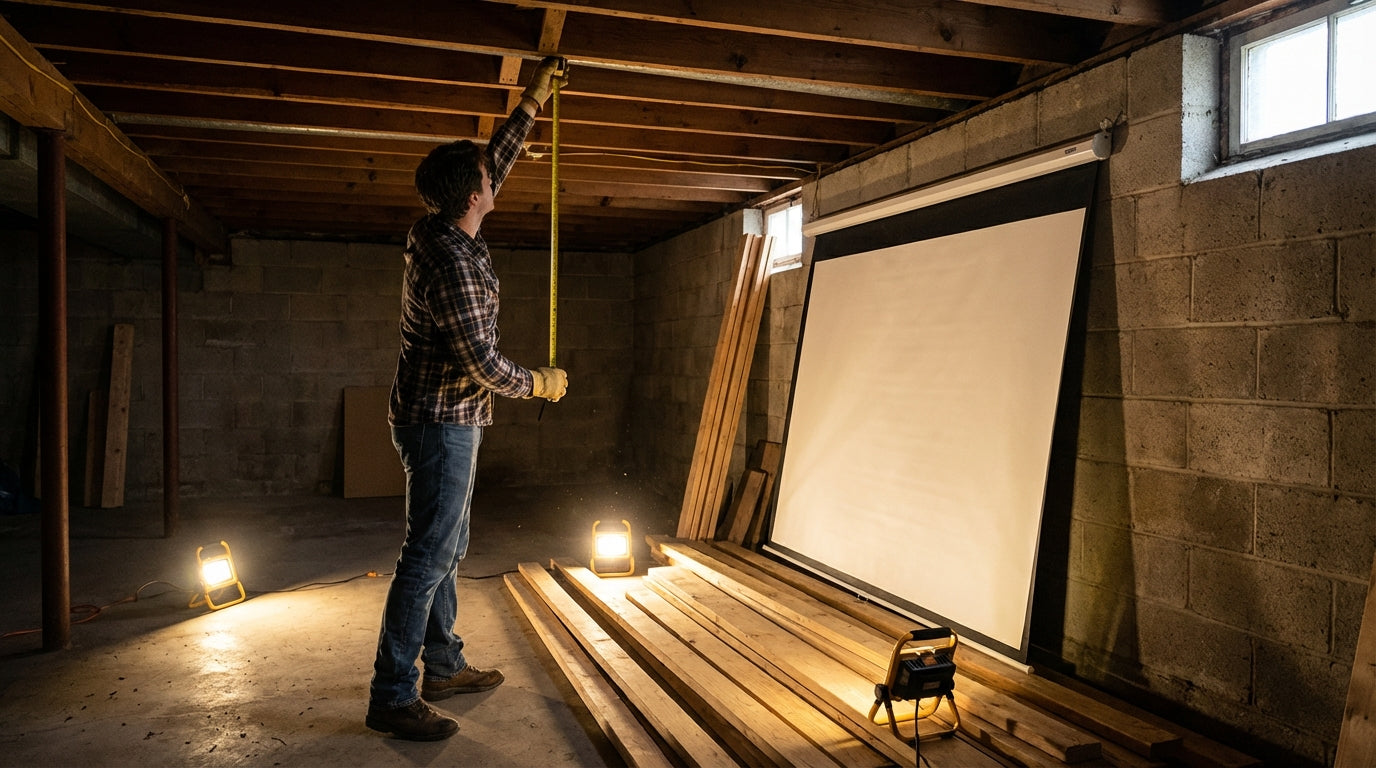
Here's a number that should reset how you're approaching your basement build: most finished basements top out at 7 to 8 feet of ceiling clearance. A golf simulator needs a minimum of 9 feet — 10 feet if you're under 6 feet tall, and 11 feet if you're taller than 6'5". (Source: Indoor Golf Design / Golfers Authority)
That gap is where basement simulator projects stall, blow their budgets, or never get finished. But here's the flip side: if you solve the ceiling problem and choose the right golf simulator screen for your basement setup, you've landed in one of the best rooms in the house. Total darkness. No windows. Ambient light control that a garage or spare bedroom can't touch.
Here's everything you need to know before you spend a dollar on equipment.
Why Your Screen Choice Is More Consequential in a Basement
In a garage or spare bedroom, pulling down and replacing an impact screen is annoying. In a low-clearance basement with tight walls and limited maneuvering room, it's a real project. Getting the screen wrong once means paying — in time and money — to do the installation twice.
Ready to shop impact screens?
Browse the full Carl's Place lineup — every screen ships ready to mount with real size specs.
Shop Carl's Place Impact Screens →The home golf simulator market was valued at USD 1.2 billion in 2024 and is projected to reach USD 2.8 billion by 2032 at a CAGR of 9.5%. (Source: Market Research Intellect / Data Horizzon Research, 2024) North America accounts for 46.6% of global simulator market share — and North American homes disproportionately feature low-ceiling finished basements. (Source: Grand View Research, 2025) More basement simulator builds are being planned every year, which means more people are navigating exactly these constraints.
Picking the right screen the first time isn't just best practice here. It's how you protect the whole investment.
The Ceiling Height Problem (And What It Costs to Fix)
Nine feet is the hard floor for a usable simulator. Ten feet is the practical standard for players under 6 feet tall. Taller players need more. (Source: Indoor Golf Design / Golfers Authority)
If you want to gain those extra feet structurally — underpinning and digging the floor down — expect to pay $40,000 to $60,000 for the construction work alone, before any simulator equipment enters the conversation. (Source: Green Pro Golf Simulators / PR Builders) That number changes how you think about every other line item in your build, including your screen.
For a full breakdown of height requirements by player height and swing type, our guide on ceiling height requirements for golf simulator home setups goes deep on the real numbers.
Sizing Your Screen for Low Ceiling Clearance
Most basement builds land on a 9×7 ft or 10×8 ft screen. Sometimes smaller. With limited vertical clearance, you need to budget 12 to 18 inches above the screen for framing hardware — which typically takes a full 10-foot-tall screen off the table entirely.
Width is your friend here. Going wider adds peripheral immersion without touching your vertical clearance. If your ceiling allows a 10-foot-wide screen at a safe height, prioritize width every time. The experience difference is significant and it costs you nothing in headroom.
Need help with the math? Our no-nonsense screen sizing guide walks through exact dimensions for common room configurations.
Screen Material: Where Basement Builders Should Spend More
This is the decision most basement builds get wrong. People tighten the budget on the screen because it doesn't feel technical. It absolutely is — and in a basement, the stakes are higher.
Budget polyester screens are rated for 20,000 to 50,000 ball impacts before failure. Premium multi-layer screens like the SIGPRO are rated at 150,000+ strikes. (Source: Home Performance Lab / Shop Indoor Golf Screen Guide) In a room where screen replacement means disassembling a tight installation, that 4–5× lifespan difference isn't just a spec sheet number. It's a direct cost-of-ownership factor.
By the Numbers: Rated Impact Lifespan by Screen Tier
Golf Simulator Impact Screen Rated Durability by Material Tier
Source: Home Performance Lab, Shop Indoor Golf, Carl's Place Screen Guide — midpoints used for ranges
Comparing Screen Materials for Basement Builds
Not all impact screens are built for the same conditions. Here's how the four main material tiers stack up against the demands of a permanent basement install:
Golf Simulator Impact Screen Material Comparison for Basement Builds
Swipe to compare →
| Material Tier | Max Ball Speed Rating | Price Range (10x10 ft) | Rated Impact Lifespan |
|---|---|---|---|
| Budget Polyester | 140–180 mph | $180–$300 | 20,000–50,000 impacts |
| Poly Blend 95 | 180 mph | $300–$600 | 50,000–100,000 impacts |
| Poly Spacer (dual-layer) | 180+ mph | $440–$800 | 100,000+ impacts |
| HiQ / Premium Multi-Layer | 200+ mph | $600–$1,120 | 150,000+ impacts |
The Basement Advantage: Ambient Light Is Your Secret Weapon
Here's the upside that doesn't get talked about enough. A minimum projector output of 3,000 lumens is required for a 10-foot screen, and screens larger than 12 feet wide need 4,000 to 5,000 lumens — but even a 5,000-lumen projector looks washed out if ambient light is uncontrolled. (Source: Carl's Place Golf Simulator Blog / BenQ Golf Simulator Lighting Guide)
In a sealed basement, you control every lumen in the room. No afternoon sun cutting through a garage window. No light leaking under a door. A mid-tier projector in a dark basement consistently outperforms a high-end projector in a poorly controlled above-grade room. That's not a small advantage — it's a meaningful image quality upgrade you get for free just by being in the right space.
For more on how ambient light destroys simulator image quality and what to do about it, our post on golf impact screen ambient light problems covers everything before you finalize your projector and screen combo.
The Basement Simulator Checklist: In Order
Before you buy anything, work through these decisions in sequence:
- Measure ceiling clearance accurately — floor to joist, not drywall. Account for framing height (12–18 inches above screen) before committing to any screen size.
- Choose screen height first, then maximize width — within your ceiling constraint, go as wide as your wall allows for the best immersive experience.
- Buy at minimum a mid-tier screen — Poly Blend or Poly Spacer as a floor, not a ceiling. Budget screens aren't worth the replacement headache in a basement install.
- Plan your throw distance early — basements often limit how far back you can position a projector. Know your throw ratio requirements before purchasing.
- Use a wall-mounted enclosure frame — more stable than freestanding setups in tight spaces, and easier to keep plumb on concrete or block walls.
A basement simulator done right is one of the best home builds a golfer can make. Solve the ceiling problem, buy a screen that lasts, and you've got a room that pays off for years.
Ready to find the right screen for your basement setup? Browse our full impact screens collection — including options sized and rated for permanent residential installs where replacement is not an option you want to revisit.
Planning the whole bay? Use Build Your Bay: pick your room size, screen and mat, and we match every part (enclosure, framing, back cover, hitting mat) and add it all to your cart in one click.
Related reading: Golf Simulator Impact Screen Outdoor Setup Tips: What You Need to Know Before Taking Your Sim Outside · Golf Simulator Basement Conversion Checklist: The 7 Steps to Run Before You Buy Anything


Not sure which simulator fits your room?
The two-minute Simulator Finder Quiz checks your space and budget against every system we carry.

Keep Reading
Related guides

golf simulatorGolf Simulator Enclosure Lighting Plan: Where to Mount Fixtures So They Never Wash Out Your Screen

golf simulatorGolf Simulator Basement Conversion Checklist: The 7 Steps to Run Before You Buy Anything

DIY golf simulatorGolf Simulator Garage Build Cost Breakdown: Every Line Item at Three Budget Tiers