golf simulator
Golf Simulator Projector Short Throw vs Long Throw: Which One Actually Fits Your Room?
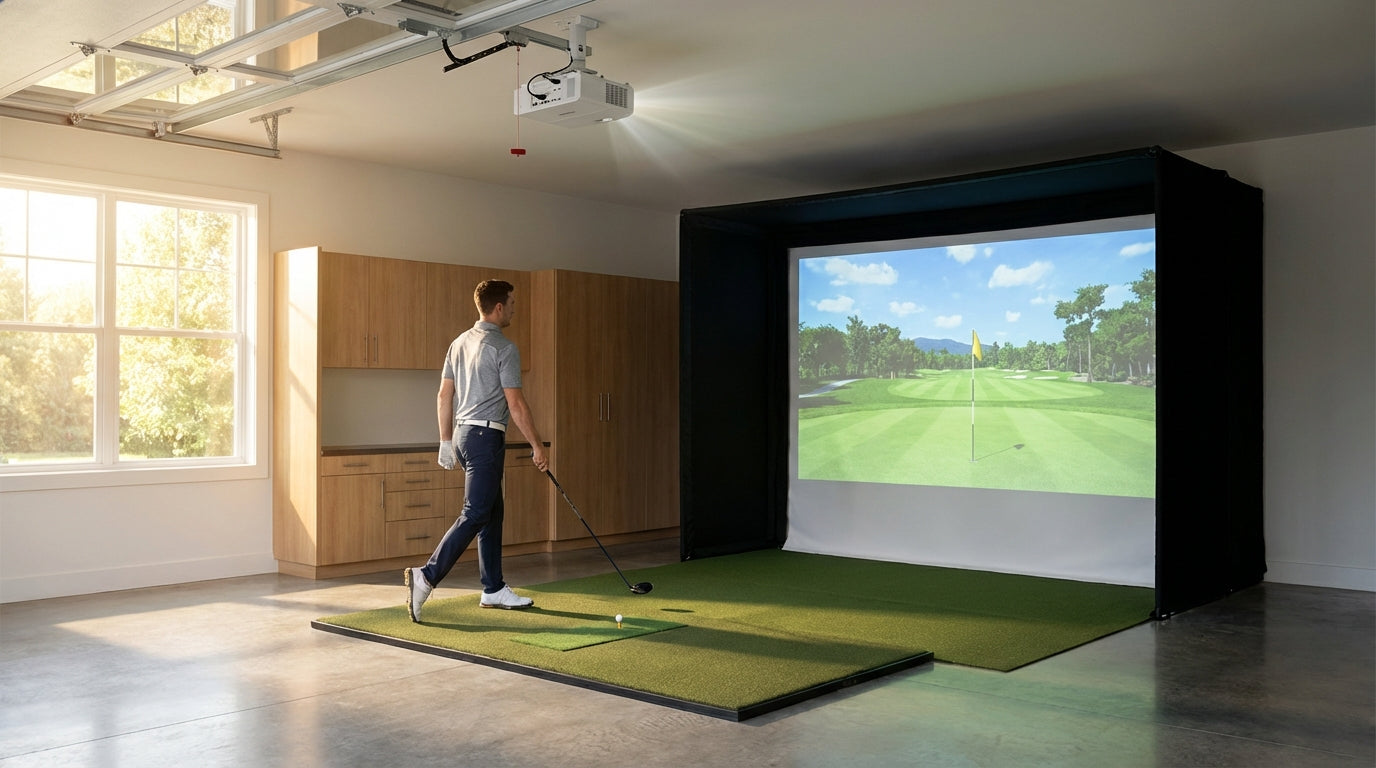
Here’s a number that should settle this debate before it starts: a standard throw projector needs 10–15 feet of clearance just to fill a 10-foot wide screen. (Source: Top Shelf Golf / BenQ US) Now subtract the 6–8 feet your hitting area takes behind the mat. In a standard one-car garage you’re already out of room — and you haven’t even accounted for where you’re actually standing.
Throw ratio is the most boring-sounding spec in your projector search. It’s also the one that determines whether your simulator works at all. Get it wrong and you’re dealing with shadow-filled ball flights, a washed-out image, or a return label on a $2,000 projector that physically can’t fit your room.
Here’s how to get it right.
What Throw Ratio Actually Means (In Human Terms)
Throw ratio = distance from projector to screen ÷ screen width. A 1.5 throw ratio on a 10-foot wide screen means you need the projector 15 feet back. A 0.7 ratio means 7 feet. An ultra short throw at 0.38 gets you down to 4 feet.
For golf simulators, this hits different. Your room depth serves two masters: the projector throw distance AND the hitting area where you’re swinging. You can’t stand inside the projection cone. So whatever the projector needs has to come from what’s left after your 6–8 foot hitting zone.
Short throw projectors (0.4–1.0 ratio) were essentially built for this problem.
Room Depth: Where Most Simulator Builds Get Burned
The minimum viable golf simulator room is 10’ wide × 15’ deep × 9’ tall. The ideal is 12’+ wide × 18’+ deep × 10’ tall. (Source: Carl’s Place / BenQ US Golf Simulator Space Guide) A standard single-car garage at roughly 12×20 feet hits the minimum — but leaves almost no margin for a long throw projector.
Here’s how throw distances stack up by projector type when filling a 10-foot wide screen:
Minimum Throw Distance to Fill a 10-Foot Wide Screen by Projector Type
Source: Top Shelf Golf / BenQ US / TheaterCalc Golf Simulator Calculator
Ultra short throw can fill that same screen from 4 feet away. Standard throw at a 1.5 ratio needs 15 feet — before the mat is even down. If your room is under 18 feet deep, short throw isn’t a preference. It’s a requirement.
If you’re tight on space across the board, our best golf simulators for small garages guide covers the full space-planning equation. Projector throw is just one piece of it.
The Shadow Problem Nobody Warns You About
Standard throw projectors mounted on the ceiling become a shadow factory past 14 feet from the screen. At full swing — especially on drives — your body can fill a meaningful chunk of the projected image. (Source: BenQ US Projector Placement Guide / My Golf Simulator) You end up watching your own silhouette instead of ball flight data.
Short throw setups in the 0.69–0.89 ratio range fix this. The projector stays close enough to the screen that your swing arc stays outside the projection cone. That’s not a minor convenience — it’s the primary reason short throw has become the default for home golf simulator bays.
Ultra short throw projectors flip the script entirely — they’re almost always floor-mounted pointing upward at the screen from very close range, which creates its own mounting geometry to plan around. For a full breakdown of mount types and what each means for your room layout, see our ceiling mount vs floor stand comparison.
By the Numbers: What the Data Says
The specs that actually matter when picking a throw ratio:
- Short throw projectors fill a 10-foot screen from 6–9 feet; standard throw requires 10–15 feet. In a typical 20-foot garage, that’s the difference between a setup that works and one that doesn’t. (Source: Top Shelf Golf / BenQ US)
- 3,000–5,000 lumens is the sweet spot for home golf simulators. Short throw projectors lose less light over shorter distances — a 3,500-lumen short throw will often look brighter than a 4,500-lumen standard throw sitting 15 feet back. (Source: Rain or Shine Golf Projector Buyer Guide / Virtual Tee Golf)
- The BenQ LK936ST — the most popular high-end golf simulator short throw projector — delivers 5,100 lumens of 4K laser output from a 0.81–0.89 throw ratio at $4,899. Its 20,000-hour laser lifespan significantly cuts long-term ownership cost. (Source: BenQ US / Golf Sim Depot)
- Budget short throw starts around $800–$909 vs under $500 for comparable standard throw models — a 30–60% price premium for the more complex wide-angle optics. (Source: Home Performance Lab / GolfJoy Projector Guide)
For a deeper look at how throw ratio, lumens, and resolution work together as a system, our post on throw ratio, lumens, and resolution for impact screens covers the full spec decision from scratch.
Short Throw vs Standard Throw: Head-to-Head
Short Throw vs Standard Throw Projectors for Golf Simulator Bays
| Spec | Ultra Short Throw | Short Throw | Standard Throw |
|---|---|---|---|
| Throw Ratio | < 0.4 | 0.4 – 1.0 | > 1.0 |
| Distance to Screen (10ft wide) | ~4 ft | 6 – 9 ft | 10 – 15 ft |
| Minimum Room Depth | 12 ft | 15 ft | 18+ ft |
| Shadow Risk (ceiling mount) | Low (floor mount) | Low | High |
| Recommended Lumens | 3,000+ | 3,000 – 5,000 | 3,000 – 5,000 |
| Price Range | $1,500 – $4,000+ | $800 – $4,900 | $400 – $2,000 |
| Screen Surface Sensitivity | Very High | Low | Low |
| Best For | Rooms under 12 ft deep | Typical garage/basement | Dedicated 18+ ft rooms |
Standard throw only makes sense at 18 feet or deeper — and even then you need to verify shadow geometry before committing. Ultra short throw unlocks the smallest rooms but demands a perfectly flat, smooth screen surface and very specific mounting. Short throw in the 0.7–0.89 range is the practical sweet spot for the overwhelming majority of home builds.
The Price Reality
Short throw optics are more complex to engineer, and the price reflects it. Budget short throw starts around $800 for laser models like the Optoma ZW350ST. High-end 4K laser (BenQ LK936ST) runs $4,900. Comparable standard throw at the same lumen output starts under $500.
That 30–60% premium is real. But here’s the thing — if your room physically requires short throw, buying a cheap standard throw and then discovering it doesn’t fit isn’t a savings. It’s a return label and a few hundred dollars in wasted time.
The other angle worth running: laser projectors in the short throw category often carry 20,000-hour lifespans. A lamp-based standard throw might need a $200–$400 bulb replacement every 3,000 hours. Over a 5-year sim life, the laser math frequently wins.
Which Throw Ratio Is Right for Your Room?
The fast version:
- Room under 12 feet deep: Ultra short throw only. Very limited options, expect $1,500+, floor mount required. Plan your screen surface carefully — UST projectors are unforgiving on wrinkles.
- Room 12–17 feet deep (typical one-car garage or basement bay): Short throw 0.7–0.89. This covers 95% of home simulator builds and is where most of the best-value projectors live.
- Room 18+ feet deep: Standard throw becomes viable. You’ll save money upfront, but measure your swing clearance and verify shadow geometry before buying.
Whatever you choose, the projector is only as good as the surface it’s hitting. A screen that hot-spots, wrinkles under impact, or absorbs too much light will kill image quality regardless of how dialed-in your throw ratio is. Get the screen right first, and the projector math gets a lot simpler.
Browse our full lineup of impact screens at GolfingSim — engineered for optimal image quality with short throw projectors in standard garage and basement bays. The right screen makes every lumen count.
Not sure which simulator fits your room?
The two-minute Simulator Finder Quiz checks your space and budget against every system we carry.


Keep Reading
Related guides

golf simulatorGolf Simulator Impact Screen Tear Repair: When to Patch and When to Replace

ambient light rejecting golf impact screenAmbient Light Rejecting Golf Impact Screen: Why True ALR Can’t Survive Your Driver (and What Actually Works)

chipping and puttingGolf Simulator Impact Screen for Chipping and Putting: Does Your Screen Actually Handle the Short Game?