
golf mat cushioning
Golf Simulator Hitting Mat Thickness Guide: How Much Cushion Do You Actually Need?
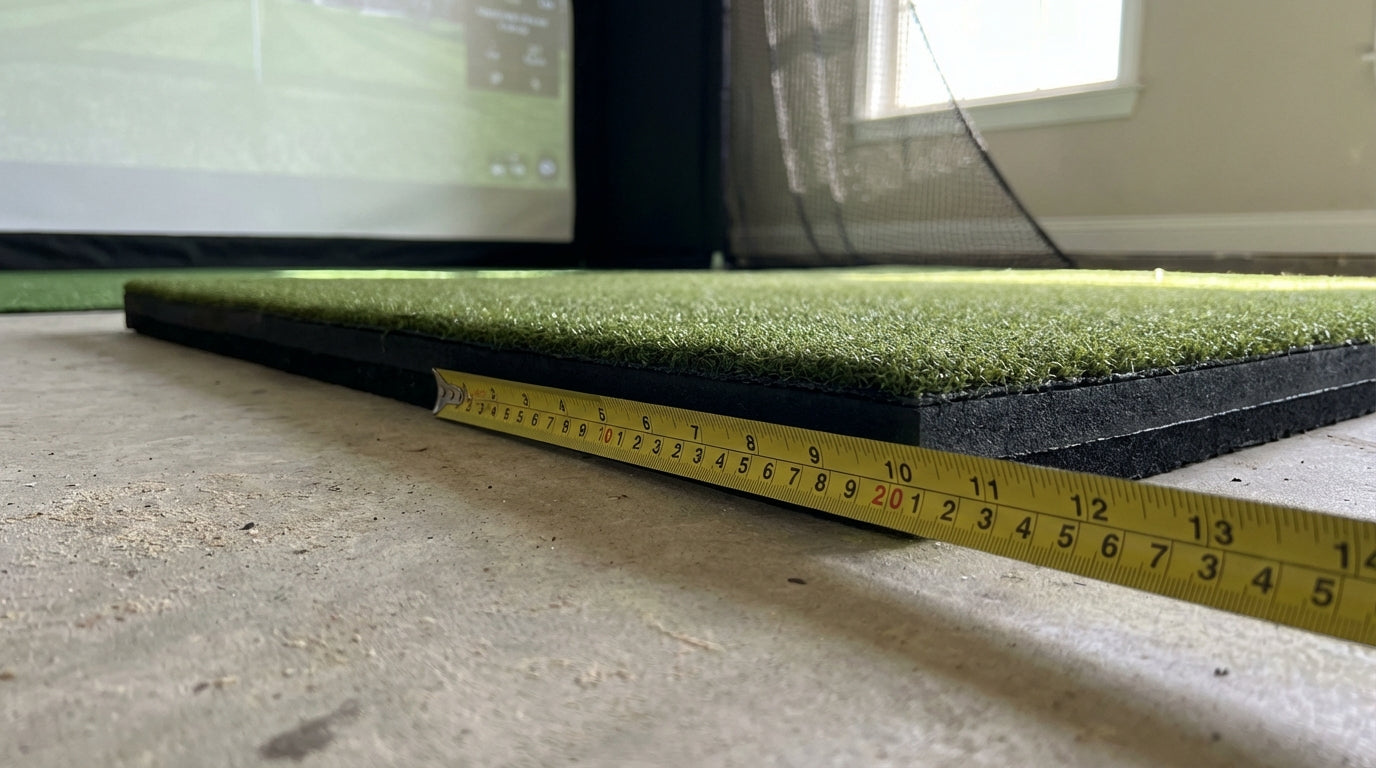
Standard range mats produce spin rates approximately 2,000 rpm lower on irons and launch angles 2–3 degrees higher than real grass. That’s not a sensor problem. That’s a mat problem — specifically, a thickness and turf construction problem. (Source: Golf Simulator Forum)
Before you blame your launch monitor or start tweaking your swing path, take a serious look at what you’re standing on. In a home golf simulator, hitting mat thickness is the one spec that affects both your joint health and the quality of your ball data — and most buyers treat it as an afterthought.
Here’s a complete golf simulator hitting mat thickness guide built around real testing data, so you can make the right call before you buy.
Building one now? Carl’s Place HotShot mat system — from $500.
Why Mat Thickness Matters More Than You Think
On real grass, the turf compresses, absorbs shock, and allows a natural divot interaction. A thin mat on a concrete floor does none of that. Every strike sends a vibration spike straight up through the club into your wrists, elbows, and shoulders.
Mats under 1 inch thick are flat-out dangerous on concrete. Experts cite the jarring effect of hard-surface impact as a direct cause of wrist sprains, golfer’s elbow, and rotator cuff injuries over repeated sessions. (Source: The Club at the Highlands / FiberBuilt Golf)
And your data pays the price too. Thin mats with inadequate turf construction skew spin rates and launch angles enough to make your numbers unreliable — which defeats the whole point of having a launch monitor in the first place.
The Subfloor Question (Most Builders Skip This)
Your floor type is the most important input into mat thickness. A mat that works fine on a padded wood subfloor can be a joint-destroyer on bare concrete. Same mat. Wildly different outcome.
Concrete (Most Common, Most Demanding)
Concrete is completely unforgiving. The minimum recommended total mat thickness for direct concrete use is 30 mm (roughly 1.2 inches) — but that’s a floor, not a target. Realistically, you want 1.5” to 1.75”+ for a full simulator setup with regular full swings. (Source: Backyard Golf)
If your simulator lives in a garage or unfinished basement with bare concrete, this is not where you cut costs.
Rubber or Foam Underlayment
Adding a rubber or foam layer under your mat buys you a meaningful cushion buffer. On these surfaces, 1.5 inches of total mat thickness hits the sweet spot — solid shock absorption without so much platform height that it throws off your natural stance and weight transfer.
Wood Subfloor or Plywood
A wood or plywood subfloor already has some give. Here, 1.25 inches is workable for most swing types — especially compact swingers or beginners building consistent contact. That said, never go thinner than 1 inch even on wood.
If you’re still sorting out what goes under the mat entirely, the best flooring for a golf simulator room guide covers rubber, turf, foam, and hardwood options with real trade-offs for each.
By the Numbers: What the Data Actually Says
- 2,000 rpm spin deficit. Standard mats produce spin rates roughly 2,000 rpm lower on irons than real grass, with launch angles running 2–3 degrees high. That’s not minor — it’s the difference between useful practice data and misleading noise. (Source: Golf Simulator Forum)
- 30 mm minimum on concrete. Below the 30 mm floor on bare concrete, too much shock energy transfers into the joints across a full practice session — the 30 mm number is a hard baseline, not a conservative suggestion. (Source: Backyard Golf)
- Premium mats still introduce offset. Fiberbuilt mats — widely considered a gold standard — launched the ball 4–5 degrees higher than real grass and measured approximately 1,000 rpm less backspin in real-world comparative testing. Even the best mats at their optimal thickness introduce measurable data offset. (Source: FriendlyGolfer.com / Golf Simulator Forum)
- Pile depth is half the equation. Turf pile (the fiber layer above the rubber base) should be at least 10 mm thick and ideally 35 mm to allow realistic downward strike practice and reduce the shock spike that causes elbow injuries on thin mats. (Source: Backyard Golf / Simply Golf Simulators)
Getting your mat dialed in also pays dividends for launch monitor reliability. The golf simulator launch monitor calibration tips post covers what else you can do to squeeze more accurate data out of your setup beyond just the mat choice.
Recommended Minimum Mat Thickness by Subfloor Type
Source: Backyard Golf thickness guide / SimplyGolfSimulators / TellMeMoreGolf — compiled recommendations
Matching Thickness to Your Swing Style
Your swing profile matters as much as your floor type. A steep, aggressive downswing generates far more impact energy per strike than a shallow sweeping motion. That difference in shock load should drive your thickness decision just as much as what’s under the mat.
Golf Mat Thickness vs. Swing Style & Performance Trade-offs
Swipe to compare →
| Thickness Range | Best Swing Profile / Use Case | Key Trade-offs |
|---|---|---|
| Under 1" (<25 mm) | Outdoor grass only; casual chippers | Too firm for concrete; high injury risk; poor shock absorption |
| 1.0"–1.5" (25–38 mm) | Wood subfloor; compact swing; beginners | Adequate on wood; marginal on concrete; moderate data accuracy |
| 1.5"–2.0" (38–51 mm) | Concrete floor; all swing types; simulator focus | Best balance of feel, joint protection, and launch monitor accuracy |
| 2.0"–2.5"+ (51–64 mm) | Steep downswing; high-handicap; injury rehab | Maximum cushion; may slightly elevate launch angle readings; adds platform height |
If you want to go deeper on how your hitting surface compares to a real tee box setup, the golf simulator hitting mat vs. tee box comparison breaks down what each setup actually replicates — and where each one falls short.
Don’t Ignore the Pile Layer
Total mat thickness is not one material — it’s base rubber plus pile (the fiber turf layer on top). These two components behave completely differently under a swing. A mat with 1.5” total thickness but only 6 mm of pile plays much harder than a mat with 1.5” total and 20 mm of pile.
When comparing specs across brands, ask to see base thickness and pile depth broken out separately. The pile layer is what creates realistic club-turf interaction. Without enough fiber depth, the club hits rubber almost immediately — harder on your joints, and bad news for angle-of-attack data on camera-based launch monitors that read the turf interaction as part of their tracking.
Aim for at least 10 mm of pile. If you’re a steep swinger working on taking proper divots, 30–35 mm pile depth is where you start to feel a realistic difference.
The Bottom Line
A complete golf simulator hitting mat thickness guide doesn’t start with the mat — it starts with your floor. From there, factor in your swing style, then make sure the pile layer is thick enough to matter.
For concrete with no underlayment: 1.5”–1.75” minimum, full stop. For wood subfloor with cushioning: 1.25” works for most. Steep swing or injury concerns? Go 2”+ and accept a slight launch angle offset as the price of protecting your elbow.
Everything else in your simulator — projector, software, launch monitor — depends on your ball data being accurate. Start with a mat that’s actually thick enough for your floor, and you’ll get more useful feedback out of every other piece of gear in the bay.
Building a setup worth hitting into? Browse our full range of golf simulator impact screens — the other half of a bay that actually performs.
Planning the whole bay? Use Build Your Bay: pick your room size, screen and mat, and we match every part (enclosure, framing, back cover, hitting mat) and add it all to your cart in one click.


Not sure which simulator fits your room?
The two-minute Simulator Finder Quiz checks your space and budget against every system we carry.

Keep Reading
Related guides

golf simulatorGolf Simulator Enclosure Lighting Plan: Where to Mount Fixtures So They Never Wash Out Your Screen

golf simulatorGolf Simulator Basement Conversion Checklist: The 7 Steps to Run Before You Buy Anything

DIY golf simulatorGolf Simulator Garage Build Cost Breakdown: Every Line Item at Three Budget Tiers