
golf simulator
Golf Simulator Hitting Mat vs. Tee Box: Which Setup Actually Replicates Real Course Conditions?
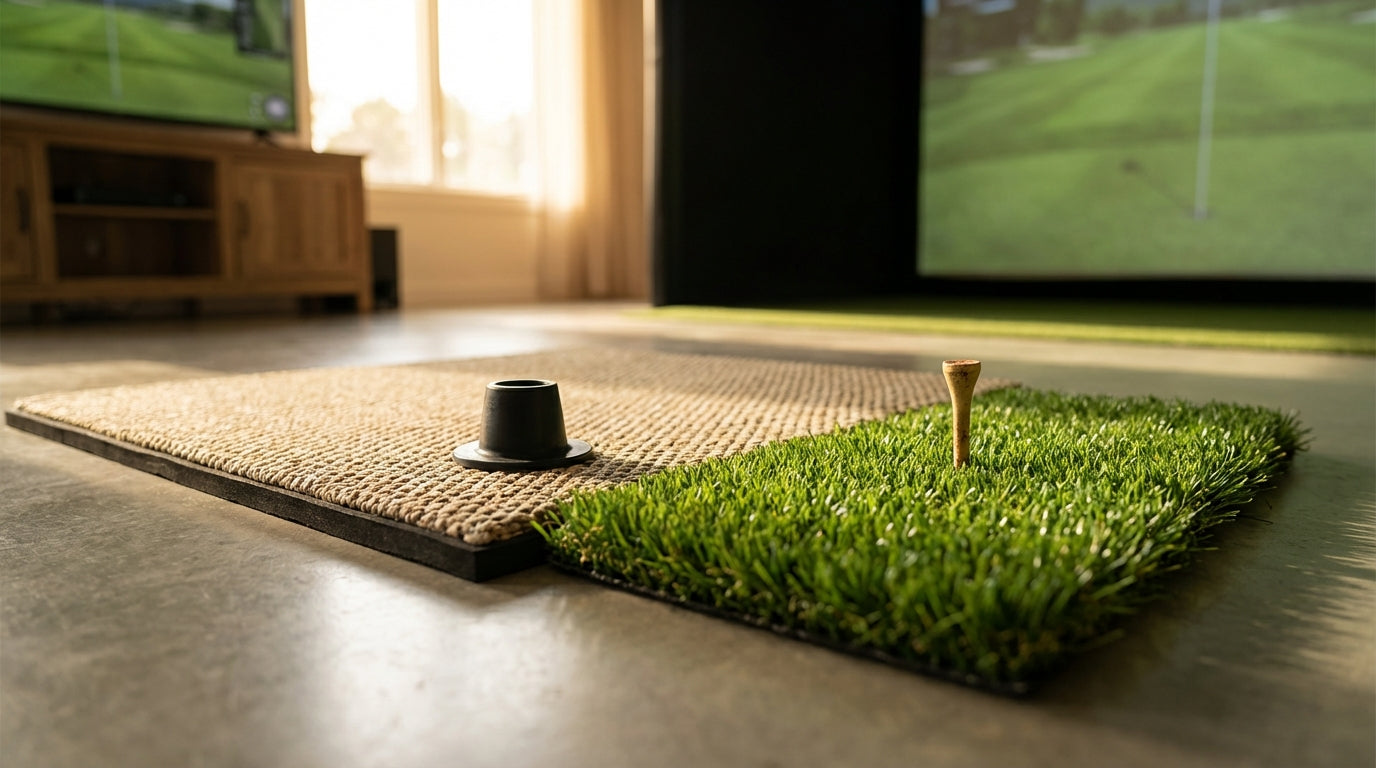
Most golfers setting up a home simulator obsess over launch monitors and impact screens. Fair. But here's a number that should reorder your priorities: the difference between teeing at 0.5 inches and a standard driver height is 14.19 yards of carry distance and a 3.54-degree launch angle swing. (Source: MyGolfSpy Tee Height Test / Voice Caddie research) That's a full club gap — and it comes entirely from tee height. Not the mat material. Not the rubber insert brand. Whether your surface lets you tee the ball where it actually needs to be.
The golf simulator hitting mat vs tee box debate sounds simple. It isn't. The wrong surface doesn't just feel off — it actively trains bad contact patterns, skews your launch monitor data, and over time puts unnecessary stress on your lead wrist. Here's what the numbers actually show.
Tee Height Is the Only Variable That Matters
A Golf Digest robot test — run using a Foresight Sports QuadMAX launch monitor and a professional swing robot — found zero statistically significant difference in ball speed, carry distance, or shot dispersion between rubber and wooden tees when tee height was held constant. (Source: Golf Digest Mythbusters Robot Test, Golf Laboratories)
Building one now? Carl’s Place HotShot mat system — from $500.
That settles the rubber-vs-wood debate permanently. Tee material doesn't matter. Tee height does — and most budget hitting mats give you no meaningful control over it.
A fixed 1-inch rubber insert is fine for iron work. For driver practice, you want 1.5 to 2.5 inches depending on your ball height preference and clubhead size. If your mat locks you into a short insert, your driver session data is essentially made up.
What a Low Tee Actually Does to Your Ball Flight
MyGolfSpy's tee height testing makes the cost concrete. Dropping from standard driver height to a 0.5-inch tee produces:
- 326 rpm more backspin on average — the data signature of a low-face contact mis-hit
- A 3.54-degree launch angle deficit, caused by low-face contact
- 14.19 yards of lost carry distance — enough to change your club selection
None of those are rounding errors. If your mat is forcing this on every driver swing, you're not practicing a driver — you're drilling a specific mis-hit pattern into muscle memory and calling it training.
What a "Tee Box" Setup Actually Means in a Home Simulator
In simulator context, a tee box setup is usually one of two things: artificial turf laid over your subfloor so you can push real tees in at any height, or a dedicated turf strip adjacent to your hitting mat used specifically for tee shots.
The appeal is obvious. Real wooden or plastic tees at whatever height you want. No rubber insert gymnastics. The same stance feel you get on an actual first tee.
The tradeoff is surface flexibility. A premium hitting mat handles iron lies, wedge work, and driver practice from one surface. A turf-only tee box nails driver simulation but doesn't replicate a fairway iron lie the same way. Most serious sim players with the space run both — a quality mat for iron work and a turf strip for driver practice. If you're locking in your room design, that dual-surface approach is worth planning around from the start.
The Joint Protection Angle Nobody Mentions First
Lead wrist injuries affect professional golfers at incidence rates as high as 30%, and hitting repeatedly on hard mat surfaces without adequate cushioning is a documented aggravating factor. (Source: The Physio Lab / TrueStrike Health Benefits page)
This compounds faster than most people expect. If you're hitting 80–100 shots per session on a budget rubber mat laid over concrete, your joints absorb every single impact differently than they would on real turf or a gel-cushioned premium mat. Artificial turf tee boxes absorb shock naturally through the material depth. Budget mats on hard floors? That shock goes directly into your wrist.
If you're building a setup you plan to use year-round — which is the whole point — joint protection belongs in your mat budget calculation, not as an afterthought. Our golf simulator mat thickness and quality guide breaks down exactly what separates mats engineered to last from ones that will have you icing your wrist by spring.
By the Numbers: What the Data Actually Shows
- 14.19 yards of carry distance separate a 0.5-inch tee from a standard driver tee height — a full club gap, not a stat to dismiss. (Source: MyGolfSpy Tee Height Test / Voice Caddie research)
- 326 rpm more backspin generated at the shorter tee setting, consistent with the low-face contact you do not want to be training on a regular basis. (Source: MyGolfSpy Tee Height Test)
- Zero statistical difference between rubber and wooden tees when height is held constant — so stop worrying about tee material and start asking about height range. (Source: Golf Digest Mythbusters Robot Test, Golf Laboratories)
- $4.12 billion — projected global golf simulator market size by 2033 at an 8.7% CAGR, meaning real engineering investment is flowing into mat and surface technology right now. (Source: Grand View Research, Golf Simulator Market Report 2033)
Average Cost by Golf Simulator Hitting Mat Tier
Source: Industry estimates based on Yardstick Golf, Golferlogic.com, ShopIndoorGolf, TrueStrike product pages
Hitting Mat vs. Tee Box Setup: Feature Comparison
Swipe to compare →
| Setup Type | Tee Options | Joint Protection | Course Realism | Avg Cost Range |
|---|---|---|---|---|
| Budget rubber mat | Fixed rubber insert (1"–2") | Poor — rigid surface on concrete | Low — no divot feedback, limited tee height | $50–$200 |
| Mid-range foam mat | Rubber insert + limited real-tee slots | Moderate — foam underlayer | Moderate — some give, still artificial | $200–$600 |
| Premium gel/bristle mat (TrueStrike, Fiberbuilt) | Rubber + real wood/plastic tee capable, 150k-shot rated insert | Excellent — gel divot simulation, vibration absorption up to 94.7% | High — mimics turf compression and divot | $950–$1,500 |
| Artificial turf tee box (no mat) | Real wood or plastic tees in ground | Good — turf depth absorbs impact naturally | Very High — real tee, real stance feel | $300–$800 installed |
| Real grass/soil tee box | Real tees pushed into soil | Natural — ground absorbs shock organically | Closest to on-course — true lie, real divot | $500+ (prep + turf installation) |
Which Setup Is Right for Your Swing?
Here's a practical framework based on how you actually use a simulator — not how the marketing copy describes it.
Choose a premium hitting mat if:
- You want one surface that handles irons, wedges, and driver practice without switching setups
- Iron contact and divot feedback are central to what you're working on
- Your space doesn't support a separate turf section
- Joint protection through vibration absorption is a priority — especially if you're on a hard subfloor
Choose an artificial turf tee box if:
- Driver practice is your primary simulator goal
- You want the most accurate replication of a real first tee feel
- You have room for a dual surface — mat for irons, turf strip for the driver
- You're building from scratch and can plan the floor layout around it from day one
Your surface choice also ties directly into the rest of your room layout. If you haven't locked in your floor plan yet, our golf simulator room flooring guide covers every surface option — rubber, turf, foam, and hardwood — so you don't end up ripping something out six months later.
One more thing worth flagging: your launch monitor's data accuracy depends on consistent ball position relative to the sensor. A tee height change of even an inch can shift that relationship on certain camera-based systems. Our launch monitor placement guide walks through how to dial in the numbers correctly before you commit to a setup.
The Bottom Line
The golf simulator hitting mat vs tee box question really comes down to one practical test: does your current setup let you tee the ball at actual driver height?
If the answer is no — if you're stuck with a low fixed rubber insert — you're not practicing driver. You're reinforcing a low-face strike pattern that doesn't exist on a real course. Fix the surface before you buy anything else. The launch monitor, the software, the screen — none of it matters if the foundation is training you wrong.
When you're ready to complete the bay, start with what you're actually hitting into. Browse our full range of golf simulator impact screens — built for home setups that take the game seriously.
Planning the whole bay? Use Build Your Bay: pick your room size, screen and mat, and we match every part (enclosure, framing, back cover, hitting mat) and add it all to your cart in one click.
Related reading: Golf Impact Screen Depth Behind Hitting Mat: Exact Distances for 16, 18, and 20-Foot Rooms


Not sure which simulator fits your room?
The two-minute Simulator Finder Quiz checks your space and budget against every system we carry.

Keep Reading
Related guides

golf simulatorGolf Simulator Enclosure Lighting Plan: Where to Mount Fixtures So They Never Wash Out Your Screen

golf simulatorGolf Simulator Basement Conversion Checklist: The 7 Steps to Run Before You Buy Anything

DIY golf simulatorGolf Simulator Garage Build Cost Breakdown: Every Line Item at Three Budget Tiers