
golf impact screen vs hitting net upgrade
Golf Impact Screen vs. Hitting Net Upgrade: What the Data Actually Says
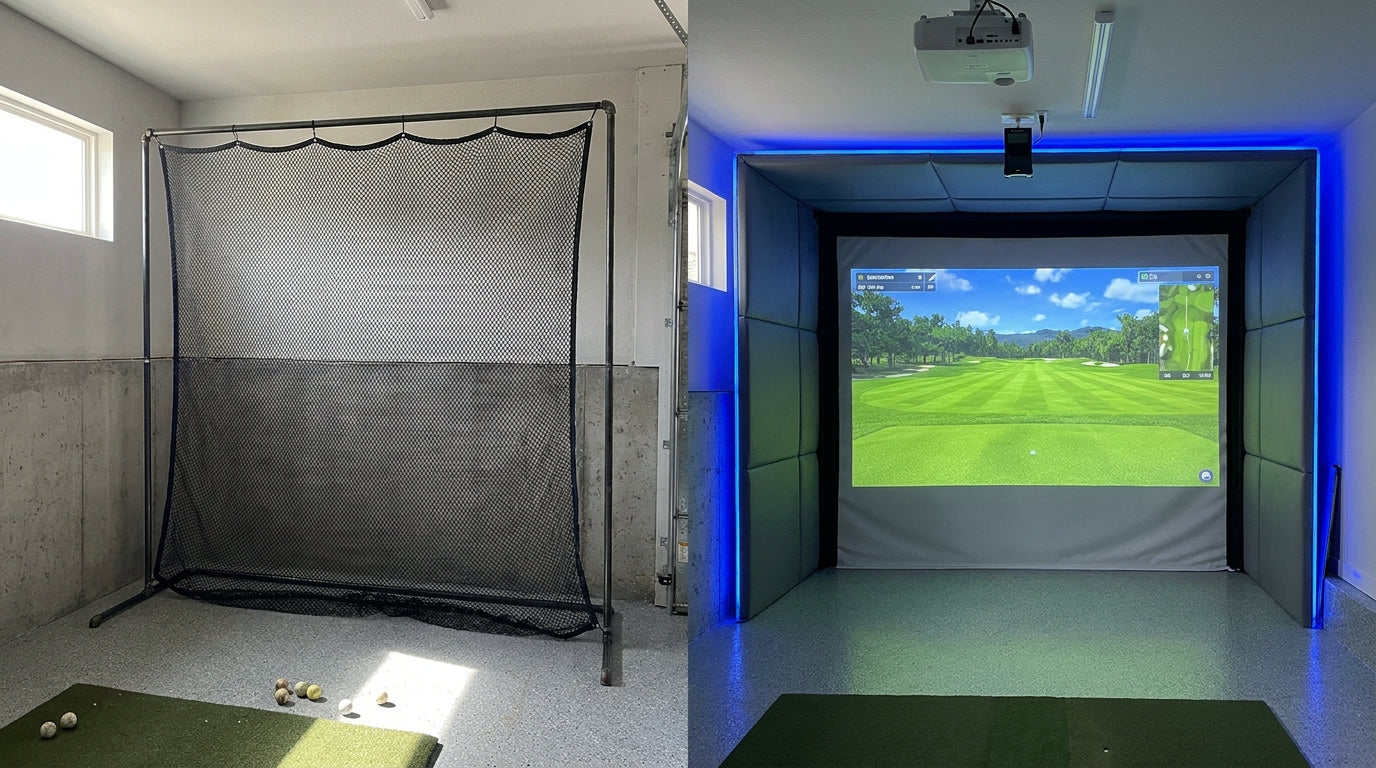
A premium three-layer impact screen is rated for 150,000 shots — enough to cover 30 years of play at 50 rounds per year. (Source: Indoor Golf Shop / shopindoorgolf.com SIGPRO Premium documentation) A basic hitting net? Most carry no shot rating at all. That single data point frames the golf impact screen vs. hitting net upgrade question better than any spec sheet.
If you're weighing this decision right now, you're probably somewhere between "the net still works" and "I think I'm leaving something on the table." This guide cuts through the noise — projection quality, noise reduction, durability, and total cost over time — with actual numbers behind every claim.
Why Golfers Outgrow the Hitting Net
A hitting net does exactly one thing: stops the ball. For pure swing-grooving in the off-season, that's fine. But once you add a launch monitor to the equation, the net's limitations get obvious fast.
Ready to shop impact screens?
Browse the full Carl's Place lineup — every screen ships ready to mount with real size specs.
Shop Carl's Place Impact Screens →Your launch monitor reads ball speed, spin, and launch angle with real precision. All of that data exists in a vacuum when you're hitting into a net. You know the numbers — but you can't see where the shot went, can't play a round, and can't close the feedback loop that makes indoor practice actually translate to the course.
An impact screen fixes that entirely. Pair it with a projector and you're playing actual courses from your garage. The screen becomes the simulator — and the choice between a net and an impact screen is really a choice between practice tool and actual golf.
The Three Differences That Actually Matter
1. Projection Quality: Zero vs. Game-Changing
No hitting net at any price can display projected imagery. Budget impact screens can — though edges may be dim and blurry depending on projector lumens. Premium three-layer screens deliver HD-sharp, full-color projection that holds up even in bright ambient light.
If full simulator play is on your roadmap at all, this difference alone makes the upgrade decision easy. You either have projection capability or you don't — there's no workaround with a net.
2. Noise: The 42% Advantage
Triple-layer poly spacer screens reduce ball impact noise by 42% compared to single-layer polyester screens. (Source: virtual-golf-simulator.com product specification testing) That's the gap between a sharp crack echoing through the walls and a dampened thud that's genuinely livable.
For garage and basement setups, noise controls when you can practice. A hitting net offers zero acoustic advantage by design. A three-layer screen changes the situation meaningfully. For more on building a quiet bay, see our Golf Simulator Impact Screen Sound Dampening Guide.
3. Durability: Shot Ratings vs. Guesswork
Premium screens are built around testable durability specs. The SIGPRO Premium is rated for 150,000 shots — 30 years of regular play. (Source: Indoor Golf Shop / shopindoorgolf.com SIGPRO Premium product documentation) The Carl's Place Premium was independently tested through 14,000+ shots with zero sag, rips, or image degradation. (Source: MyGolfSpy independent head-to-head testing)
Basic hitting nets carry no formal shot rating. When the net fails — and it will — you replace it. For a direct comparison of how material tier affects longevity, see our Golf Simulator Screen Material Durability Comparison.
By the Numbers: What the Data Says
- 150,000 shots — rated lifespan of a premium three-layer screen, equivalent to 30 years at 50 rounds/year with 100 shots per round. (Source: Indoor Golf Shop / shopindoorgolf.com)
- 42% quieter — noise reduction from triple-layer poly spacer screens vs. single-layer polyester. (Source: virtual-golf-simulator.com product specification testing)
- ~3mm thick — material profile of premium tri-layer screens, roughly twice the standard single-layer spec, rated for ball speeds up to 250 mph. (Source: SIGPRO Premium and virtual-golf-simulator.com product specifications)
- $3.81 billion — projected global golf simulator market by 2033, growing at a 9.1% CAGR from $1.9 billion in 2025. (Source: Fortune Business Insights, Golf Simulator Market Report 2033) That growth isn't coming from people buying hitting nets.
Price Across Tiers: Where Your Money Actually Goes
Average Retail Price by Golf Practice Setup Tier
Source: Big Horn Golfer, Home Performance Lab, GolferLogic — 2025 market pricing
Spread a $1,050 premium screen across 150,000 rated shots and you're paying under a penny per swing. A $175 net that needs replacing every few years — with no published shot rating — doesn't hold up the same way when you actually run the numbers.
Budget impact screens in the $150–$350 range are a legitimate middle step: projection-capable and meaningfully more durable than a net. The ~1.5mm single-layer construction still trails significantly in noise reduction and long-term lifespan, but it's a real upgrade for anyone not yet ready to go full premium.
Side-by-Side: Full Feature Breakdown
Hitting Net vs. Impact Screen: Feature Comparison by Tier
Swipe to compare →
| Feature | Basic Hitting Net | Budget Impact Screen | Premium Impact Screen (3-layer) |
|---|---|---|---|
| Image Projection | None | Fair (dim, blurry edges) | Excellent (HD-sharp, full color) |
| Noise Reduction vs. Net | Baseline | Minimal | ~42% quieter (acoustic testing) |
| Material Thickness | Cord/mesh (no standard) | ~1.5mm single-layer polyester | ~3mm tri-layer poly spacer |
| Rated Shot Lifespan | Unrated | ~5,000–10,000 shots | 100,000–150,000+ shots |
| Simulator Compatible | Yes (ball data only) | Yes (basic sim capable) | Yes (full HD sim ready) |
| Average Retail Price | $100–$500 | $150–$350 | $700–$1,500+ |
Which One Should You Actually Buy?
Here's the decision framework that holds up regardless of budget:
- Swinging indoors, no sim software? A solid hitting net covers it. Keep it simple.
- Using a launch monitor for ball data? Step up to at least a budget impact screen — projection closes the feedback loop that makes the data meaningful.
- Running full simulator software with a projector? Mid-range or premium. You'll see the image quality difference immediately at normal throw distances.
- Building a permanent setup for daily use? Premium three-layer screen. The per-shot math and noise reduction make it the most cost-efficient long-term choice by a wide margin.
Already using a screen and starting to see wear? Our Golf Simulator Screen Replacement guide walks through the exact signs to look for before committing to a full swap.
The golf impact screen vs. hitting net upgrade isn't a hard call once you're serious about the game. A net is a starting point — a proper impact screen is the simulator. Browse our full selection of golf simulator impact screens, built for real use and tested at real ball speeds.
Not sure which simulator fits your room?
The two-minute Simulator Finder Quiz checks your space and budget against every system we carry.


Keep Reading
Related guides

golf simulatorGolf Impact Screen for a Two-Car Garage: How to Size, Center, and Hang One Across the Wide Bay

golf simulatorGolf Impact Screen Max Ball Speed Rating: What Your Screen Really Survives at 110+ MPH

corner setupGolf Simulator Impact Screen for a Corner Setup: How to Angle It Without Wrecking Your Bounce-Back