
golf simulator
Golf Simulator Impact Screen for High Ceilings: How to Size, Hang, and Tension It Right
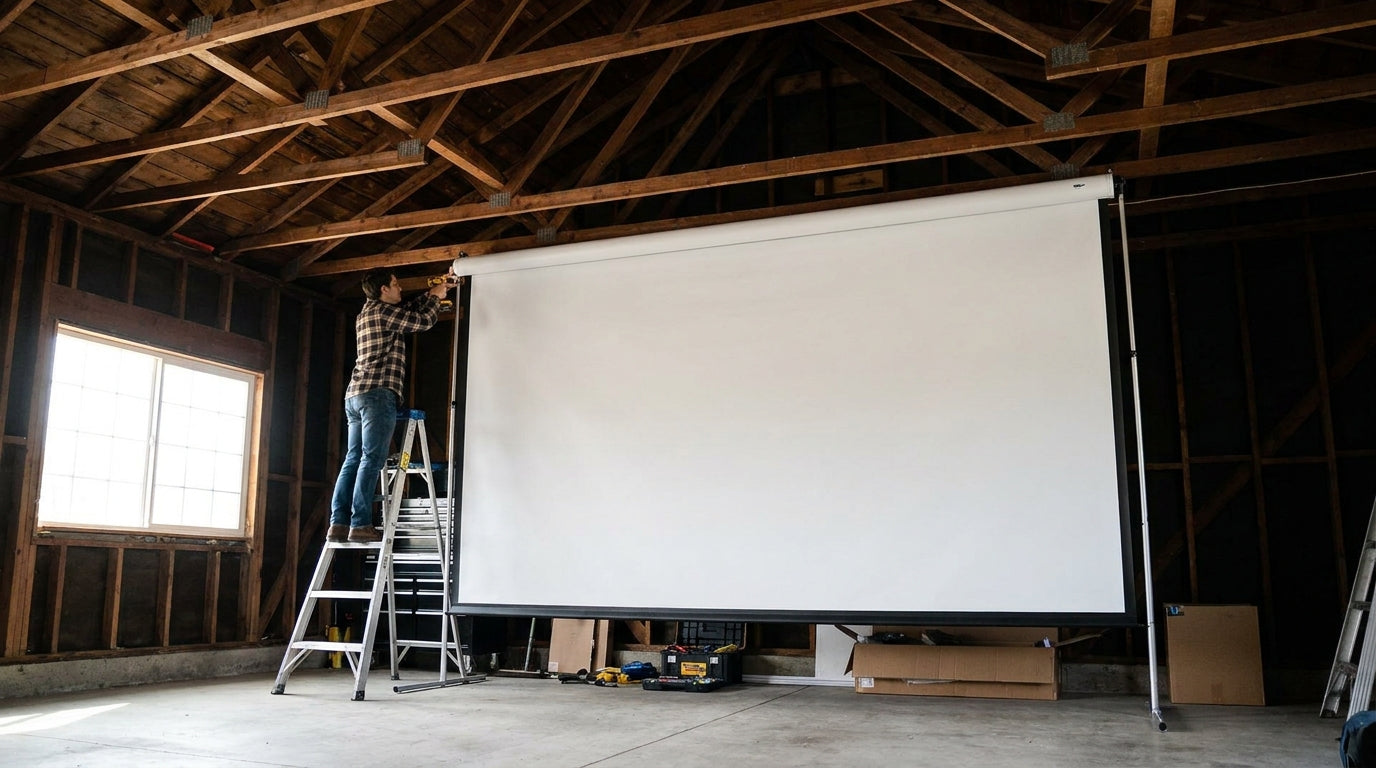
Here's the number that trips up everyone building a sim in a tall room: the tallest standard impact screens top out around 108 to 120 inches — that's 9 to 10 feet (Source: Spectrum Golf / Carl's Place screen size guides). So if you've got a 14-foot vaulted barn ceiling, your screen is going to leave a huge gap up top. And that's completely fine.
Most people with a high-ceiling room assume bigger room means bigger screen. It doesn't. Your screen sizes to your swing and your image, not to your rafters. The real challenges in a tall space are reach, safe mounting height, and keeping tension even across a screen that's hanging higher than usual.
Let's break down how to build a golf simulator impact screen for high ceilings the right way — so you don't overspend, over-build, or end up with a saggy screen you can't reach to fix.
Why a High Ceiling Changes Less Than You Think
The whole point of ceiling height in a sim is swing clearance. The absolute minimum for a golf simulator is 9 feet, with 10 feet as the recommended industry standard for safe, comfortable full-swing clearance (Source: Home Performance Lab / Golfers Authority, 2026).
Once you clear that bar, extra height above your screen does nothing for your swing. A 12-foot ceiling swings exactly like a 10-foot ceiling. The overhead space is just... space.
So the first mental shift: in a tall room, you are not trying to fill the wall. You're positioning a normal-sized screen at the right height and letting the empty space above it exist. That gap doesn't hurt your image, your swing, or your ball flight.
Size the Screen to Your Swing, Not the Ceiling
Common enclosure screen sizes step from 96" x 96" up to 120" x 108", 132" x 96", and 144" x 108", with an 8 ft x 8 ft screen as the minimum recommended for the best experience (Source: Spectrum Golf / Carl's Place screen size guides).
Notice the height numbers: 96 to 108 inches. That's 8 to 9 feet, tops. Even the biggest standard screens weren't designed to reach a vaulted ceiling — and they don't need to.
What you actually want is a screen tall and wide enough to fully catch your image and any mishits. Go wide for comfort and safety. But there's no version of "taller ceiling" that means "buy a 12-foot screen." Those don't really exist in the standard world, and building one custom just adds sag risk and cost.
If you're stuck on dimensions, our golf simulator projector screen size chart lays out the exact numbers before you commit.
Minimum Ceiling Height Needed for a Golf Simulator by Golfer Profile
Source: Home Performance Lab & Golfers Authority (2026)
Mounting High: Reach and Standoff Matter More Than Height
Here's where a tall room actually does change things — access. If you hang your screen and frame up high to center the image, you now have to reach that top rail every time you re-tension or adjust. Plan for a sturdy ladder, and keep the top attachment points somewhere you can safely get to.
Don't forget the screen still needs room to breathe behind it. The impact screen should sit 12 to 16 inches away from the wall (roughly a 6 to 12 inch minimum gap) so it can flex and absorb ball impact (Source: Carl's Place / My Golf Simulator mounting guides). In a barn or garage with the frame standing off from a tall wall, that standoff matters far more than how much ceiling sits above you.
If there's no solid wall behind your mount point at all — common in barns and open garages — our guide on the ceiling mount setup for hanging from joists walks through anchoring to overhead structure safely.
What the Data Says About Tension on a Taller Screen
The number one thing that goes wrong on a high-mounted screen is uneven tension — wrinkles, sag, and bounce-back. The fix starts before you hang anything.
For proper tension, the screen should be cut about 6 inches shorter than the inside width of the enclosure, leaving roughly 3-inch gaps on each side for bungee attachment (Source: Golfbays / My Golf Simulator impact screen FAQs). You don't build the screen to fill every dimension — those gaps are what let you pull it wrinkle-free.
Fabric choice matters too. Impact screens are commonly built as 2.5 mm single-layer or 5.0 mm dual-layer noise-cancelling fabric, with thicker multi-layer screens resisting stretch marks and wrinkles better (Source: Shop Indoor Golf / Canvas ETC impact screen guides). On a taller drop, that thicker weave holds tension more evenly and sags less.
And the target feel: tension should be firm but not rigid — just enough on the sides to remove wrinkles without causing excessive ball bounce-back, with a level, square frame so the screen pulls evenly on all sides (Source: My Golf Simulator / Ace Indoor Golf frame-build guides). A square frame is non-negotiable when you're hanging high; a racked frame telegraphs every flaw. Our guide on screen distance from the wall covers the standoff side of this.
Spend on Fabric, Not on Chasing the Ceiling
Premium impact screens range from about $440 to $1,120 depending on size, while budget single-layer screens run under $200 and a standard Carl's screen is $244.95 (Source: Golfstead / Shop Indoor Golf / Golfer Logic, 2026). In a tall room, put that budget toward a thicker, better-tensioning screen — not toward some oversized custom panel trying to reach the rafters.
Golf Impact Screen Tiers: Thickness vs. Price
Swipe to compare →
| Tier | Layers / Thickness | Typical Price |
|---|---|---|
| Budget (e.g., Amazgolf) | Single-layer, ~2.5 mm | Under $200 |
| Standard (Carl's) | Single-layer, ~2.5 mm | $244.95 |
| Preferred | Mid-grade weave | ~$300–$440 |
| Premium | Dual-layer, ~5.0 mm | $440–$1,120 |
The High-Ceiling Cheat Sheet
Clear 10 feet for your swing and stop worrying about the rest. Size your screen to your image and safety margin — 8x8 minimum, up to about 108 inches tall. Mount it where you can still reach the top rail, keep 12 to 16 inches of standoff behind it, and cut for those 3-inch side gaps so tension pulls clean.
A high ceiling is a gift for swing comfort and ball flight visuals. It is not a reason to over-build your screen. Get a thick, well-tensioned screen on a square frame, and that empty space overhead becomes a feature, not a problem.
Ready to size one for your tall room? Browse our impact screens collection and match the fabric to your swing — not your rafters.
Not sure which simulator fits your room?
The two-minute Simulator Finder Quiz checks your space and budget against every system we carry.


Keep Reading


