
golf impact screen vs practice net comparison
Golf Impact Screen vs Practice Net: Why Serious Golfers Always Make the Switch
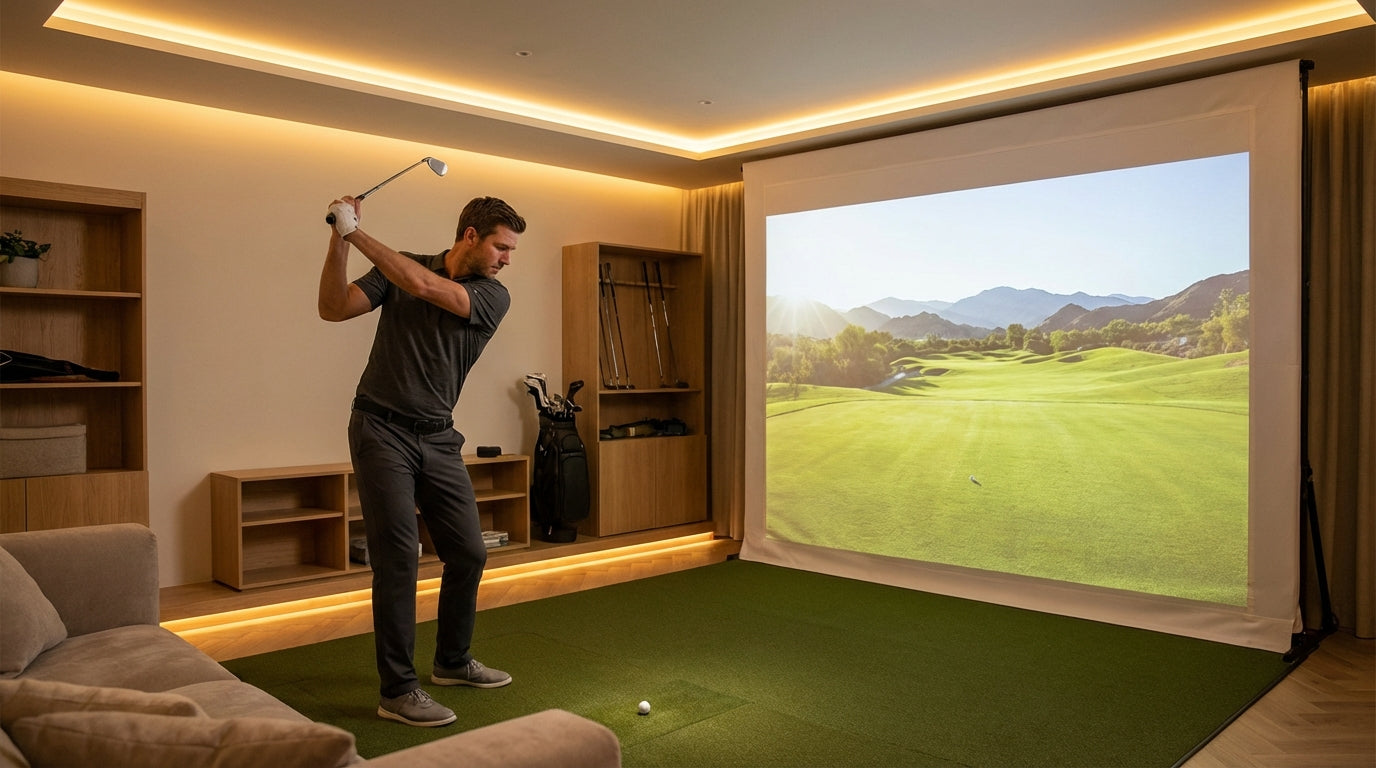
You bought the practice net. You set it up in the garage, hit a few balls, and thought — this is fine. And it was fine. For about two weeks.
Then the ball just kept disappearing into the net, the same as always, with zero feedback, zero data, and zero fun. If you've been there, you already know where this story ends: standing in front of a proper golf impact screen, wondering why you waited so long.
Here's the full golf impact screen vs practice net comparison — what actually separates the two, and why the upgrade matters more than most golfers expect.
What a Practice Net Actually Gives You
Let's be fair. A practice net isn't useless. It lets you swing a real club and make real contact with a real ball. For pure swing repetition — grooving tempo, working on takeaway, loosening up before a round — a net does the job.
But that's where it stops. A net catches the ball. That's the entire product. There's no shot shape, no carry distance, no trajectory feedback. You hit a dead pull into the netting and have absolutely no idea if that was a two-yard miss or a twenty-yard miss.
For the casual golfer who just wants to hit balls without leaving the house, a net is a reasonable starting point. But if you're trying to actually improve, you're working blind.
What an Impact Screen Actually Does
An impact screen is a completely different piece of equipment solving a completely different problem. It's not just a ball-stopper — it's the projection surface for a full simulator setup.
Paired with a launch monitor, an impact screen shows you exactly where your ball went: carry, total distance, ball speed, launch angle, spin rate, and shot shape in real time. You hit the screen, the ball data appears, and you watch a virtual shot fly down a virtual fairway.
The feedback loop is immediate and specific. That's what actually changes your game.
Image Clarity and the Simulator Experience
If you're projecting onto your screen — and most serious home sim setups do — golf simulator screen quality matters more than people realize before they buy.
Cheaper screens have visible texture, uneven surfaces, or hotspots that wash out the projected image. A quality impact screen gives you a flat, uniform surface with excellent gain — meaning the projected image looks crisp, bright, and immersive even in a well-lit room.
Practice nets obviously have zero projection capability. But even as a pure backstop, a proper screen handles repeated high-velocity ball strikes in a way a flimsy net simply can't.
Ball Response and Feel Off the Screen
Here's something most comparisons skip: how the ball feels when it hits the surface.
Good impact screens are designed to decelerate the ball quickly without bouncing it back at dangerous speeds. The material absorbs impact in a controlled way, so the ball drops harmlessly rather than ricocheting. This matters a lot for enclosed spaces like garages and basements.
Some cheaper nets and screens send the ball back unpredictably. If you've ever taken a line drive off a rebounding ball in a small space, you know that's not a setup you want your kids anywhere near.
Quality screens eliminate that problem with purpose-built materials tested for exactly this kind of repeated, high-speed impact.
Impact Screen Durability vs Practice Net Longevity
Impact screen durability is one of the biggest factors in long-term value, and this is where the comparison gets interesting.
Practice nets are typically made of nylon or polyester mesh. They're not designed for the punishment of a daily driver hit repeatedly at the same target zone. Over time, they stretch, sag, develop holes, and lose tension. Most golfers who use a net regularly will replace it within a year or two.
A quality impact screen uses multi-layer woven materials — often a combination of polyester and nylon with reinforced edges — specifically engineered to withstand tens of thousands of full-speed ball strikes. A well-made screen used in a proper frame should last years, not months.
When you run the numbers over a few years, the per-session cost of a good screen is often lower than repeatedly replacing a worn-out net.
The Home Golf Practice Setup Question
The real question isn't just screen vs net. It's what kind of home golf practice setup you're actually trying to build.
If you want to swing a club occasionally and stay loose during the off-season, a net is probably enough. But if you want a setup that genuinely improves your game — that gives you data, courses to play, and a reason to practice every day — you need a screen as the foundation.
A launch monitor without a screen to project onto is half a setup. A screen without a launch monitor is still more useful than a net. But together, they create a system where every session produces measurable feedback and real improvement.
When It's Time to Make the Switch
Most golfers who make the switch from a practice net to an impact screen say the same thing: they wish they'd done it sooner. Not because nets are terrible, but because the difference in motivation is enormous.
When you can see your shot, play a full round of Pebble Beach on a Tuesday night, and watch your ball speed creep up over a month of consistent practice — you actually want to practice. That's the thing no one tells you about the golf net upgrade: the biggest benefit isn't the data. It's that you'll use it more.
A net you stop using is the most expensive piece of equipment in your garage. A screen you use every day is the best investment you made in your game.
Bottom Line
Practice nets have a place in golf — they're portable, cheap, and fine for warm-ups. But for a real home simulator setup, an impact screen isn't a luxury upgrade. It's the core of the whole system.
Better feedback. Better durability. Better experience. If you're serious about improving your game at home, this is where it starts.
Ready to upgrade your setup? Browse our full range of impact screens at GolfingSim Impact Screens — built for real ball strikes, real projection, and real improvement.
Not sure which simulator fits your room?
The two-minute Simulator Finder Quiz checks your space and budget against every system we carry.


Keep Reading


